Queens DA to appeal ruling that found prosecutors hid evidence in 1991 double murder case
/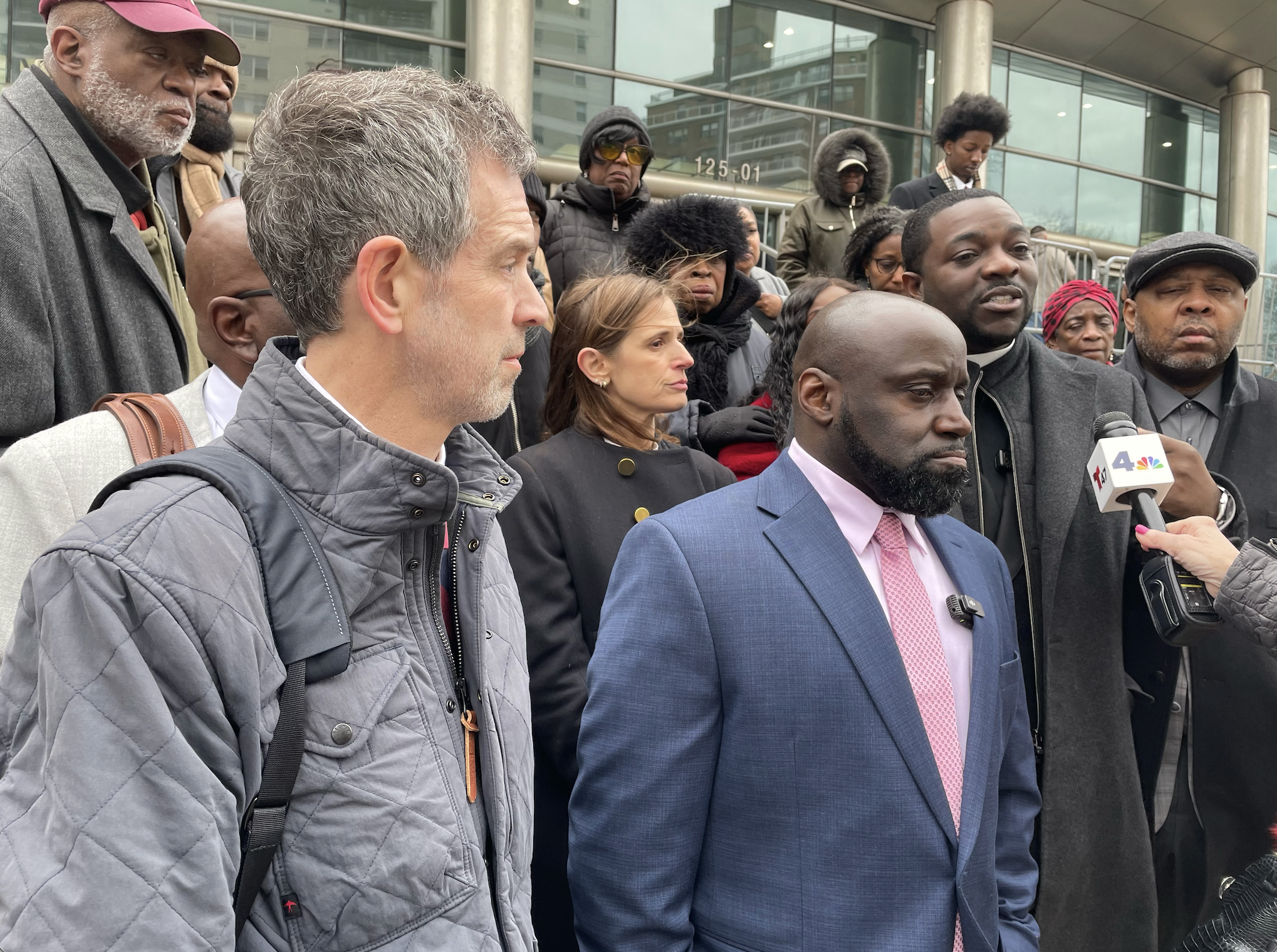
Allen Porter, second from left, had his 1995 double homicide conviction overturned in January. The Queens district attorney’s office said they plan to appeal the ruling on Thursday, March 12, 2026. Eagle photo by Jacob Kaye
By Jacob Kaye
The Queens district attorney's office told a judge on Thursday that it plans to appeal her January decision to vacate the conviction of Allen Porter, a 54-year-old who served over three decades in prison for a double murder he says he didn’t commit.
Prosecutors with the Queens DA said they disagreed with Queens Supreme Court Administrative Judge Michelle Johnson’s decision to overturn Porter’s conviction after finding that prosecutors hid key pieces of evidence in Porter’s original trial, in which he was convicted of the 1991 murder of drug dealer Charles Bland and his girlfriend, Cherrie Walker, in the Woodside Houses.
Johnson said in January that the level of evidence concealment in the case was “substantial” and “alarming,” according to reporting by Gothamist.
But the DA’s office stuck to its case on Thursday and said it has begun working on an appeal. Should their appeal fail, prosecutors said they would likely attempt to retry Porter, 35 years after the killings.
Porter, who was released from Green Haven Correctional Facility earlier this year, has spent the past several months on house arrest, waiting to hear what Queens prosecutors planned to do after Johnson’s ruling. Following the hearing on Thursday, Porter told reporters that he was “deeply disappointed” in the DA’s decision.
“I think I've suffered long enough, my family has suffered long enough,” he said. “I just want this to be over.”
“My life is on hold yet again, after it's been on hold for over three decades,” he added.
Porter’s innocence claim is not new. Since his 1995 conviction, Porter has taken various legal avenues in the hopes of having his conviction overturned. An appeal in 1998 failed in the Appellate Division, as did a writ of habeas corpus submitted in federal court several years later.
His case was even up for review by Queens District Attorney Melinda Katz’s Conviction Integrity Unit – he eventually pulled his case from consideration, the Daily News reported.
Much of the legal work has come as a collaboration between Porter and Jabbar Collins, who had his own murder conviction overturned in 2010. Porter and Collins first met behind bars and continued their friendship after Collins was released and began Horizon Research Services, a legal research firm.
Together, they pored through Porter’s case alongside attorneys Karen Newirth and Charles Linehan and began to find a troubling pattern.
The lone eyewitness in the case, who was 17 years old at the time of the murder, recanted her testimony and said she had been coerced by detectives to pin the killings on Porter, Gothamist reported.
Even more evidence turned up in 2023, when Porter filed a motion to overturn his conviction in Queens Criminal Court. That’s when they found notes written by prosecutors describing Porter’s potential innocence and alternate suspects.
“It's outrageous,” Linehan said. “This is a clear cut example of a case that should have been dismissed immediately when the notes were finally turned over in this case, and every minute since then that the DA’s office has failed to do that is a failure of justice and a failure of DA Katz's promise to the people of Queens to not only do justice and continue promoting public safety, but to correct mistakes of the past.”
“The idea that they would keep this going is completely vindictive,” he added.

Allen Porter prays alongside his family, legal team, friends and members of the Greater Allen A. M. E. Church after a hearing in Queens Criminal Court. Eagle photo by Jacob Kaye
Brendan Brosh, a spokesperson for the Queens DA, said that prosecutors continue to believe Porter pulled the trigger inside the Woodside Houses parking lot in 1991, killing Walker and Bland. Johnson’s ruling did not find that Porter was innocent, only that prosecutors committed misconduct.
“While we respect the court’s decision, we have filed a notice of appeal and believe that the jury conviction is valid,” Brosh said in a statement. “This office maintains that the conviction at the trial level and the affirmation on appeals, rendered justice for the two victims.”
While the road to Thursday’s court appearance has been a long one for Porter, his attempt to be declared innocent is not expected to come to an end any time soon.
The appeals process could take anywhere from six months to two years to complete and, should the DA fail and decide to retry the case, it may take another several years before a jury again hears about the circumstances behind the 1991 murders.
Rev. Lula Ward-Brewer, Porter’s mother, said that all the waiting had already “taken a toll on us.”
“I just pray that this will come to an end,” she said. “About the judges bench it says, ‘In God We Trust,’ and that's why we're standing here today. In God we trust.”
Porter is not the only Queens man to have his over-three-decade-old conviction thrown out, only to have it challenged by the DA’s office.
His case shares similarities to that of Michael Robinson, who was convicted in 1993 of killing his estranged wife in a Bayside home where she worked as a home health aide.
Newly uncovered DNA evidence led to the reversal of his conviction in 2023. Katz’s office disagreed with the ruling but had its attempt to appeal rejected by New York’s top court, the Court of Appeals. Several months later, prosecutors said they wanted to retry Robinson.
After two and a half years of hearings and preparation, Robinson, who completed his prison sentence in 2019, is set to be retried for murder in April.