Mamdani threatens property tax increase to balance budget if state won’t fill gap
/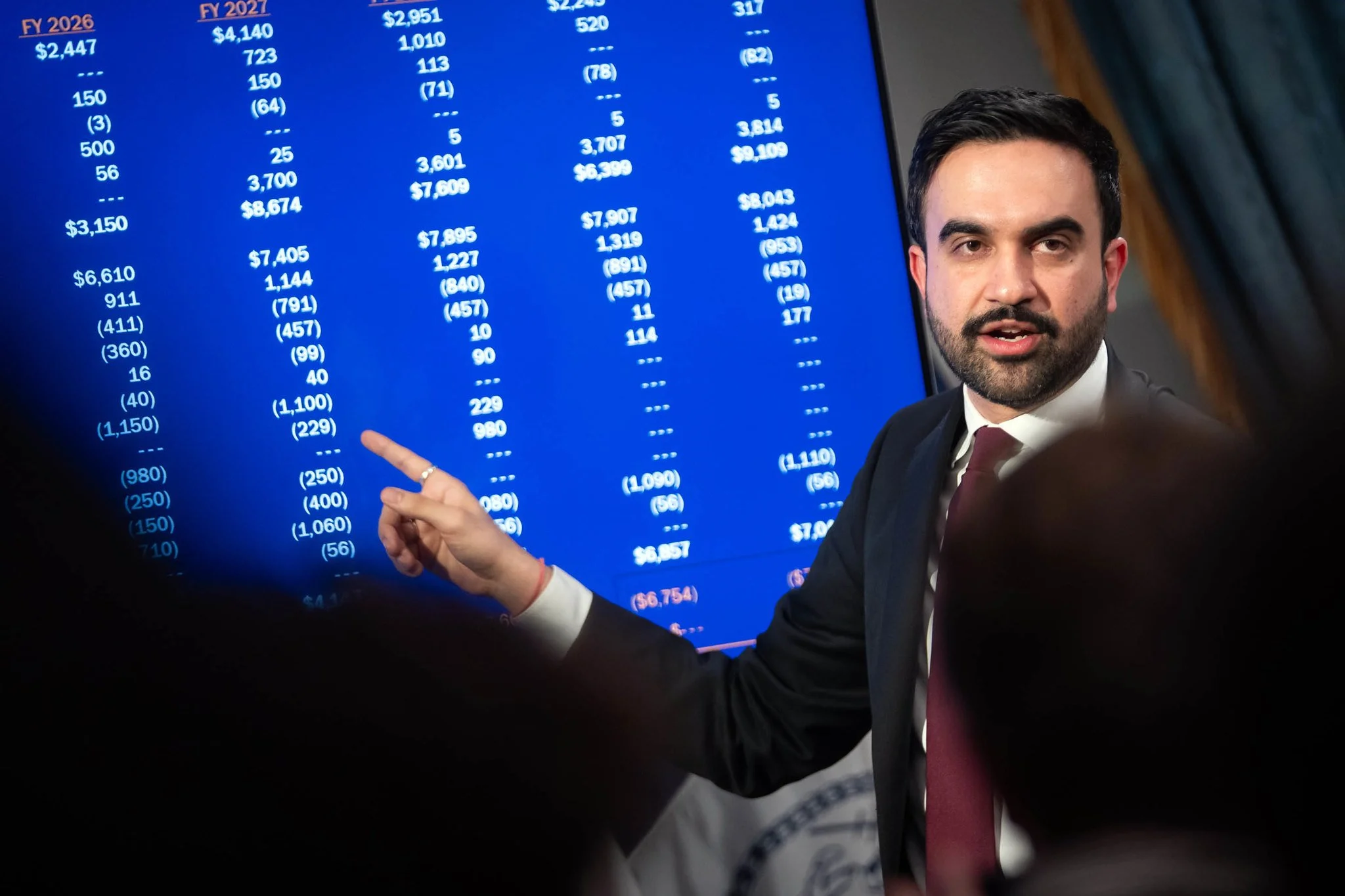
Mayor Zohran Mamdani laid out two paths for the city’s budget on Tuesday. One where the state raises taxes on the wealthy and major corporations, and a nuclear option that would include a significant increase in city property taxes. Photo by Ed Reed/Mayoral Photography Office
By Ryan Schwach
Mayor Zohran Mamdani threatened to dramatically raise property taxes in order to balance the city’s budget if the state does not raise taxes on New York’s wealthiest residents and corporations.
The mayor outlined two potential paths to make up for a more than $5 billion budget shortfall on Tuesday as he laid out the first executive budget proposal of his administration. First, he described his preferred scenario, one where Governor Kathy Hochul and the state legislature end the “drain” of city revenues and raise taxes on millionaires. Then he described the nuclear option, where he said he would be forced to raise the city’s property taxes by 9 percent and dip into financial reserves to make up the budget gap he’s largely blamed on his predecessor.
Mamdani said property tax increases were a “last resort,” that he has no desire to actually implement in order to fund his proposed $127 billion budget. However, the new city executive immediately caught heat for the proposal, which critics said would harm New York’s homeowners, renters and his own ambitious plans to make the city more affordable.
“Faced with no other choice, the city would have to exercise the only revenue lever fully within our own control, we would have to raise property taxes,” Mamdani said.
“This is a budget that reflects the only tools that the city has at its disposal when we are seeking property taxes, that is a tool of very last resort,” he added. “This is a fiscal crisis that was not created by working and middle class New Yorkers, it should not be placed on their backs in order for the city to resolve that.”
Raising taxes on millionaires and corporations is a hallmark of Mamdani’s politics, as well as the democratic socialist movement that propelled him to victory.
“I believe that they can afford to pay a little bit more,” he said.
While he has some support from his base and his allies in Albany, leaders in the state capitol, and, most importantly, Hochul, have made it clear the tax increase is not in the cards.
Tuesday’s announcement comes just a day after Hochul injected an additional $1.2 billion to help the city, which, along with other financial measures, has brought the city’s initial $12 billion budget gap down to $5.4 billion. Mamdani continued to describe the deficit as a “significant chasm" on Tuesday.
“We will spend the coming months doing everything in our power to ensure that our final budget reflects the first path, but we remain firmly within a budget crisis,” he said. “It is a crisis that we can and will overcome, but we cannot do so without either significant structural changes in Albany or painful decisions of last resort here at home.”
Mamdani has largely blamed the budget gap on Mayor Eric Adams’ budgeting and spending tactics, as well as his election opponent, former Governor Andrew Cuomo.
He said in January that the Adams administration poorly allocated city funds and undershot actual costs, and that a Cuomo-era policy made it so the city does not get a fair share of state funding for the billions it gives New York in revenues each year.
Mamdani repeatedly stated during the Tuesday presentation that the budget was still preliminary, and that the city continues to explore ways to fix the budget crisis outside of the property tax increase.
However, that did not stop the widespread condemnation of the mere suggestion of property tax increases, which undoubtedly would prove to be a political headache for Mamdani.
“As I told Mayor Mamdani this afternoon, a property tax hike upwards of 9.5 percent, as considered, is a nonstarter,” said Queens Borough President Donovan Richards, an ally to the mayor. “Under no circumstance should we consider balancing our budget on the backs of working-class New Yorkers, especially seniors on fixed incomes and public sector workers who keep our city running.”
“In this new era, Queens homeowners desperately need our city to reform its already broken property tax system — one that sees Black and brown homeowners in middle class communities paying more than brownstone owners in the city’s most affluent neighborhoods,” the BP added. “To enact such a significant property tax increase across the board would only worsen our wealth inequality and overall affordability crises, while threatening to return us to the days of the 2008 financial catastrophe, when Southeast Queens was the national epicenter of property foreclosures.”
Richards encouraged city and state officials to find more “sensible paths,” to fix the city’s morbid financial outlook.
Queens Chamber of Commerce President Tom Grech said a property tax increase would be incredibly detrimental to the borough’s business economy.
“This will go further to damage our reputation during a very, very challenging time,” he told the Eagle. “In my opinion, and on behalf of the small businesses of Queens and beyond, it's a non-starter.”
City Council Speaker Julie Menin and Queens Councilmember Linda Lee, who chairs the Council’s Finance Committee, said in a joint statement that “dipping into rainy day reserves and proposing significant property tax increases should not be on the table whatsoever.”
“The Council believes there are additional areas of savings and revenue that deserve careful scrutiny before increasing the burden on small property owners and neighborhood small businesses, which could worsen the affordability crisis,” they said. “The Council will release its own projections ahead of preliminary budget hearings and will conduct a thorough review of the Administration’s financial projections. Our goal is to deliver a balanced budget that protects essential services, addresses the affordability crisis, and reflects shared fiscal responsibility.”