Hochul cites Queens fraud ring as she pushes auto insurance overhaul in budget
/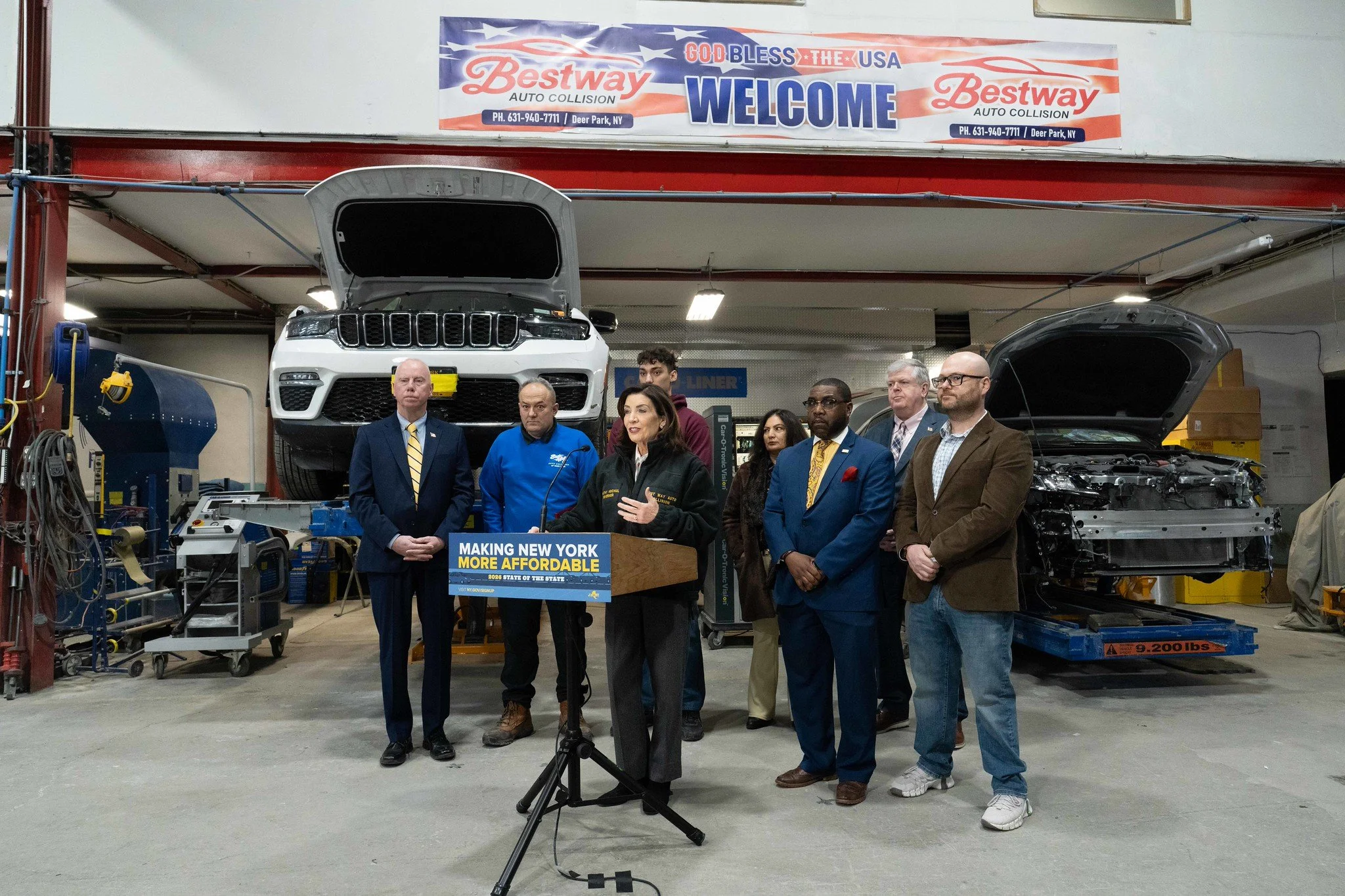
Governor Kathy Hochul pointed to an auto insurance fraud ring in Queens when touting her proposed bills to address insurance fraud during a press conference on Long Island this week. Photo by Don Pollard/Office of Governor Hochul
By Jacob Kaye
Governor Kathy Hochul earlier this week cited a sprawling insurance fraud ring run by two Queens women when pushing for a slate of auto insurance reforms she hopes to pass in the state budget.
Hochul said Wednesday on Long Island that staged accidents and the fraudulent medical insurance claims that follow are to blame for New York’s highest-in-the-nation auto insurance rates, and that her package of insurance reform bills is the way to bring prices down.
While making her argument, the governor pointed to a fraud ring run by Carolina Veronica Rodriguez-Moran and Ruth Stefany Rodriguez-Mora, who both live in Queens. A Long Island judge ruled in December that Integon National Insurance Company didn’t need to pay out claims to the women and a large group of co-defendants who colluded to stage eight car crashes and collect the insurance payouts.
Suffolk County Supreme Court Justice Maureen Liccione found that the women directed a group of drivers and passengers to buy cars with cash, quickly get temporary insurance policies from Integon, then deliberately get into rear-end collisions with commercial trucks on major roads.
After the crashes, the group would nearly always go to one of two medical offices – both in Queens – for treatment. There, they received unnecessary therapy, expensive diagnostic tests and prescriptions for unneeded medical equipment, the judge found. The doctor’s offices would then get kick backs from the group, according to the suit brought by Integon.
Because the group never paid the premiums on the short-lived insurance policies, they would be canceled, leaving the insurers on the hook for the fraudulent claims, according to the ruling.
But the scheme wasn’t unique, Hochul claimed.
Over the past five years, suspected motor vehicle insurance fraud cases have increased by 80 percent in New York, according to the governor’s office. In 2023, the year the eight crashes in the Suffolk County case were staged, there were 1,729 staged crashes in New York.
Hochul said on Wednesday that the “rampant fraud and runaway litigation costs that are jacking up the prices for everyone.”
“They're the result of a flawed system, one that rewards greed and dangerous behavior, a system that's exploited by a lot of bad actors and criminals — and this is criminal behavior,” the governor said.
The case has also been highlighted by Citizens for Affordable Rates, a group of business owners that supports Hochul’s reform efforts. The group’s supporters include Uber, the Trucking Association of New York, and the National Action Network, according to reporting by Streetsblog and New York Focus.
“This case perfectly illustrates why New York families pay up to four times more for auto insurance than drivers in other parts of the country,” said José Bayona, a spokesperson for Citizens for Affordable Rates. “Organized fraud rings operating out of metro area medical clinics and facilitated by insurance brokers are driving up costs for every honest policyholder in the state.”
“These aren’t victimless crimes — when fraudsters steal from insurance companies, working families in Astoria, Flushing, and Corona pay the price through higher premiums,” he added.
As a solution, Hochul has proposed working a number of reforms into the state’s budget. Among them is a bill that would increase the time insurers have to investigate cases of suspected fraud. Currently, the time to investigate is capped at 30 days.
A separate bill would cap the insurance payout for non-economic damages, like pain and suffering and emotional distress, for drivers who were engaging in unlawful behavior at the time of the crash, like driving drunk or driving without insurance.
“Imagine this: a drunk driver crashes into somebody. They're under the influence. They made the decision to drive while intoxicated,” Hochul said. “They cause an accident, cause harm and they can recover fully for emotional distress. They can end up suing the person they hit — got this?”
But Hochul’s bills aren’t without opposition, and her effort to push them through with the budget may end up being the biggest budget fight in Albany this year.
While her legislation is backed by the New York Insurance Association and Citizens for Affordable Rates, it’s been opposed by the New York State Trial Lawyers Association, which argue several of Hochul’s bills will only “limit access to the courts and access to justice for New Yorkers.”
“These proposals really take away access to justice for many underprivileged, underrepresented individuals,” Sabrina Rezzy, a spokesperson for the NYSTLA, told the Eagle. “We're going to keep fighting to see that they have their day in court, that they receive accountability and that they're not revictimized by a system that often helps out corporations and not New Yorkers.”
The attorney group is not opposed to the entire slate of bills but has taken issue with a few, including the measure to cap non-economic damage claims for those who are committing a crime at the time of the crash.
They also oppose a proposal that would change the legal definition of what amounts to a serious injury by, in part, eliminating a section that stipulates that a serious injury can be determined if someone misses 90 out of 180 days of work.
Rezzy said her colleagues have represented clients who may work on their feet and, as a result of their injury, miss work. However, they don’t meet the other current definitions of serious injury, like visible scarring or a fracture.
“I just tend to see this apply more to the working class, like teachers, like drivers, people that are on their feet all day making a living,” Rezzy said.
The NYSTLA also disputes Hochul’s claim that the insurance fraud is as rampant in New York as she says it is. Rezzy said it’s difficult to know exactly how prevalent fraudulent claims are because data from regulators and insurance companies aren’t made public.
Nonetheless, Rezzy said the attorney group supports efforts to tamp down insurance fraud and lower insurance rates in New York.
“I think there are many, many approaches to looking at what's causing high insurance rates for consumers outside of taking away their access to the courts and to justice,” she said.