Chief judge spotlights struggles in Family Court in State of the Judiciary speech
/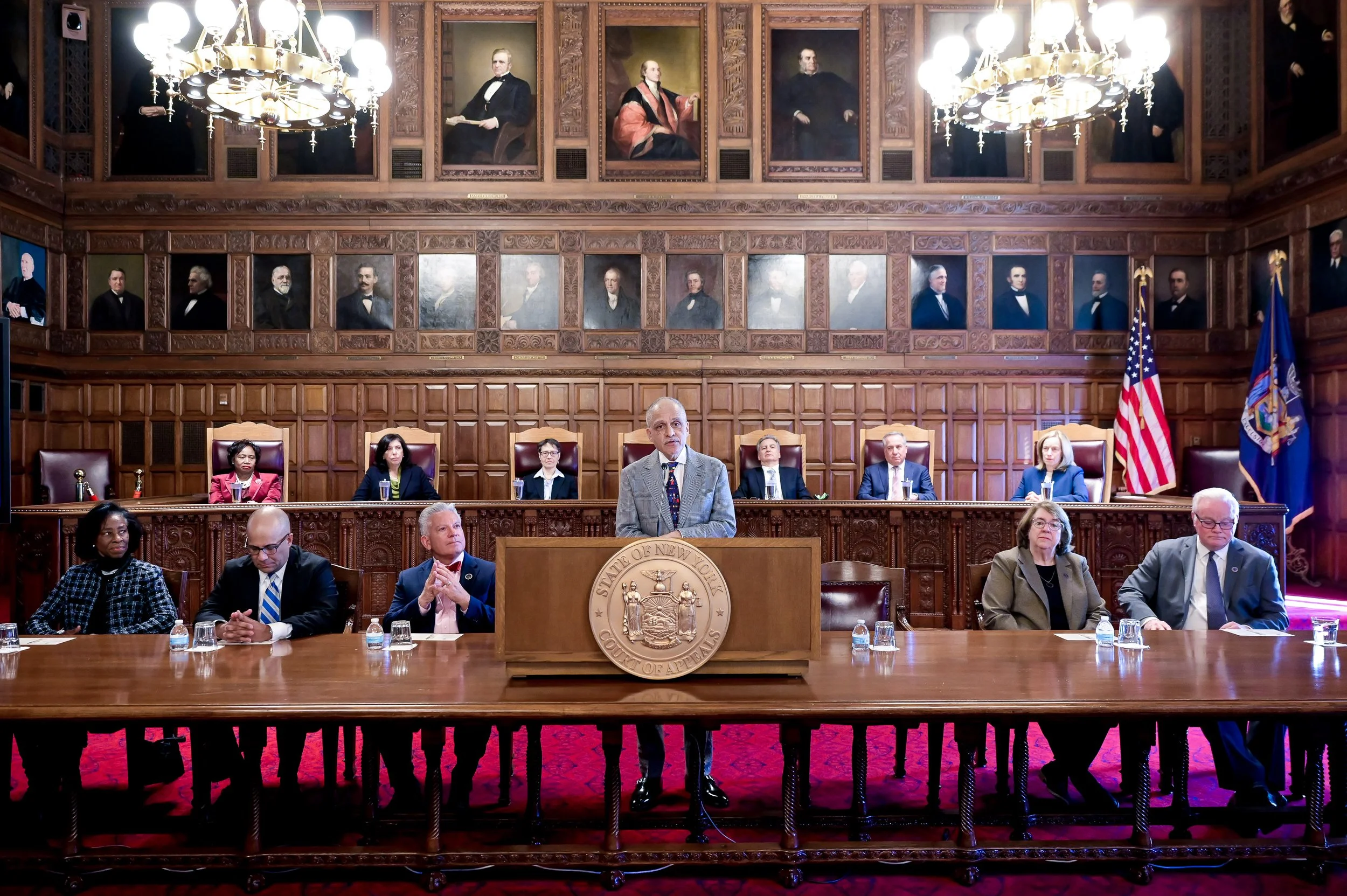
Chief Judge Rowan Wilson delivers his 2026 State of the Judiciary speech. Photo by David Handschuh/OCA
By Jacob Kaye
New York’s top judge shined a light on the state’s Family Courts, which he described as “simultaneously the most important of our courts, the most difficult court for judges, lawyers and parties, and the most under-resourced of our courts,” during his annual State of the Judiciary speech on Monday.
Chief Judge Rowan Wilson, who has centered his past three State of the Judiciary speeches around problem-solving courts and court-related reform efforts, chose to highlight the issues facing the state’s Family Courts and those whose lives are litigated in its courtrooms.
As in years past, Wilson’s speech was brief. A majority of the programming was ceded to New Yorkers with firsthand experience of Wilson’s chosen topic. Top court officials and elected officials from across the state in attendance heard from adults whose children had been separated from them during Family Court proceedings, New Yorkers who were separated from their parents as children and abused while in the state’s foster system, and from some of the lawyers and advocates who represent children under difficult circumstances.
While Wilson noted that troubles within the state’s Family Courts arise in part because of a lack of funding, he said the real fault with Family Court lies outside the courts’ walls.
“If we had a magic wand, we should use it to eliminate Family Court entirely by eliminating the problems families have,” Wilson said. “But that isn't possible, because the root causes of the distress that families, parents and children have are not created by the courts, but are fomented elsewhere.”
As a start to the solution, the chief judge endorsed a recent proposal from Governor Kathy Hochul and New York City Mayor Zohran Mamdani to create a $4.5 billion universal child care program for two-year-olds in the five boroughs.
“Imagine the stress that a poor family faces – maybe the family is a single mother trying to hold down a job that barely covers food and housing, while also trying to care for young children,” he said. “Free and accessible child care gives that mother the ability to further her education or advance her career, knowing that her children are safe and being educated and cared for, which gives the whole family stability and the promise of a better future.”
Such a story was not lived by Josiah Gilbert, who spoke about his turbulent childhood through the Family Court and foster care systems during the State of the Judiciary address on Monday.
Gilbert’s mother gave birth to him when she was 18 years old and had to drop out of college to care for him because “affordable child care was out of reach.”
“That interruption altered the trajectory of her life and limited the opportunities available to our family,” Gilbert said.
Gilbert and his mother, who was living with a series of untreated mental health issues, experienced homelessness for several years until the New York City Administration for Children's Services filed a neglect case against his mother.
At the conclusion of the case, which took years to make its way through Family Court, Gilbert was sent to live with his grandmother, who soon went back to the courts and had him placed in congregate care.
“It was one of the worst experiences of my life,” Gilbert said. “I felt like I was living in a badly operated warehouse for children. It was basically a detention facility, where I had no freedom about what to wear, what to eat and when to sleep.”
But Gilbert said his luck turned around when he was placed with a caring foster family that guided him toward education and programs that he credited with his success as a client and community engagement manager at the Legal Aid Society, where he currently works.
“My journey into advocacy was born from survival, and many parts of my story are not unique,” Gilbert said. “They are the commonplace, predictable occurrences in a system that is reactive instead of preventative. We wait until families are in crisis, until children are removed, until trauma is entrenched, then we intervene. By that point, the harm is irreversible.”
“If families are given access to resources before the crisis escalates, affordable child care, educational support, housing stability, financial assistance, mental health care, youth-centered services, many cases like mine would never enter Family Court at all,” he added.
Multiple speakers who were separated from their parents as children said Monday that they often felt powerless in the courts and didn't feel as though adults were listening to their needs until they were connected with an attorney or social worker.
While Wilson touted the work of Family Court judges and staff, he also celebrated the work of 18-B attorneys, who struggled for years to get the state to increase their pay while seeing their number dwindle.
“Much of the representation in Family Court is handled by public defense organizations,” Wilson said. “The family law practitioners in those organizations are forced to handle unimaginable caseloads.”
“We must properly fund lawyers and family courts so they can fully represent their clients and work toward dismantling the discrimination present in the child welfare system,” he added.