Queens man becomes first convicted under New York’s new deed theft law
/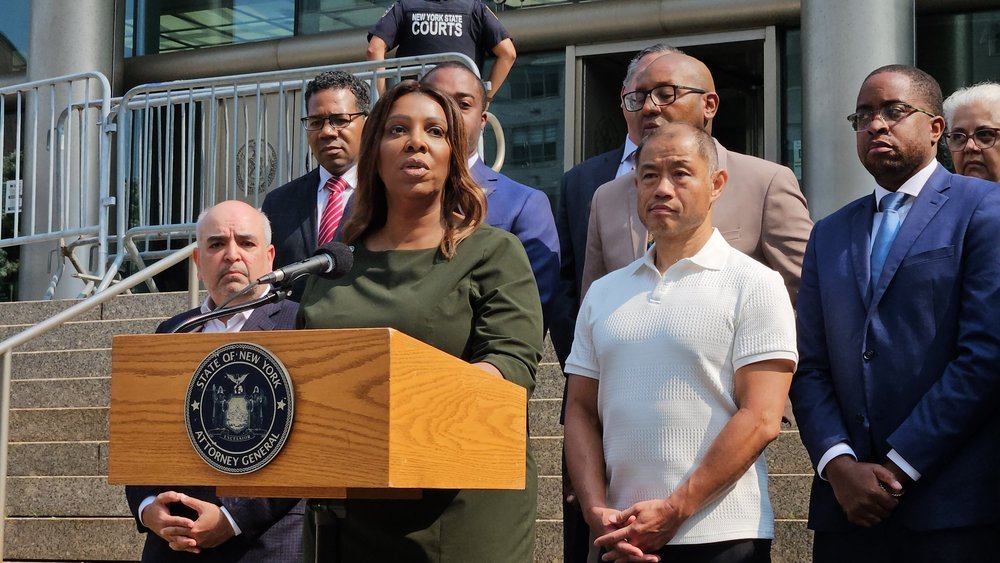
New York Attorney General Letitia James announced her office had reached a plea deal with Victor Quimis, who was accused of stealing an elderly woman’s home through a deed theft scheme. Eagle file photo by Noah Powelson
By Noah Powelson
A Queens man admitted to stealing the home of an elderly, bedridden woman suffering from dementia, and is now the first person to be convicted under the state’s new criminal deed theft law.
Victor Quimis, 40, pleaded guilty as part of a deal with the New York Attorney General’s office on Thursday and admitted he forged documents to steal the deed to the late Renuka Bherwani’s home. Bherwani was in hospice care when Quimis transferred ownership of the Kew Gardens Hills home to a corporation he controlled, and stole more than $300,000 after taking out a mortgage on the property.
As part of the plea deal, Quimis agreed to vacate the deeds to the property and return Bherwani’s home to her family. Bherwani died shortly after the deed theft took place.
Quimis is due back in court for sentencing on Jan. 15, 2027, before Justice Leigh Cheng. Prosecutors said they will be seeking to void the mortgage on the home during sentencing.
Quimis’ co-defendant in the case, 69-year-old Deepa Roy, of Manhattan, has not pleaded guilty and is scheduled to go on trial in the case on Feb. 8, 2027.
Quimis is the first person to be prosecuted and convicted under a new law that the state legislature passed in 2024 criminalizing deed theft. The law, which was championed by Attorney General Letitia James, also increased the severity of the penalties and gave the AG’s office jurisdiction to prosecute offenders.
“Deed theft is a malicious crime that robs families of their homes, their community, and their financial security,” James said in a statement. “Victor Quimis preyed on an elderly woman at the end of her life to steal the home she owned for nearly 40 years. As a result of today’s conviction, Victor Quimis will be held accountable, and Mrs. Bherwani’s home will be returned to her family.”
Bherwani's son and the executor of her estate, Kamal Bherwani, thanked the AG’s office for their work returning the home that had been taken during one of the most difficult periods for his family.
“My mother lived in that house for nearly 40 years, and she was in hospice care in it when her home was stolen out from under her,” Kamal Bherwani said in a statement. “Deed theft targets the elderly and the vulnerable, and I urge any family that sees something wrong with a deed to call the Attorney General's office immediately.”
According to the AG’s office, Quimis and Roy targeted Bherwani as part of a multiyear scam to gain the widow’s trust before forging her signature and exploiting bureaucratic protections and vague laws to steal her family’s home.
Bherwani and her husband purchased the Kew Gardens Hills home in 1986 after immigrating to the country. In 2020, the 88-year-old Bherwani was diagnosed with dementia and was left bedridden, requiring constant at-home care. A few years later, in 2022, Bherwani’s husband, Mohan Bherwani, passed away.
Not long after her husband’s death, Roy appeared at Bherwani’s front door and convinced health care workers she was a friend of the widow.
It is unclear how Roy first learned of Bherwani, but the AG’s office said the alleged fraudster had spent years establishing a rapport with Bherwani and at one point attempted to move into the home before Bherwani’s children stopped her.
In October 2024, unbeknownst to Bherwani’s children, Roy and Quimis allegedly forged a deed with Bherwani’s signature that transferred ownership of the home to the duo for free. The signature was notarized with a forged signature and an incorrectly dated stamp from a Nassau County licensed notary, according to the AG. The duo also allegedly forged Bherwani’s signature on a number of other real estate transfer documents, including documents that put the property’s utilities in their names.
The two then allegedly forged her signature again to transfer the home to Hunter Studios, a company Quimis owned. Quimis then took out a $552,000 mortgage on the home, which he used to pay off Bherwani's remaining mortgage and liens that were now in his name. He allegedly laundered the proceeds and pocketed the remaining $312,000 for his own use.
Roy allegedly received at least $15,000 for her role in the deed theft scheme via a bank check.
Bherwani’s family only discovered the deed theft in December 2024 after they opened the mail and found a letter addressed to Quimis from the Department of Environmental Protection. The letter congratulated Quimis on becoming the “new owner” of the home and included instructions on setting up utility payments for the property.
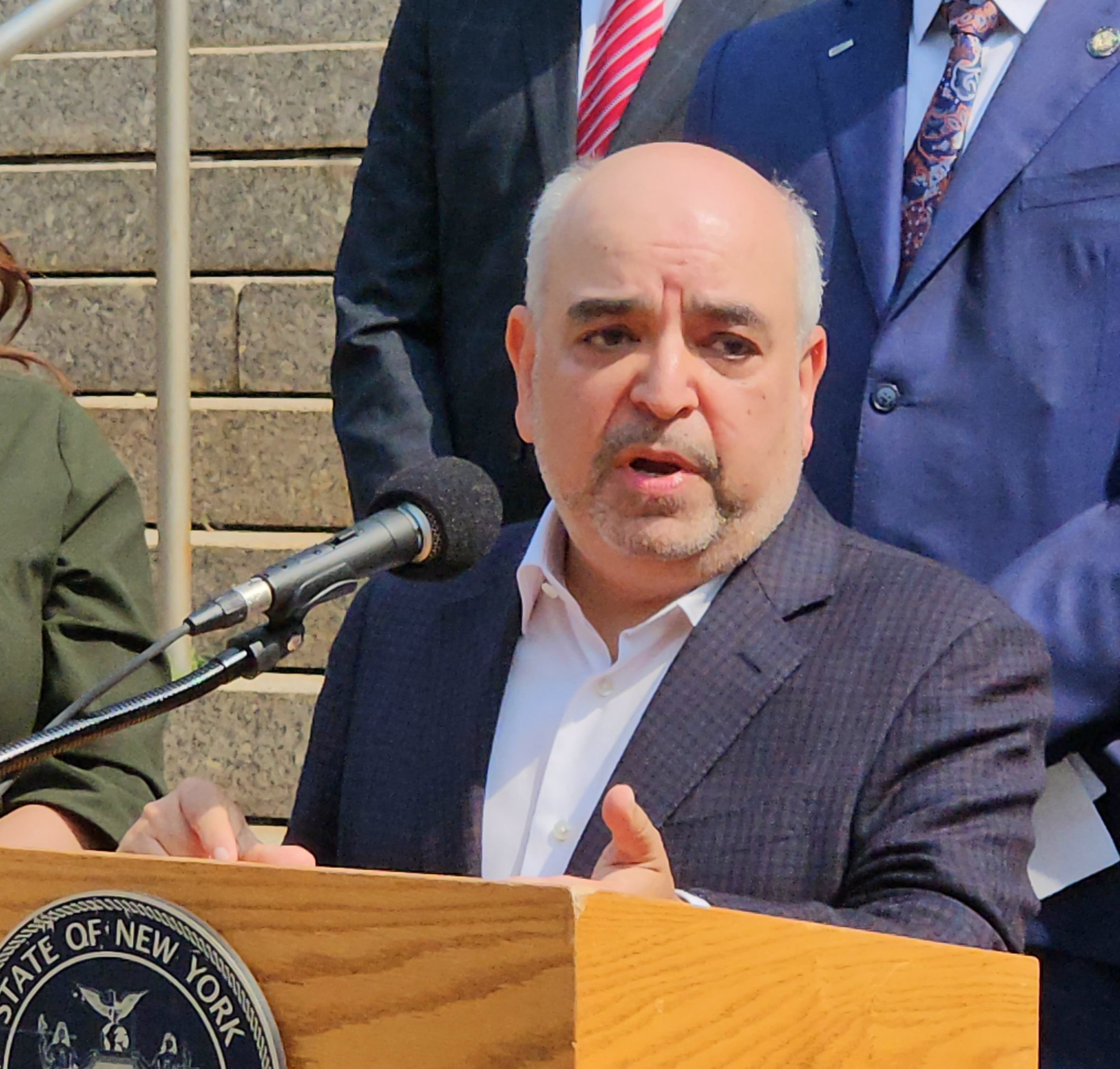
Kamal Bherwani, the son of Renuka Bherwani, said his mother’s home was stolen while she was receiving hospice care. Eagle file photo by Noah Powelson
They reported the alleged deed theft to the AG’s office shortly after, and both Quimis and Roy were arrested on Aug. 7, 2025.
Bherwani passed away in June 2025.
Deed theft schemes have been on the rise in recent years. When the charges against Quimis and Roy were first announced, Queens Borough President Donovan Richards said that Queens alone had seen over 1,000 deed theft complaints in the last decade. People of color are disproportionately targeted and impacted by the crimes.
Elderly people experiencing cognitive decline are often the most targeted by would-be deed thieves, as are immigrants or non-native English speakers who may not be as familiar with government processes.
Queens State Senator Leroy Comrie said these schemes are not just theft but can completely uproot families that have built generational wealth and security through their property.
“For families across New York State, a home represents decades of hard work and the opportunity to leave something behind for the next generation,” Comrie said in a statement. “Deed theft puts all of that at risk, especially for seniors and longtime homeowners who are deliberately targeted by people looking to profit at their expense.”