
Mamdani’s Rikers plan faces opposition from correctional officers union
/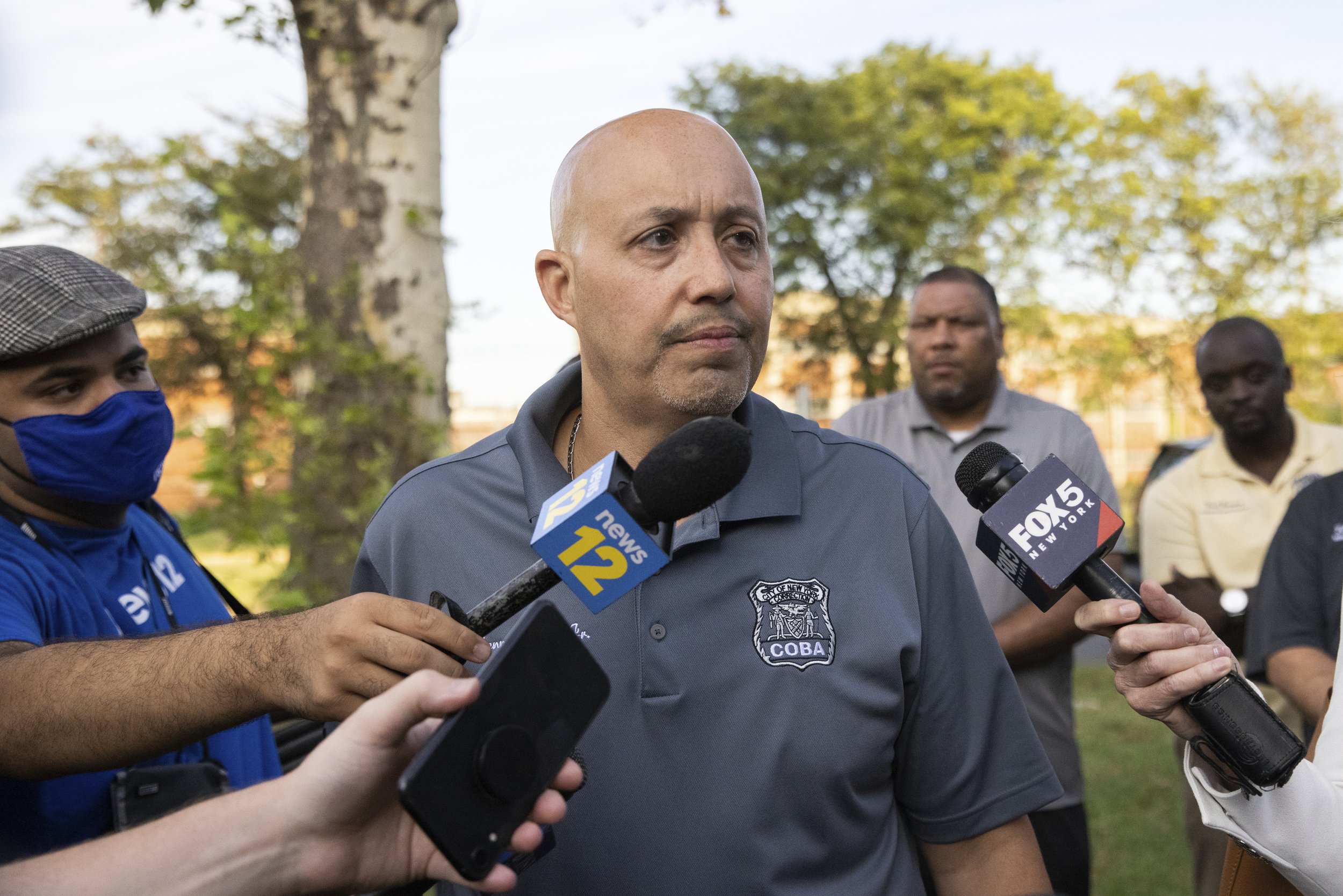
Benny Boscio, the president of the Correctional Officers Benevolent Association, called on the city to abandon its plan to build four borough-based jails and instead build new jails on Rikers Island. AP file photo by Jeenah Moon
By Jacob Kaye
The city’s correctional officers said the city’s new plan to close Rikers Island and replace it with four borough-based jails is “ill-conceived,” and called on City Hall to reverse course by building new lock-ups on the isolated jail island where over 100 people have died in the past decade.
Benny Boscio, the head of the Correctional Officers Benevolent Association, said in a lengthy statement to the Eagle that while officers support parts of Mayor Zohran Mamdani’s blueprint to shutter Rikers Island by 2032, the union believes its central feature is flawed. Rather than move detainees to four new borough-based facilities by 2032 – a new deadline the mayor committed to on Friday – Boscio said the city should build new jail facilities on the island that has served as the city’s central hub of pre-trial detention for nearly a century.
The union’s opposition to the plan, which was first passed into law by the City Council in 2019, is not new, nor was much of Mamdani’s blueprint to close the jail complex released last week.
Most of the plan centers around efforts to lower the city’s detained population through methods like speedier case processing, alternative-to-incarceration programs and reentry services. The city would need to reduce its incarcerated population by around 2,500 people between this year and 2032 to accommodate the new jails, which together will be able to hold 4,100 people at any given time.
The population reduction effort was at the crux of COBA’s critique of the plan, which was announced at City Hall on Friday by the mayor alongside many members of the city’s criminal justice community. No representative of the correctional officers appeared to be in attendance.
“We support modern, safe and humane correctional facilities,” Boscio said. “But you cannot build a safer [New York City] by simply reducing jail capacity and hoping violent crime disappears.”
The city’s jail population currently sits around 6,600 people, 85 percent of whom are being held pre-trial. The figure remains relatively unchanged from a year ago, though the average daily population in 2026 is currently around 7 percent lower than the average daily population in 2025.
Rikers’ population hit a modern-day low in 2020, when around 3,800 people were behind bars on the island as a result of the pandemic, changes to the state’s bail laws and the institution of population reduction strategies by top Department of Correction officials, including work release and supervision programs. The massive dip in population was cited as the city’s north star on Friday by Chief Administrative Judge Joseph Zayas, the second-highest ranking judge in the state’s court system.
“We actually did what we are trying to do again,” Zayas said.
Supporters of the plan to close Rikers say the effort will result in safer outcomes for both detainees and the city as a whole. New facilities will result in safer conditions for both detainees and officers, and the location of the new jails, which will be close to the city’s criminal courthouses, will help everyone there feel more connected to the city, officials say.
According to the city, the new jails will stand in stark contrast to the dilapidated facilities on Rikers Island, which is only connected to the rest of the city by a single bridge to Queens.
“An island is the opposite of connection,” Department of Correction Commissioner Stanley Richards, the first formerly incarcerated person to serve as the head of the troubled agency, said on Friday.
But COBA’s president resisted the call to lower the jailed population and rejected the argument that the new jails will result in better conditions in the city’s criminal justice system.
“The city’s latest plan to close Rikers Island raises serious questions about whether this administration is putting political ideology ahead of public safety,” Boscio said. “Public safety cannot be sacrificed to meet an arbitrary jail population target.”
“The lives of innocent New Yorkers, crime victims and the correction officers who serve on the front lines must always come before the pursuit of a political campaign promise,” he added.
Boscio called on officials to instead build new facilities on the island, despite the fact that all four new jails, which together are projected to cost $16 billion, are currently being designed or are actively being constructed – the Brooklyn facility is anticipated to open in 2029, followed by the Queens and Bronx facilities in 2031 and the Manhattan facility in 2032.
A similar argument was recently made in an opinion piece published by the New York Times by Elizabeth Glazer, who served as the head of the New York City Office of Criminal Justice under Mayor Bill de Blasio and who was one of the original architects of the plan to close Rikers and replace it with the borough-based jails.
Glazer argued in the Nov. 17 article that building new jails on Rikers would allow the city to create safer conditions in jails more quickly, though she did not explain how updating the seven jails on the island would be completed faster than new jails currently being built.
Though Mamdani did not follow Glazer’s recommendation, his blueprint released last week included efforts to modernize the old jails on Rikers as the city waits for the borough facilities to be completed. The mayor committed to fixing all broken cell doors on Rikers Island, many of which do not properly lock, by next spring.
The promise was praised by Boscio, who also credited the mayor for emphasizing “the importance of improving the working conditions for our correction officers” in the plan.
“We welcome the city's commitment to fixing all of the over 2,000 inoperable cell doors by April of next year, which we have been advocating for many years,” Boscio said. “Securing these cells will prevent violent inmates from breaking out of their cells and attacking correction officers and other inmates. We will hold the city accountable to that timeline.”
“Prioritizing the safety of our members and their working conditions is central to both our advocacy and the future success of our jails,” he added.
Though no correctional officer representative spoke during Friday’s announcement, several officials, including the mayor and DOC commissioner, noted the importance of providing better conditions for officers and ensuring they buy into the attempt to reform the agency’s culture so that the violence that has plagued Rikers for a century is not exported to the new jails.
“Our officers, captains, supervisors and civilian staff come to work every day in facilities that reflect decades, decades of neglect,” Richards said. “Too often, they are asked to manage consequences of the environment that create fear, confusion and frustration.”
“We must bring with us a centering of dignity, compassion and accountability,” he added. “We cannot pour humanity into new cement. We cannot do this without the deep work of changing that culture for everybody, including the staff.”