New bill aims to hold NY judges accountable for AI-generated court errors
/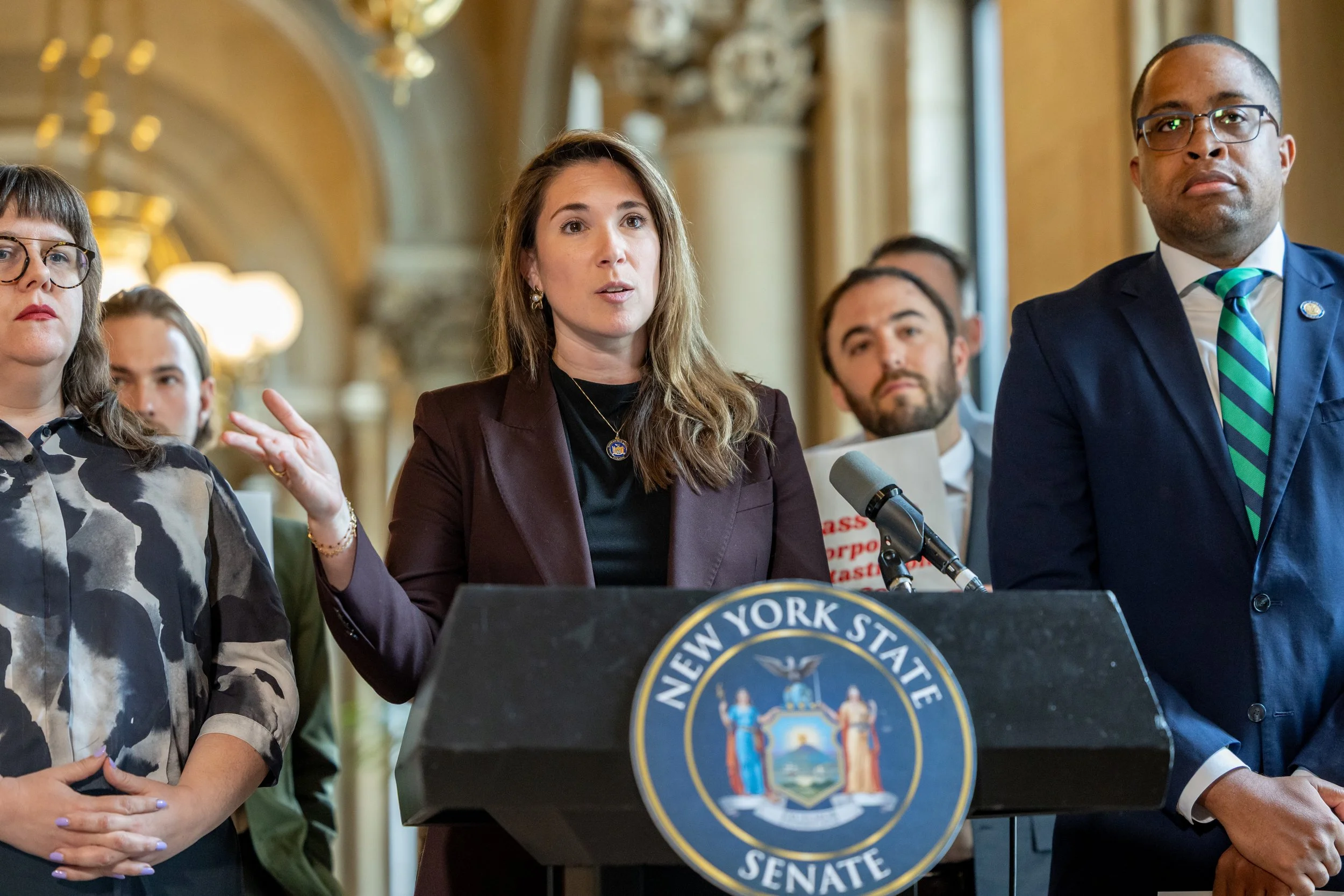
State Senator Michelle Hinchey introduced a new bill that would discipline judges for citing fabricated AI case law in their court orders. Photo via NYS Senate
By Noah Powelson
As New York’s courts navigate a new era of artificial intelligence, a new bill in the state legislature aims to establish disciplinary consequences for judges who recklessly use the technology in their decisions.
A new bill was introduced in the State Senate last week that would make improper use of AI in court orders a sanctionable offense for the judges who issue them. The bill – sponsored by State Senator Michelle Hinchey – does not forbid judges from using AI but instead creates new procedures for disciplining judges whose AI-generated court orders compromise the integrity of a case.
The bill says that if a judge’s orders are found to contain “fabricated legal authority” – statutes or other case law that don’t actually exist – that would amount to misconduct and the judge could be sanctioned. The State Commission on Judicial Conduct would be responsible for investigating the fabrications and disciplining any offending judges.
The commission is the only authority in the state that has the power to publicly admonish or remove a judge from the bench. Under the bill, the commission would be tasked with determining a judge’s culpability, whether the fabrications affected the case’s outcome and whether to issue sanctions against the judge.
A spokesperson for the commission said it was currently reviewing the legislation and had no immediate comment on the bill.
Hinchey said that AI regulation for New York judges is needed as state and federal judges across the country have admitted to issuing error-ridden court orders created with AI tools.
“Judges make decisions that directly impact people’s freedom and their rights, so we need to ensure their work is based on real case law and facts, not AI fabrications,” Hinchey said in a statement. “As we’ve seen across the country, there have been multiple cases of judges basing court orders on inaccurate AI information.”
“Our legislation would be the first in the country to hold judges accountable when their reliance on AI causes real harm, and we believe it’s critical that New York act now with meaningful guardrails to protect the sanctity of our judicial system,” Hinchey added.
AI has seen major adoption by attorneys and law firms over the past year, and recent reports say the technology is becoming more common in judges’ chambers.
According to a Northwestern University survey of federal judges released in March, more than 60 percent of judges who responded reported using at least one AI tool in their judicial work. Around 22 percent of survey respondents also reported using AI tools on a weekly or daily basis.
But some judges have been caught citing case law that the AI made up – sometimes referred to as “hallucinations.”
In 2025, federal judges in Mississippi and New Jersey admitted to the U.S. Senate Judiciary Committee that they used court orders with AI-generated content that contained numerous errors. An Oklahoma judge also admitted to issuing fictitious citations that were generated by AI.
One of the judges, U.S. District Judge Julien Xavier Neals of New Jersey, claimed the fabricated case law was created by a law school intern using ChatGPT – an AI chatbot that can generate text for a variety of functions – without authorization or disclosure.
In the case of U.S. District Judge Henry Wingate of Mississippi, an order he issued for a civil rights lawsuit had incorrect names for both the plaintiffs and defendants, and had fabricated allegations not included in the original complaint.
Under Hinchey’s bill, New York judges caught in similar situations could face disciplinary action by the Commission on Judicial Conduct, though the exact punishment would be determined on a case-by-case basis.
Hinchey said she will be pushing to get the bill passed in the upcoming 2027 legislative session.
The bill comes after New York court officials introduced a first-of-its-kind policy on proper AI use for judges and attorneys.
In New York, AI tools are currently available for Unified Court System employees through UCS devices, but only after they complete an initial training course. Use of AI tools without completing the UCS training course is prohibited. The policy also limits UCS employees to using a list of pre-approved and vetted AI tools.
In January, the UCS released a 154-page report detailing how AI technology can provide the public expanded access to the courts, but also warning that it comes with significant security and bias risks if used haphazardly.
“We have a duty to carefully explore—and fully understand—AI’s strengths and limitations, so that we may use it responsibly, intelligently, and optimally, in furthering the delivery of justice across the State,” First Deputy Chief Administrative Judge Norman St. George said at the time.
In October, the courts released further guidance for attorneys when making court filings with AI-generated information. The guidance said that while attorneys are not prohibited from using AI and are not required to disclose if they do, they are still fully responsible for every word they submit to the court.
Any fictitious case law an attorney submits before a court, the guidance said, could result in serious repercussions and sanctions.
“AI must be treated as an assistive tool, never as a substitute for human judgment, discretion, or decision-making,” the guidelines read. “Where the task involves making such determinations, or requires up-to-date knowledge, avoid using an AI tool.”