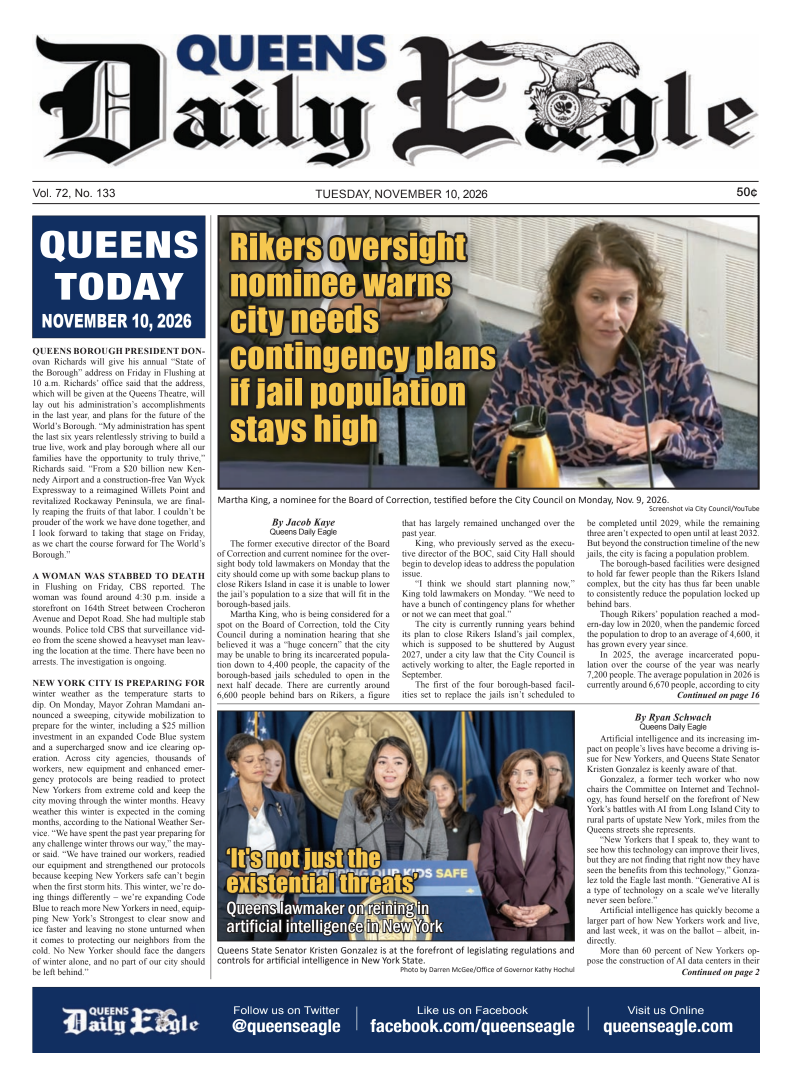
‘It's not just the existential threats’: Queens lawmaker on reining in artificial intelligence in New York
/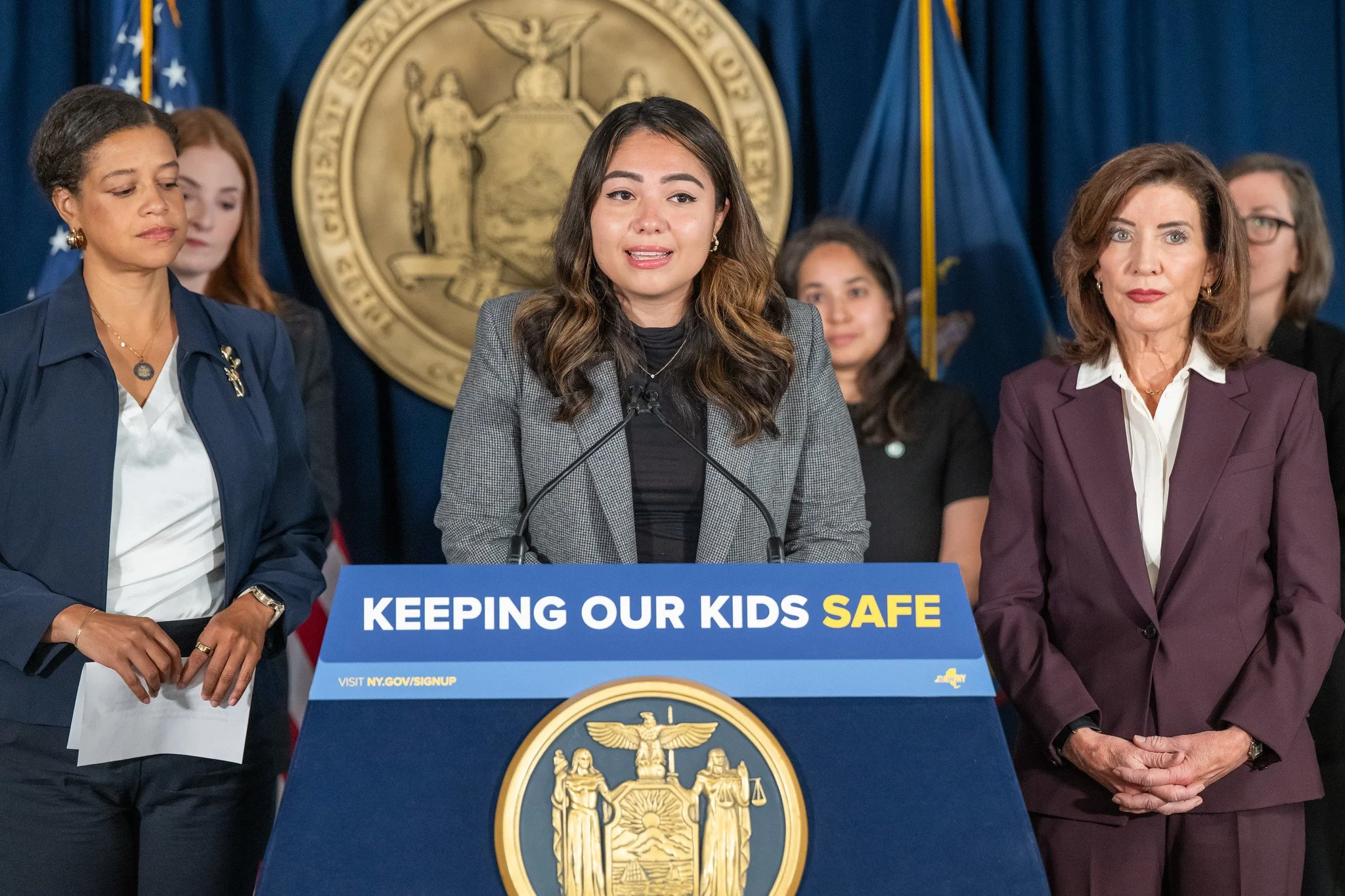
Queens State Senator Kristen Gonzalez is at the forefront of legislating regulations and controls for artificial intelligence in New York State. Photo by Darren McGee/Office of Governor Kathy Hochul
By Ryan Schwach
Artificial intelligence and its increasing impact on people’s lives have become a driving issue for New Yorkers, and Queens State Senator Kristen Gonzalez is keenly aware of that.
Gonzalez, a former tech worker who now chairs the Committee on Internet and Technology, has found herself on the forefront of New York’s battles with AI from Long Island City to rural parts of upstate New York, miles from the Queens streets she represents.
“New Yorkers that I speak to, they want to see how this technology can improve their lives, but they are not finding that right now they have seen the benefits from this technology,” Gonzalez told the Eagle last month. “Generative AI is a type of technology on a scale we've literally never seen before.”
Artificial intelligence has quickly become a larger part of how New Yorkers work and live, and last week, it was on the ballot – albeit, indirectly.
More than 60 percent of New Yorkers oppose the construction of AI data centers in their communities according to a Siena University poll, showing just how prevalent the issue of AI development is in the state.
When the threats of AI are considered, it's hard to ignore worries about widespread job loss, the siphoning of water and energy supplies and nebulous concerns about an AI-induced cataclysm within the next decade, the lawmaker said.
Gonzalez, a junior legislator with the only tri-borough district in the city, argued that a lot of that “doom and gloom,” while worth legislating against, can actually help the AI tech giants distract from more immediate issues.
“It makes us think of future catastrophes that have not materialized and distracts us from how they are actually developing their tools and using their tools today,” she said. “New Yorkers are looking for us to be proactive in protecting them.”
Gonzalez said she is more concerned about the impacts of AI on increasing costs, the power grid and mental health.
The lawmaker has led and sponsored several pieces of legislation to regulate AI, including the RAISE and FAIR Acts, which impose controls on the booming industry and how it is used in local elections. She co-sponsored the RAISE Act with Brooklyn Senator Andrew Gounardes.
In October, Governor Kathy Hochul signed another piece of legislation Gonzalez sponsored that aims to improve safety for kids using AI chatbots.
“It's not just the existential threats, but it's the everyday uses that are also existential for families,” Gonzalez said.
Perhaps the biggest step toward regulating AI that New York has recently taken was Hochul’s moratorium on data center construction, which Gonzalez supported.
While AI titans, including OpenAI CEO Sam Altman and Elon Musk, are unlikely to target Queens for a massive data center, the proliferation of the water- and energy-guzzling structures affects the residents of Long Island City just as much as the upstate towns getting data centers in their backyards, according to Gonzalez.
“Our utility bills are already too high,” she said. “The energy grid that we have is on the brink of rolling blackouts and is aging, and we are struggling to keep up with just current demand.”
Power plants across the state, including in Queens, are running more often to keep up with the new AI demand.
“My constituents and constituents across the state are living with the real, everyday consequences, like asthma and premature births, of being close to dirty fossil fuel plants,” she said. “Certainly running AI should not come at the cost of all of that.”
Regulating the AI industry, which has mostly pushed back on any attempts that would see the technology reined in, is a challenge.
“Big tech has gotten away with barring any federal legislation that holds them meaningfully accountable, while also lobbying against many of the bills I talked about on the state and local levels to ensure that none of their profits are harmed by the passage of regulation,” she said. “Any time they have said they want a regulation, and I've put a bill that would regulate them in front of them, they have said, ‘But not like that.’”
“I think that oversight and transparency is essential when we're talking about a technology that…can end humanity potentially,” she added.
The Eagle spoke with Gonzalez a few days after the City Council brought in representatives from major AI companies to testify about the technology. The hearing was meant to be a show of force against the industry, but Gonzalez said it was similar to the exchanges she has experienced at the state level while pushing regulations.
“I think so much of what was said in the hearing was a lot of the same boilerplate responses that we have gotten from these tech companies,” she said. “These companies are disingenuous and not to be trusted. They're speaking out of both sides of their mouths by saying, on one hand, that we need regulation, and that the government has to play a role in creating a positive future for inclusion, while also actively killing any bill that would meaningfully hold them accountable.”
But Gonzalez, who worked in tech in a previous life, still uses AI in “low-risk” applications, like creating itineraries, and thinks there is a potential for a safe future that includes AI.
“I think a positive future is one where we are able to use this technology for the maximum public good, which looks like use cases in healthcare where we are doing research,” she said. “It also looks like this technology being a tool that makes our lives easier or work easier, but not a replacement.”
“I think there is a role for the government to play in achieving that positive vision and for making sure that it's a people first vision,” she added.
Going forward, Gonzalez said she would be focused on promoting AI regulation legislation, including measures that may help improve New Yorkers’ understanding of the tech. Among those is the AI Literacy Act, which would fund AI safety education in classrooms.
“The bottom line is that we do have the power to change the future,” she said. “We do have the power to set the terms of innovation. We have to keep going.”
This story has been updated at 11:17 a.m. on Nov. 10 to reflect that Gonzalez co-sponsored the RAISE Act with Brooklyn Senator Andrew Gounardes.