As Jenny Rivera’s term nears end, new data highlights her influence on top court
/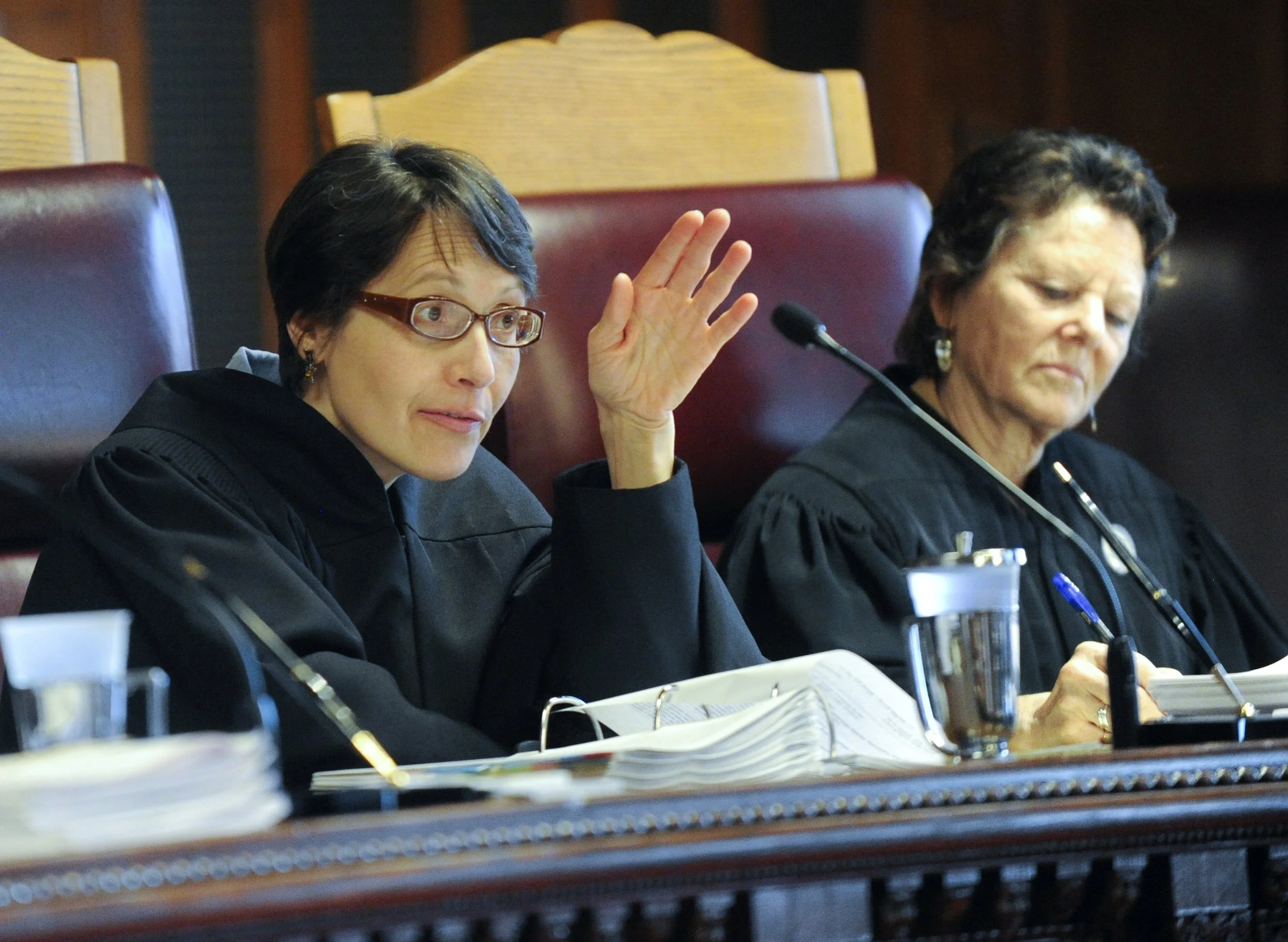
Senior Associate Judge Jenny Rivera’s term on the Court of Appeals is set to end on Feb. 10, 2027. AP file photo by Hans Pennink
By Noah Powelson
New York’s highest court could see some major changes in how it rules if its most progressive judge does not return to the bench for a new term after her current one ends in 2027, according to new data from a judicial watchdog group.
The judicial watchdog group Scrutinize released new data on Wednesday detailing the voting patterns and decisions made by the judges sitting on the Court of Appeals. The data highlights how each of the court’s seven jurists voted when the court was split on a decision, as well as the rare instances when a jurist dissented from the rest of their peers.
The data was released on a publicly accessible platform called Decoded, which offers a new analysis of how the state’s top judges make thousands of decisions on legal issues that have a wide-ranging impact on New Yorkers.
Decoded comes as Governor Kathy Hochul is preparing to replace Associate Judge Jenny Rivera, whose term on the Court of Appeals is set to end on Feb. 10, 2027.
Oded Oren, the CEO of Scrutinize, told the Eagle that the platform is meant to give New Yorkers insight into how the court decides key legal issues. A longer-term goal for the project is to include analysis of any candidates applying for Rivera’s seat who make it to the governor’ shortlist.
“We are developing the data and information that New Yorkers will be able to use to assess the shortlist, so that you know they don't have to rely on the short biography that the commission gives,” Oren told the Eagle. “They won't have to rely on statements by elected officials or anything like that. They'll have the information at their fingertips so they can make their own mind about candidates.”
Decoded shows the issues on which Rivera has tended to vote in favor of certain legal protections, including extending deadlines for civil claims and expanding due process protections.
According to the data, there have been 307 cases involving due process protections in which the court was split while Rivera has served on the bench. Of those 307 cases, Rivera voted to increase due process protections 211 times, far more often than any of her colleagues.
Rivera has also shown that she has no problem being the sole dissenter on cases brought before the court. During her tenure, there have been 88 cases in which Rivera was the sole dissenter on the panel, more than any of her colleagues.
The only other judge who came close was Chief Judge Rowan Wilson, who has been the sole dissenter 33 times during his tenure on the court.
Martin LaFalce, an assistant professor of Clinical Legal Education at St. John’s University and the director of the university’s Defense and Advocacy Clinic, previously told the Eagle that Rivera’s experience is directly observable in her opinions and dissents.
Of the seven judges on the Court of Appeals, Rivera is the only one with a career in public service and human rights advocacy. Before becoming a judge, Rivera worked for the Legal Aid Society's Homeless Family Rights Project and the Puerto Rican Legal Defense and Education Fund. She was also appointed special deputy attorney general for civil rights by the New York State Attorney General.
“She has been a powerful dissenter,” LaFalce said. “Whether it’s been in the context of discrimination in jury selection, whether it's in the context of Fifth Amendment right against self-incrimination, whether it is in the context of bans on the use of propensity evidence – she has been a powerful voice for the accused.”
Rivera’s reappointment would be the first Court of Appeals appointment for Hochul to consider since 2023, when she appointed Associate Judge Caitlin Halligan, who built a career as a prosecutor for both the state attorney general and the Manhattan district attorney.
With just three years on the Court of Appeals, Halligan has far fewer cases to draw on for analysis compared with Rivera, who has sat on the bench since 2013.
During her time on the court so far, Halligan has produced much more mixed results when voting on cases involving due process protections. Of the 76 such cases Halligan heard, she voted to expand protections 26 times and decrease protections 28 times. The remaining 22 votes were listed as either mixed results or could not be classified by Scrutinize.
Halligan has also yet to be the sole dissenter on a case before the top court.
Rivera is still eligible to seek another term, but she will be competing with other prospective lower court judges and attorneys from whom Hochul can choose. She also hasn’t publicly indicated whether she wants to return to the bench. If Rivera is reappointed, she will still be required to retire in 2032, when she reaches the legal age limit for Court of Appeals judges.
Three more seats on the Court of Appeals could also be up for grabs at various points in 2029 and 2030.
The application window for Rivera’s seat has ended, and New York’s Commission on Judicial Nomination will compile a shortlist of candidates to recommend for the seat either later this year or early next year. Hochul will nominate one of the candidates for the seat, who would then have to be approved by the State Senate.
The potential new judge may have an outsized influence on the court’s decisions.
In her 13 years on the bench, Rivera participated in 76 cases in which the ruling was decided in a four-to-three vote.
Even Halligan, who has just entered her third year on the Court of Appeals, has voted in 30 cases decided by a four-to-three margin.
“Really, the critical moment is in those four to three rulings where her voice may not be the same voice because somebody else might replace her, and what that means to New Yorkers,” Oren told the Eagle.