Mamdani picks Queens attorney to overhaul judicial selection process
/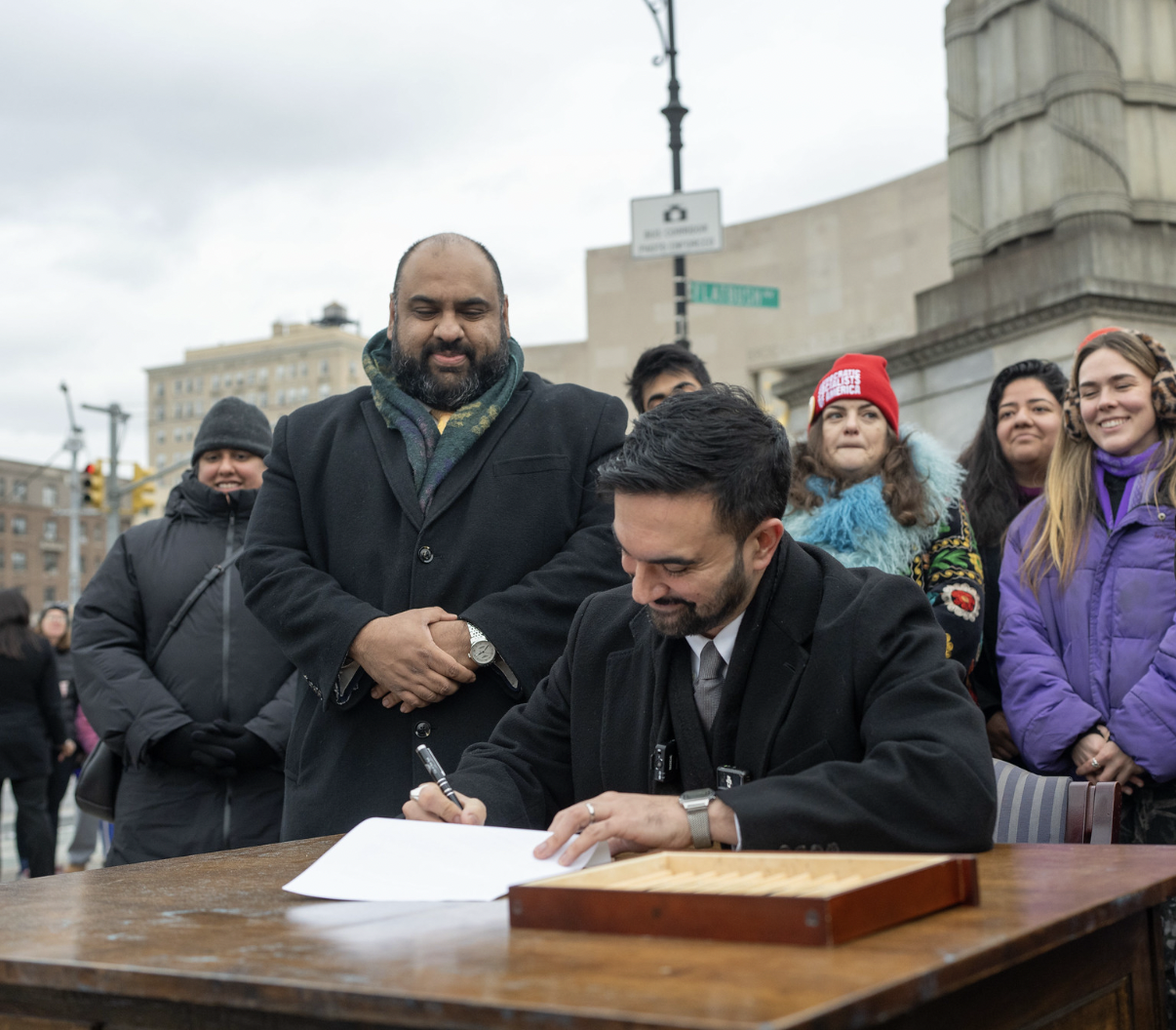
Ali Najmi, left, was appointed to serve as the chair of the Mayor’s Advisory Committee on the Judiciary by Mayor Zohran Mamdani on Friday. Photo by Michael Appleton/Mayoral Photography Office
By Jacob Kaye
Mayor Zohran Mamdani on Friday tapped a prominent Queens lawyer to lead City Hall’s judicial selection committee, a little-known group the new mayor vowed to “revitalize” by opening its work to the public.
Ali Najmi, who served as Mamdani’s attorney during his historic campaign, was named chair of the Mayor’s Advisory Committee on the Judiciary, the group that recommends judges for Family Court and Civil Court, and interim appointees to the city’s Criminal Courts to the mayor.
Najmi succeeds George Silver, the former deputy chief administrative judge for New York City’s courts who was appointed as chair of MACJ in 2022 by former Mayor Eric Adams.
While the election and civil rights attorney will be charged with leading the 19-member committee, he was also tasked by Mamdani with overhauling it.
In an executive order issued on Friday, Mamdani directed the committee, which helps to appoint around a third of the city’s judges, to make its judicial selection process more transparent.
Advocates have accused the committee in the past of being guarded about its selection process, leaving the public with little understanding of why someone was selected to serve on the bench and why others were passed over. The committee has also been criticized for often recommending prosecutors or court attorneys for judicial positions, ignoring entire swaths of the city’s legal community.
“Under Ali's leadership, this committee will take on a more public and engaged role, reaching beyond City Hall to the wider legal community, demystifying the judicial selection process, expanding who participates in shaping our courts and ensuring that our city's judicial system applies the rule of law universally, and does so without favor,” Mamdani said from Brooklyn.
“Too often, the ability for a New Yorker to become a judge has been determined by who they know, as opposed to the work that they do,” the mayor added. “And what Ali is going to bring forth is a newfound focus on ensuring that not only does our judicial system reflect the city that it serves but also that it reflects a commitment to excellence and an application of the law in a universal manner.”
Najmi and Mamdani are no strangers. The mayor has credited Najmi, a one-time City Council candidate in Eastern Queens, for helping him enter politics in New York City. The pair have worked together through the Muslim Democratic Club of New York, which Najmi co-founded, and on both Mamdani’s Assembly and mayoral campaigns.
The Glen Oaks born-and-raised attorney has experience bringing new faces into the city’s halls of justice.
As the co-founder and former president of the South Asian and Indo-Caribbean Bar Association of Queens, Najmi has helped a number of candidates get elected to the Supreme Court or appointed to a lower court bench.
Last year, his organization supported the candidacy of Soma Syed, a one-time insurgent who bested a Queens County Democratic Party candidate for a Civil Court seat in 2021. The Queens Dems recommended her for a Supreme Court position in 2025 and she was elected to the bench in November. At the start of this year, Syed became the first Bangladeshi woman to be sworn into the Supreme Court in the state’s history.
Najmi also helped elect judges who made history as the first Indian woman, Indian man, Guyanese, Trinidadian and Muslim individual elected to the bench.
“We've diversified the Queens bench,” Najmi told the Eagle on Friday. “And we're going to bring that same commitment to diversity, in every sense, including professional diversity, to this committee.”
In order to do so, Najmi said the committee, whose members will be appointed “swiftly,” will increase its outreach to bar associations, indigent legal service providers and public defense groups in order to proactively encourage attorneys who have typically been overlooked for judicial positions to apply.
The Queens attorney said he would personally travel across the city to search for applicants.
“Not enough people know about the Mayor's Advisory Committee on the Judiciary or how to apply,” he said. “And not enough people, historically, have had confidence that if you were not well-connected, or if you were not connected to a judge already, that you could be a judge.”
“But in fact, in this administration, the people who never thought they could be a judge, but deserve to be one, will finally have that chance,” he added.
Under Mamdani’s Friday executive order, the committee will be required to regularly publish demographic data on the judicial applicant pool, and make a searchable database for New Yorkers to monitor upcoming appointments.
Currently, there is no public information available to New Yorkers who may be curious about who is or is not being considered for a lower court position.
The changes to the committee’s practices come directly from a December report from good government groups Scrutinize and Reinvent Albany, which called on the then-mayor-elect to raise the curtain on the judicial selection process.
“Judicial appointments don’t have to be a black box,” Rachael Fauss, a senior policy advisor at Reinvent Albany, said in a statement at the time. “New Yorkers deserve much more information about how people get selected to be judges.”
“Our recommendations will help give New Yorkers confidence that the best candidates – not the most politically connected – become judges,” Fauss added. “The new appointments and tenure tracker will allow the public to see what seats need to be filled, and who is serving in the city’s courts.”
The committee’s new charge also received praise from public defenders, who aren’t as regularly promoted to judicial spots as their prosecutorial counterparts.
“We applaud the Mamdani administration for recognizing that public defenders bring an essential, frontline perspective to issues affecting the legal system, and that this perspective must inform who sits on the bench," Juval O. Scott, the executive director of The Bronx Defenders, said in a statement. “In the Bronx, we see every day how a single arrest or court appearance can upend a person’s life, their family, and their future, which is why judicial appointments must be grounded in a clear understanding of the real human stakes of every decision.”
“A judiciary shaped with this knowledge is critical to ensuring fairness, dignity, and justice for the thousands of people entangled in our courts each year who are the least prepared or resourced to defend their freedom,” she added.
Kristen Dubowski-Barba, the president of the Queens County Bar Association, told the Eagle on Friday that it can’t hurt that the chair of the new committee is from Queens, the most diverse county in the country.
“The fact that he's from Queens and practiced in Queens, I think can only help and be a positive,” she said.