Mayor blames Eric Adams for city’s ‘serious fiscal crisis’
/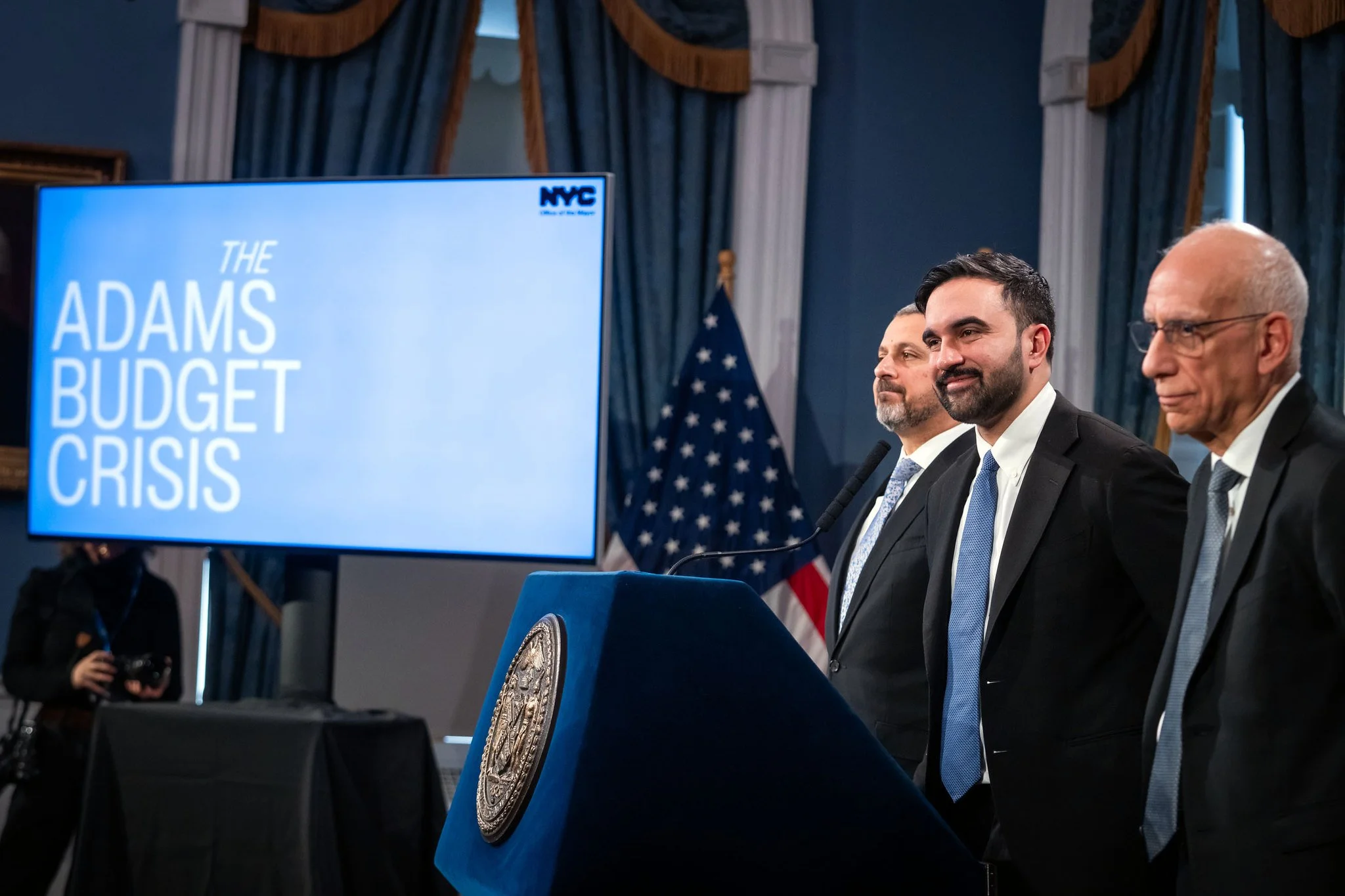
Mayor Zohran Mamdani said Wednesday the city is facing a serious financial problem, and blamed the previous administration for creating it through poor budgeting practices. Photo by Ed Reed/Mayoral Photography Office
By Ryan Schwach
Mayor Zohran Mamdani said Wednesday the city is facing a “serious fiscal crisis” that rivals the Great Recession, blaming his predecessor for four years of shoddy budgeting practices that has left the city with a bleak financial outlook.
Mamdani put the onus on Eric Adams for a nearly $12 billion budget shortfall facing the five boroughs, claiming the Adams administration mismanaged the budget and misled the public about the city’s finances.
The mayor said that his administration intends to balance the budget through “savings and efficiencies.” He also called on the state to help through what he described as a more equitable financial relationship, as well as imposing higher taxes on the wealthiest New Yorkers.
Even with his preliminary budget due in about three weeks, the mayor shared few details about where the city may make up the gap, and what might happen if the state and Governor Kathy Hochul decline to give the city more money or raise taxes.
Wednesday’s budget presentation was, according to Mamdani, an effort to communicate the impending fiscal deficit to New Yorkers as his administration crafts solutions, which he said will be made clearer in the weeks to come.
“This is the Adams budget crisis,” Mamdani said. “Former Mayor Eric Adams handed the next administration a poisoned chalice. He systematically under-budgeted services that New Yorkers rely on every single day, rental assistance, shelter and special education, while quietly leaving behind enormous gaps for the future.”
“Knowing his time in office was likely coming to an end, Mayor Adams chose political self preservation over fiscal responsibility,” he added. “This is not just bad governance, it is negligence, and now the responsibility falls upon us to protect working New Yorkers from paying the price.”
Mamdani’s claims, backed by recent reports from both the city and state comptrollers, accused the Adams administration of routinely underbudgeting city services.
“The Adams administration dramatically and intentionally understated the problem,” Mamdani said.
As an example, Mamdani pointed to the costs of homeless shelters, which Adams projected would cost $1.47 billion for the current fiscal year, undershooting the current estimates by about $500 million.
“He not only failed to budget sufficiently, he ignored projections that indicated major expenses would rise in years to come,” Mamdani said.
In a social media post, Adams rejected Mamdani’s characterization of his fiscal management.
“Facts have a way of getting in the way when slogans replace math and blame replaces leadership,” Adams said.
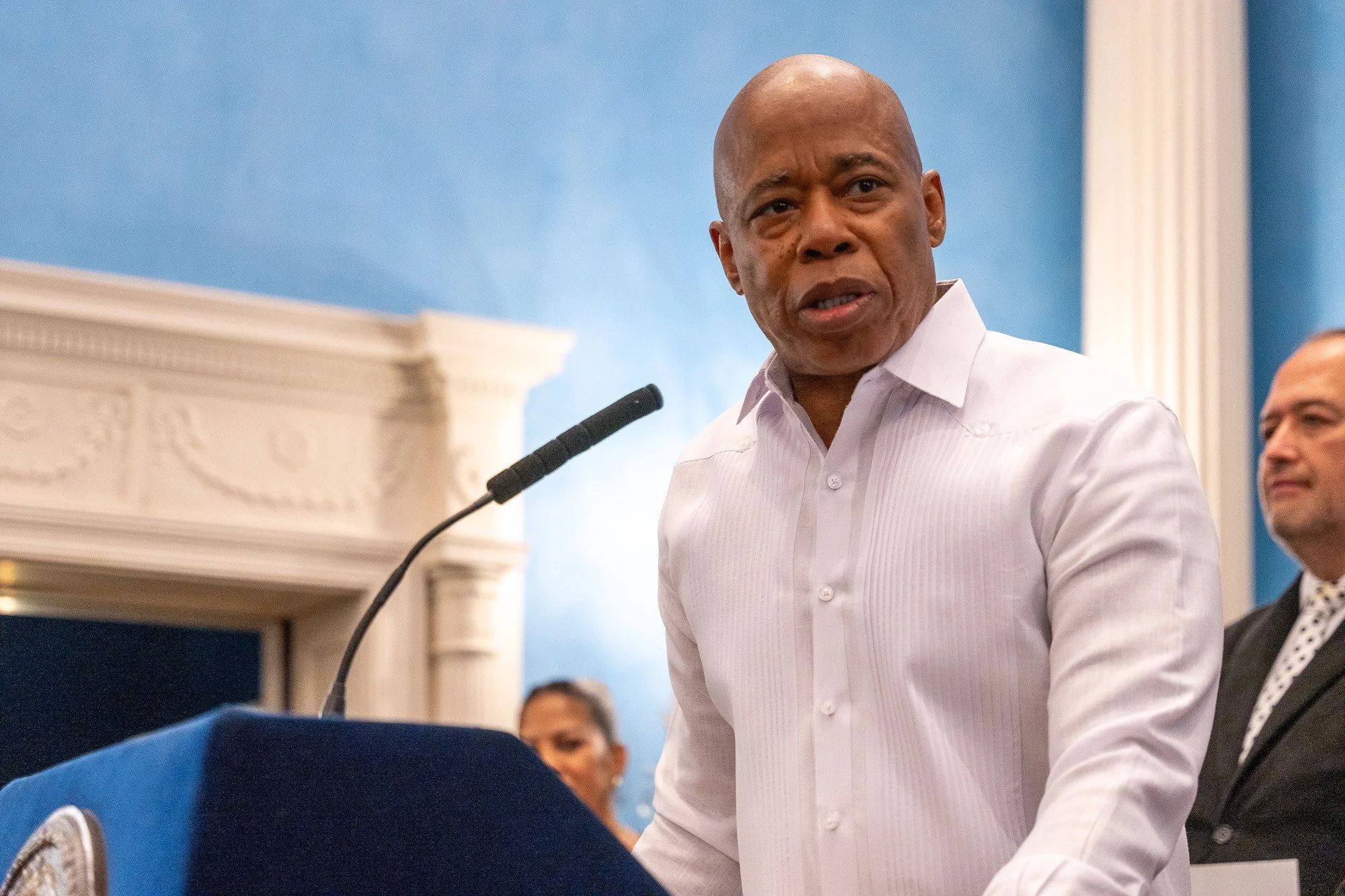
Former Mayor Eric Adams and his administration are mostly to blame for a $12 billion budget shortfall facing the city, according to Mayor Zohran Mamdani. Photo by Benny Polatseck/Mayoral Photography Office
Adams argued he didn’t create the budget gap, and touted the $8 billion in reserves the city had when he left office.
“Only someone who can't read a balance sheet would call that a crisis,” he said, also arguing that Mamdani’s “City Council comrades” also approved the budget.
“Their reflex has always been to spend first and ask questions never,” Adams said.
Mamdani did not push any blame onto the City Council, nor did he direct any ire at his close ally, former Comptroller Brad Lander.
But Lander, his successor Mark Levine and State Comptroller Tom DiNapoli saw the issue coming. All reported in recent weeks that the city would be staring down the $12 billion barrel.
“The budget issues laid out by the mayor today echo the concerns my office has flagged for years,” DiNapoli said in a statement Wednesday. “Despite revenue that my office anticipates will come in above planned collections in the current fiscal year, the city will very likely see spending exceed revenues for the fourth year in a row this year, a troubling trend.”
The Citizen’s Budget Commission also acknowledged the shortfall, but blamed it not on underbudgeting the costs of city programs, but on overspending on the programs themselves.
“The prior administration's radical underbudgeting obfuscated the size of the gap but did not cause it,” said CBC President Andrew Rein. “The primary cause was adding and expanding programs the City ultimately could not afford, while refusing to make the hard, smart choices to trim or eliminate programs that don't deliver valuable impact.”
Adams faced the bulk of Mamdani’s criticism, but the mayor’s former political rival, Andrew Cuomo, was also blamed.
“Former Governor Andrew Cuomo extracted our city's resources, using our revenue to address state level holes, while withholding from the city what it was owed,” he said.
Mamdani said that while the city contributes 54 percent of state revenue, it only received 40 percent back, which accounts for what he called a “$21.2 billion chasm.”
Cuomo did not make any public comments on Wednesday, but his longtime surrogates, Melissa DeRosa and Rich Azzopardi, pushed back.
“[Cuomo] hasn’t been in office for 5 years, the exact amount of time [Mamdani] was a do-nothing no-show legislator,” Azzopardi said in one social media post.
While Mamdani blamed Cuomo, whom he beat in both Democratic primary and general election last year, it will be up to Hochul to fill the gap.
Hochul, who was also spared from Mamdani’s fault-finding, has been hesitant to raise taxes, which Mamdani has advocated for. He reiterated on Wednesday that higher taxes, and changing the financial arrangement with the state, will be key to making up the budget gap.
“The $12 billion fiscal deficit cannot [only] be resolved through efficiencies and savings,” he said. “Part of our resolution of it will absolutely be interrogating every dollar that the city spends and ensuring that it's being spent effectively. However, that is one part. The other parts of this will also have to include changing that fiscal relationship with the state and changing the fiscal relationship with the wealthiest New Yorkers and the most profitable corporations.”
Hochul kicked off her bid for reelection on Wednesday, and told reporters that she hasn’t made any decisions about raising taxes just yet.
“The needs are great, and I want to be helpful,” she said.
Mamdani said he was “encouraged,” by his conversations with Hochul, and added that the city needs to better advocate for itself before the governor and the State Legislature. However, he had few answers about what may happen if Hochul does not meet his demands.
“What we are going to do is exhaust every option to make it clear that the time has come to reset the relationship between the city, its wealthiest residents, its most profitable corporations, and with Albany,” he said. “I believe that together, we can get there.”
As for the city’s own role in filling the gap, Mamdani was hesitant to share details on the exact “savings and efficiencies,” his administration will consider to balance the city’s gargantuan budget hole.
“Right now, we are going through every single dollar that the city spends and ensuring that every single one of us on this stage would be able to defend that dollar,” he said.
Mamdani said he will release his preliminary budget on Feb. 17, less than a week after he heads back up to his old Albany stomping grounds, this time with a tin cup, to advocate for the city’s finances before the legislature.