Advocates slam gov for failing to commute sentences of incarcerated women
/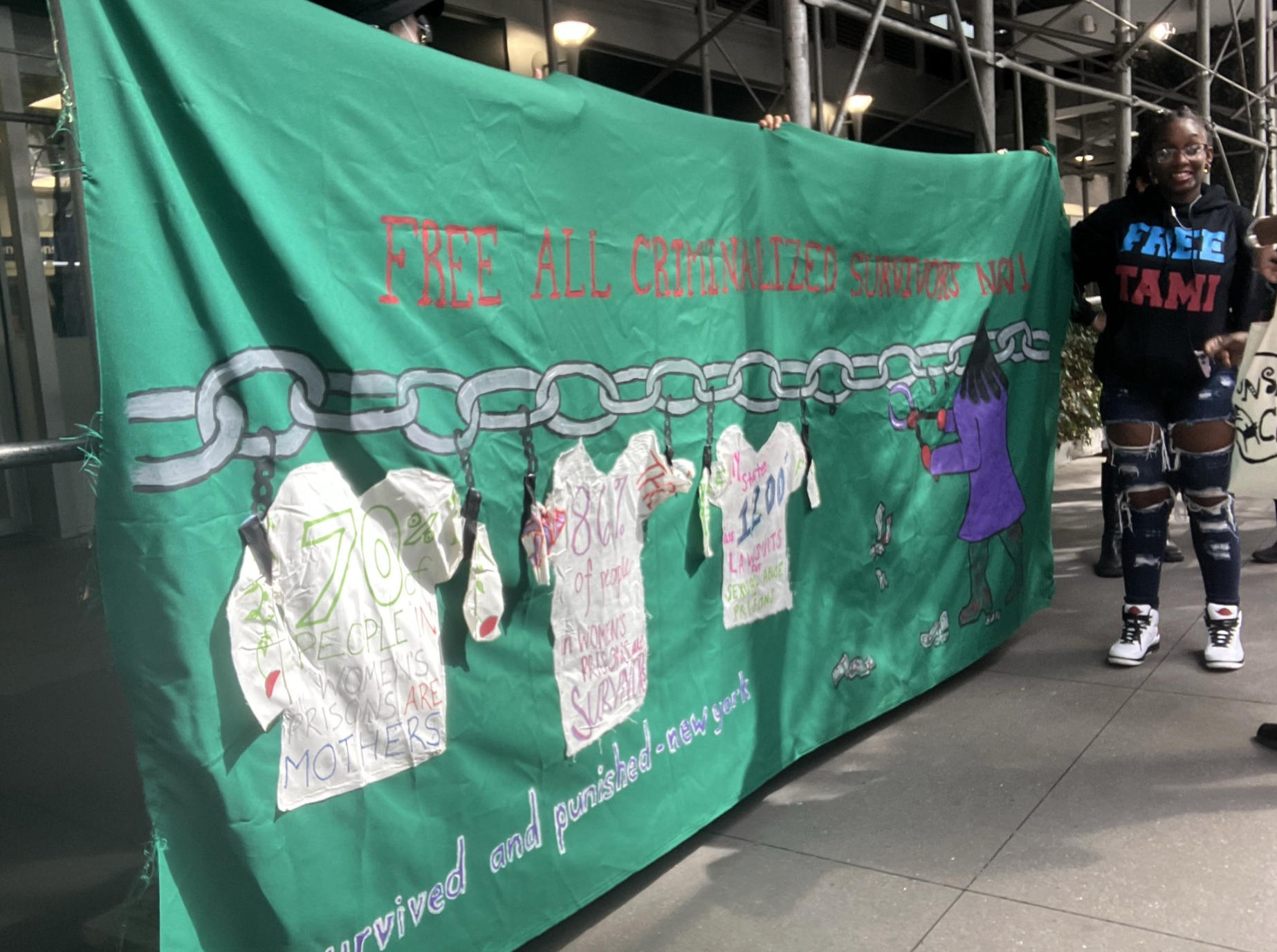
LaQuintae Eldridge stands with a sign at a rally calling for Governor Kathy Hochul to utilize her clemency powers to commute the sentences of incarcerated women, like Eldridge’s mother, Tami Eldridge. Photo via Survived and Punished NY/X
By Jacob Kaye
Tami Eldridge, a 51-year-old woman from Queens, has spent the past 25 years in a New York State prison.
While behind bars on murder charges, Eldridge has earned three master’s degrees, mentored countless women and raised a daughter, who, on Tuesday, rallied outside of the governor’s Manhattan office to demand her mom be given what has become an increasingly rare shot at clemency.
“She has a very good example of what it looks like to be rehabilitated, what it looks like to flip over a new leaf and understand what you did, and acknowledge it,” Eldridge’s daughter, LaQuintae, told the Eagle on Tuesday.
Eldridge is one of over 1,800 people with a clemency application pending with Governor Kathy Hochul, who has yet to commute the sentence of a single woman who applied for clemency since she took office four years ago.
“There are many women that have transformed their lives, that are incarcerated for domestic violence, and have received what we call ‘death-by-incarceration sentences,’” Stanley Bellamy, a Queens man whose own sentence was commuted by Hochul in 2022, told the Eagle. “We feel that they are ready and deserving of a second chance, and that the governor should give them the opportunity to return home to their families, their children.”
There was a time not too long ago when many clemency applicants and their families saw hope that the governor’s historically opaque and infrequent clemency process was going to be reformed.
But they’ve since begun to panic.
Despite promising to make sweeping changes to the clemency process during her first year in office, Hochul has largely backtracked on the reforms.
Crucial to advocates, she has mostly stopped granting clemency on a rolling basis and has massively cut back on the number of sentence commutations she’s approved, commuting only one sentence in the last 16 months.
Clemency can take two forms – a pardon, which is granted to someone who has already served their time in prison, or a sentence commutation, which is granted to someone who is currently incarcerated. Advocates have argued that while pardons are meaningful to those who receive them, commutations are more urgently needed. A large number of incarcerated New Yorkers applying for a commutation have spent decades behind bars after being issued massive sentences in the ‘80s and ‘90s, when mandatory minimum sentencing and a tough-on-crime mentality led to a spike in the state’s prison population.
The power to grant clemency belongs solely to the governor, and went largely unused for much of the 21st century. Former Governor Andrew Cuomo had attempted to revive the practice by granting clemencies every Christmas Eve, but Hochul said she wanted to take the process one step further.
The governor laid out a number of reforms in 2021 that she would go on to slowly implement over the next several years. She convened a panel to review and recommend clemency applicants to her. Her office also began communicating more regularly with people who had pending clemency applications.
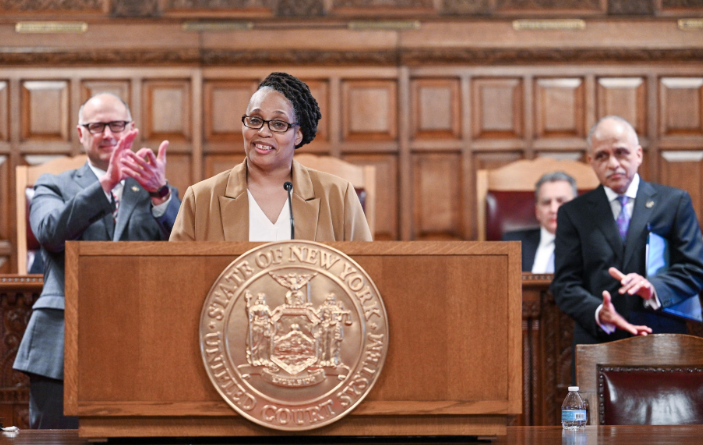
Tami Eldridge speaks at the 2025 State of the Judiciary address. Photo by David Handschuh/Unified Court System
The governor began granting clemency on a rolling basis for the first time in 2023, when she granted two commutations and five pardons in April, three commutations and 10 pardons in September and four commutations and 12 pardons in December. In all, the governor commuted the sentences of nine people and pardoned 27 others, more than the total number of clemencies she granted during her first two years in office combined.
But Hochul’s clemencies became more infrequent in 2024, a pattern that has continued into 2025.
The first round of clemency the governor granted in 2025 didn’t come until August, when she pardoned 13 people. It was the first time Hochul had issued a round of clemencies without granting a sentence commutation.
Advocates on Tuesday not only blasted Hochul for failing to use her clemency powers more regularly but for failing to use it to help any aging women out of prison.
“Governor Hochul is not being held accountable,” Serena Martin, the executive director of New Hour for Women and Children—Long Island, said. “Our sisters belong home.”
“These women have reformed, they have changed and they can do so much more,” Martin added. “But what [Hochul] is saying to their children is that their lives don’t matter because their mothers are not coming home.”
Earlier this year, Eldridge, who is incarcerated at Bedford Hills Correctional Facility, was invited by Chief Judge Rowan Wilson, the top judge in New York, to speak at his annual State of the Judiciary address, which was focused entirely on sentencing reform.
The Queens woman told some of the most powerful people in New York about the physical abuse she experienced as a child, how she was homeless for much of her youth and, about how, in short succession, her brother was brutally murdered and her mother died from breast cancer. After having her first child, Eldridge’s boyfriend got into some legal trouble, throwing the young family into a financial crisis. In an act of desperation, Eldridge said she committed murder.
“To this day it is an act I regret with all my being,” she said during the February address. “I destroyed my victim’s life, my own life and the lives of so many people – and I still do not forgive myself.”
Eldridge’s daughter said on Tuesday that the State of the Judiciary address marked a change in both her and her mother, who has grown more hopeful that she’ll be released at some point in the future.
“To see my mom have hope and to be on the outside running alongside her with hope as well, it's a new, different feeling,” said LaQuintae Eldridge, who was 4 years old when her mother was sent to prison. “Now that I’m older, I need her more now than I did before.”
The governor’s office did not respond to the Eagle’s request for comment before print time.