Discovery law changes take effect
/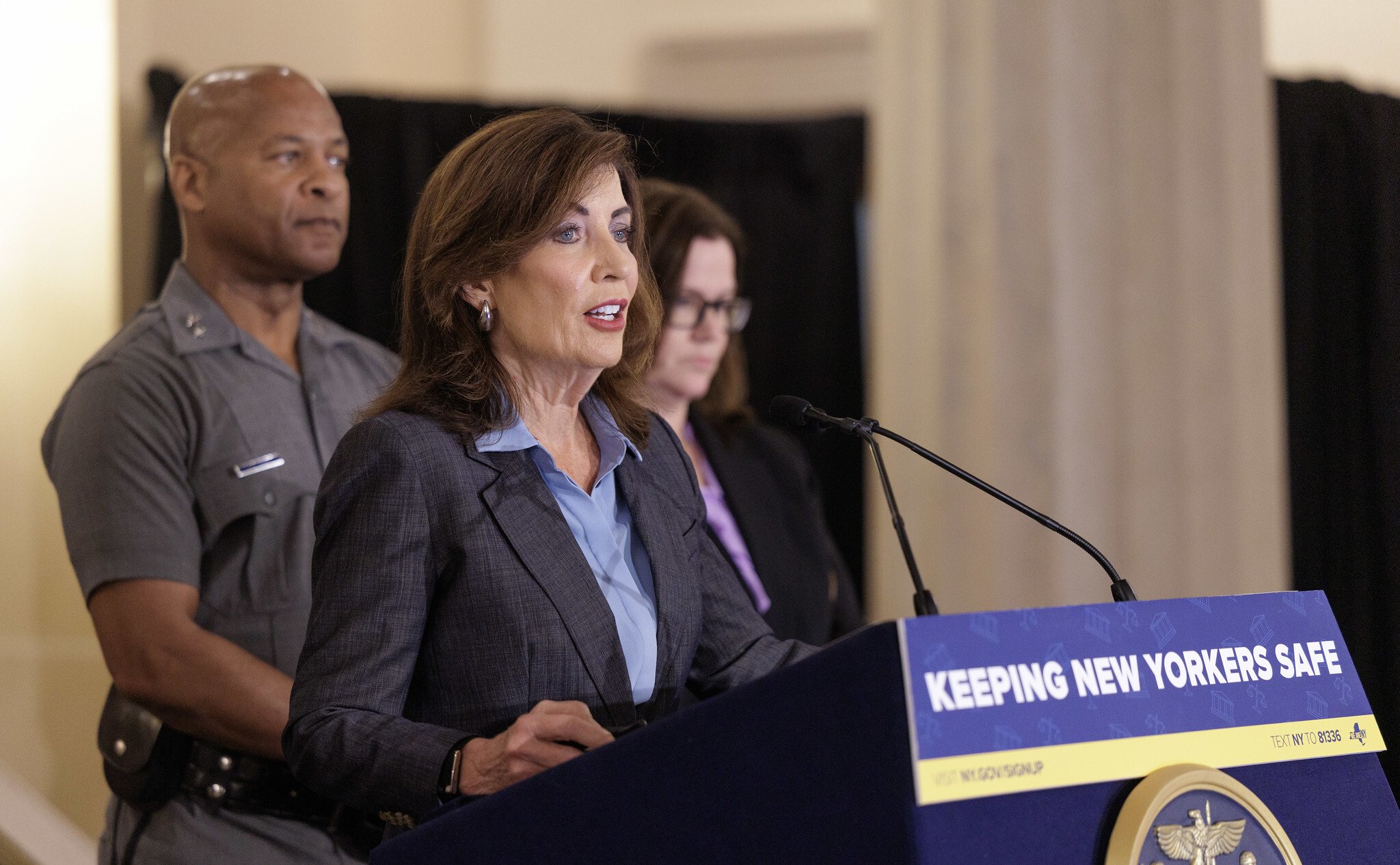
Governor Kathy Hochul announced on Wednesday that the state’s changes to its discovery laws were set to kick into effect on Thursday. Photo by Mike Groll/Office of Governor Kathy Hochul
By Jacob Kaye
A rollback to the state’s evidence-sharing laws took effect this week, nearly four months after debate over the changes held up the passage of the state’s budget.
Thursday marked the first day the recent changes to New York’s discovery laws, which underwent major reforms in 2019, officially took effect. The amendments, which Governor Kathy Hochul first proposed in January during her State of the State address, proved to be one of the most contentious aspects of budget negotiations between the governor and lawmakers, and led to a final budget agreement that came five weeks after its due date.
In the end, the changes to the state’s discovery laws didn’t go as far as what Hochul originally proposed. Instead, the governor and legislature reached a compromise that both prosecutors and defense attorneys supported to varying degrees.
Hochul pursued the alterations to the law after she said the 2019 reforms had led to a large number of cases being dismissed on technicalities – though evidence of such dismissals varied.
The changes worked into this year’s budget will lead to fewer dismissals and greater flexibility around evidence sharing while keeping the heart of the reforms intact, according to the governor.
“Seven months ago, I made a vow to stop dangerous criminals from walking free on minor technicalities,” Hochul said on Wednesday. “That era ends today where common sense discovery reforms are now the norm. We champion them and they are to take effect today all across the great State of New York.”
Hochul said her push to alter the reforms came after speaking to crime victims, some of whom told her their perpetrator's case had been dismissed because of a technical violation related to evidence sharing failures by a prosecutor.
The push for the changes also came from the state’s district attorneys, particularly those from New York City.
The city’s five DAs spent several days in Albany fighting behind the scenes for the changes. The effort came a year after they had made a similar – but unsuccessful – lobbying trip when they tried to get lawmakers agree to discovery rollbacks days before the budget was due.
Prosecutors claimed that despite their best efforts, the requirements of the discovery laws were too burdensome to meet and that the consequences of not meeting them were too steep.
“I would go into the offices and talk to local DAs, young people — right out of law school, some of them — excited about their careers, and then they find out…at the last minute that [the case they built] is thrown out on a technicality,” Hochul said on Wednesday. “The whole case they built to show society that there will be justice for victims — it's turned upside down on its head, and there was no justice for victims.”
Among the changes to the law taking effect on Thursday is a section that requires judges to consider a prosecutor’s efforts as a whole when deciding whether or not to dismiss a case after a discovery violation. Though judges had discretion on such decisions before the passage of the budget, the rule wasn’t codified.
The new law also narrows the scope of the types of materials that prosecutors need to share with the defense ahead of a discovery deadline. It also narrows what type of evidence is considered relevant to the case.
The budget bill also puts a clock on defense attorneys’ ability to challenge a prosecutor’s certificate of compliance, or a court document stating they’ve finished the evidence sharing process. Under the legislation, defense attorneys have 35 days to challenge a COC.
The state’s 2019 discovery reforms were passed after defense attorneys and criminal justice advocates said prosecutors were routinely withholding evidence until the eve of trial, putting defense attorneys at a disadvantage.
The reforms put a clock on how long prosecutors had to turn over evidence. It also created more serious consequences for a prosecutor’s failure to turn over materials, including the dismissal of a case.
The reform, which passed alongside the state’s controversial bail reforms, also more clearly defined what evidence prosecutors needed to send over to the defense.
In the years after the reforms’ passage, New York City saw a major increase in the dismissals of a handful of case types. However, the dismissal rate for indicted felonies, which account for the most serious crimes, remained virtually unchanged.
Immediately after the reforms took effect, prosecutors claimed they were having difficulty meeting the demands the law imposed on their office. While defense attorneys also saw an increase in their work as a result of the law, the state and city increased funding to DAs’ offices multiple times in the past half decade with the specific aim of helping them sift through discovery more efficiently.
Over the past five years, the Queens district attorneys’ office has seen its budget increase by $25 million, according to Queens District Attorney Melinda Katz.
Most recently, the city allocated an additional $17 million to the five boroughs’ DAs aimed at expanding prosecutorial capacity.
In Queens, Katz said her $1.75 million share of the new funding will go toward hiring more prosecutors and support staff. The funding will also help the Queens DA’s office create a crime lab, which they’ll use to sort through electronic evidence found on phones and computers.
Katz, who appeared alongside Mayor Eric Adams at a separate press conference on Wednesday, said the new crime lab will likely help Queens prosecutors meet their discovery obligations quicker by eliminating the need to send the evidence out to a third party and wait for it to be returned.
“I am happy and grateful for the funding that increased our personnel and our staff, but I'm also happy and grateful that we will be able to quickly turn around electronic evidence as well now as part of this year's budget,” Katz said.