One-on-one with mayoral candidate Jim Walden
/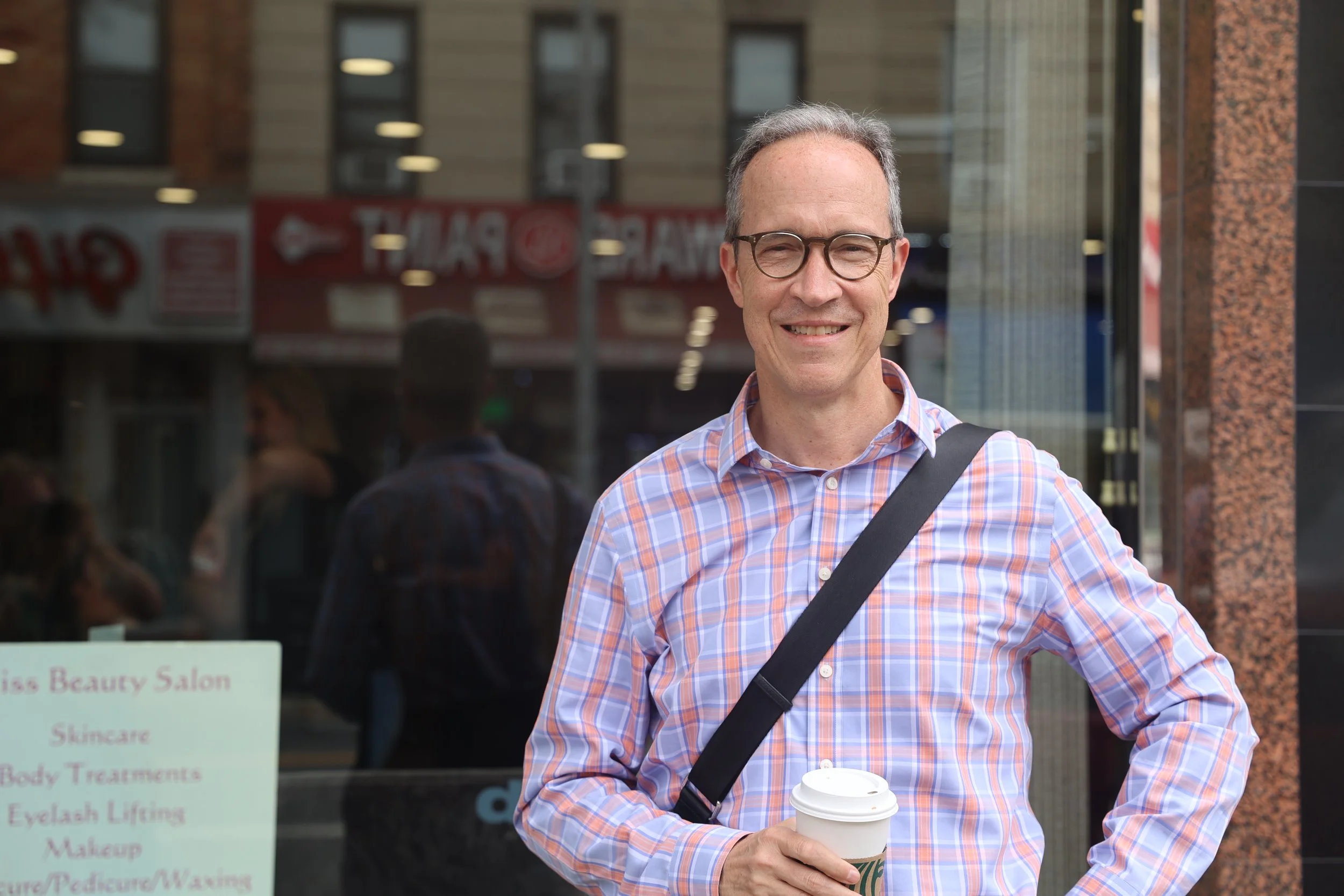
Jim Walden, independent candidate for mayor of New York City. Eagle photo by Ryan Schwach
By Ryan Schwach
In a campaign filled with big personalities, former prosecutor Jim Walden is looking to differentiate himself from the rest of the pack. It won’t be easy.
The independent candidate is competing against the Democratic nominee for the seat, Zohran Mamdani, who, in a city dominated by Democratic voters, has thus far held a large lead in the polls. There’s also the incumbent mayor, Eric Adams, who, despite poor polling numbers, has a four-year record to run on. Then there is the former governor, Andrew Cuomo, who was squarely defeated by Mamdani in the primary election but who holds near-universal name recognition and a massive campaign account. Lastly, there is the Republican nominee, Curtis Sliwa, who has been an outspoken and, at times, controversial, character in New York City for decades.
Walden, a career attorney, has been polling around one percent but insists he’s the anecdote to voters dissatisfied by the broader field of candidates.
The 59-year-old attorney recently showed up to an interview with the Eagle to discuss his plans for New York City with no staff or campaign workers, just himself and Mini Cooper plastered with an advertisement for his mayoral bid.
Before sitting down with the Eagle, Walden peeked through the window of a nail salon in Ridgewood that used to be a cafe and a known mafia hang out. When Walden was a rookie prosecutor in the U.S. attorney’s office assigned to take on RICO charges, the former cafe was at the heart of one of his earliest cases.
“I think that we ultimately prosecuted over 50 people from that case alone,” Walden said.
Walden spent years in private practice but began his career as an assistant U.S. attorney in the Eastern District of New York. After working as a prosecutor, he went on to represent high-profile clients, like Hollywood poker baron Molly Bloom and UFC fighter Conor McGregor.
The 59-year-old was the first person in the race for mayor to stage an independent campaign, before being joined by Adams and Cuomo. Unlike his two opponents, however, Walden is registered as an independent, and has been for nearly two decades.
Central to his campaign has been a call to each of the candidates challenging Mamdani to drop out shortly before the election if they aren’t polling ahead of all the other independent or Republican candidates.
So far, only Cuomo has signed onto the “No-Spoiler Pact.”
But Walden also has a policy platform. As mayor, he says he’d address government corruption, encourage the private development of affordable housing and boost the NYPD’s ranks by raising the base pay for officers.
Walden recently sat down with the Eagle to discuss his campaign and his plan for gaining traction before the November election.
The following interview has been edited for length and clarity.
Eagle: How do you plan to use your experiences in the legal world and the court system to govern New York City, if you're elected?
Walden: I kind of believe that good law turns into good policy. Part of what I did in the campaign was really study laws from the state constitution to the city charter to try to figure out ways that I could use the powers in those documents to do things that other mayors never did before. For example, the city charter makes the mayor the chief magistrate of the city. I didn't know that. I think, until I read the charter, I don't think any mayor has ever used it, but I'm going to use that power to start a new city court that deals with a couple of problems, political corruption being one of the main ones. In those ways, being a lawyer helps you.
Eagle: Tell us more about this new city court you’d create.
Walden: One of my policies is to tackle corruption by creating an independent agency. We've never had an independent agency focused on corruption in City Hall. The comptroller is like the financial watchdog. We have a public advocate that does very little. They've got like, a $7 million budget, and they're supposed to advocate for the public, but they're not allowed to even bring a lawsuit. I want to replace the public advocate with the head of the citywide Department of Public Integrity, and they would have power to prosecute corrupt elected officials, corrupt politicians, and corrupt city workers. The idea is to fast track the cases, and if someone is convicted, whether they do jail time or not, they get barred from city from being a public servant,
Eagle: You may have been the first to mount an independent campaign for mayor, but you've since been joined by two prominent Democrats. What's your pitch to independent voters who may be leaning towards either Andrew Cuomo or Eric Adams?
Walden: I'm the only true independent in the race. Obviously this was a matter of principle for me. It wasn't a matter of political survival. I've been an independent since 2006. I resigned from the Democratic party and registered as an unaffiliated voter, which is what independence is in New York. I'm outside the party system, right? [Adams and Cuomo] still have big parts of the machine backing them. I'm going to get rid of special interests entirely. I actually am the only candidate that's put out plans to get rid of special interests. I started that during the campaign by disavowing any political action committees. I've got plenty of wealthy donors that would love to write bigger checks to a PAC, and I've come out publicly and said, ‘I'm not taking it.’
Eagle: What motivated you leaving the Democratic Party?
Walden: The dysfunction between the parties. I could see the dysfunction and the blood sport between the parties that was starting to emerge and getting worse at the time. I, just as a voter, wanted to be independent from either party, which was not great in New York because then I couldn't vote in primaries. That's why I've been a huge supporter of open primaries, because independents can't vote in Democratic and Republican primaries, which, to me, just is anti-democratic.
Eagle: Even as you pitch your campaign to voters, you're still polling in single digits. How do you make a push in this race within a couple months?
Walden: As a candidate against four people that have been in the public domain for 30 years, it's not surprising that I would restart after the Democratic primary in single digits. I was up to 7 percent before the Democratic primary started. So I'm building back with my polling, doing a tremendous amount of voter outreach. I have that car, that is part of a two car caravan – the other one is a bus. We're going literally around the city. We've probably visited 50 neighborhoods so far. Our goal is to visit every single neighborhood in the city by the time the election comes.
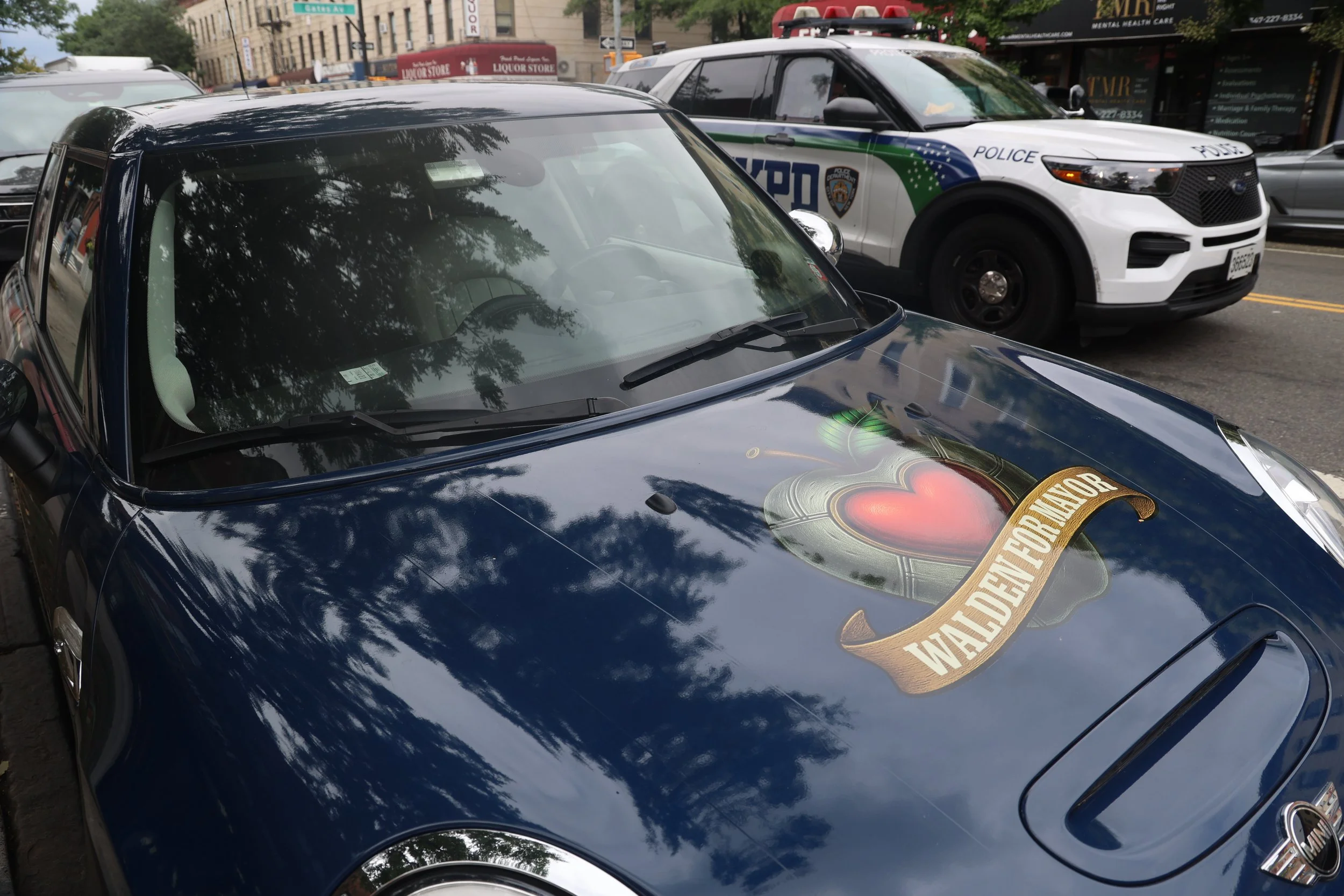
One of two campaign cars Jim Walden has employed to get his name out there. Eagle photo by Ryan Schwach
Eagle: With your pretty comprehensive legal experience, why mayor? Why not position yourself as a corporation council in an administration or a borough DA candidate?
Walden: Because I think we're at an inflection point where the city is on the verge of either regaining prosperity or slipping back into something worse. Adams has done an OK job righting the ship a little bit, but the first three years of his term, all we were was embroiled in scandal, and as bad as [Bill] de Blasio was, I didn't think that it could get any worse. Over 23 years, I've sued the city any number of times. I understand the way the city government works. I've represented dozens of elected officials in various cases, suing agencies, so I know that I have the qualifications and the ideas, frankly, to do the job. And I thought that this was an election where, given who was going to be in the race, an independent alternative was viable.
Eagle: You proposed what you call a “No-Spoiler” Pact among all the independent and Republican candidates. Cuomo has signed on but Adams and Sliwa have not. Will you stick to the pact if not all the candidates sign on?
Walden: The idea was that we all do it together, and if they won't sign up, then we’re just going to play the race out. Burn the ships. We're going ahead. But the fact that Adams and Sliwa haven't signed on doesn't mean anything to me. It's a new idea. It's out-of-the-box thinking, I get it, and they’re stubborn, vain people. I hope that at the end of the day when my polling does threaten them or I exceed them, I'm still willing to abide by the pledge. I'm hoping that that inspires them, if you will, to sign on, because it's better for New Yorkers.
Eagle: One person we haven't spoken about yet is the Democratic nominee, Zohran Mamdani. You have been very critical of him. What's your message to the majority of voters who cast their ballot for him in the primary and who are still excited to vote for him in November?
Walden: I hope those people are excited to vote for me, because I'm going to do things that he hasn't even pledged to do that give them more of what they need. I mean, he wants to freeze the rents across the rent stabilized portfolio – that does nothing for people that can't afford their rent. Now, there's a quarter million people in the City of New York in rent stabilized housing that are paying more than 50 percent of their incomes on rent. Freezing their rent is not going to help them. My plan will give a stipend so that their rent comes down to 30 percent of their income. That's a progressive program. I'm a centrist, but I believe in really good policy.
Eagle: How would you pay for the stipends?
Walden: There are three components to it. There's two belt tightening programs, if you will. It's at the city level. That's going to release about $50 million and then there's what's called a microtax. If you take a tax of less than 1/10 of 1 percent across a whole bunch of different transactions in the city, you can generate enough money to give a stipend for those tenants every single year.
Eagle: Mayor Adams’ big plan to address the city’s housing crisis was the City of Yes rezoning. How do you feel about his plan?
Walden: I was critical. But of course, it's a step in the right direction. I don't know that it makes a lot of sense to force development in communities that don't want it, and I don't think we have to start there. So that was one criticism. And the second one was putting band aids on bullet wounds. Every single housing economist that's looked at our problem said that we need 50,000 a year, and City of Yes gets you to 5,500 so it's about 10 percent of what we need. We can do much better than that if we unleash development with significant restrictions and requirements on developers, but with ample return on investment so that we build bigger.
Eagle: But a step in the right direction?
Walden: It was a step in the right direction, maybe a half step in the right direction.
Eagle: Another policy issue on your campaign's website – you hail broken windows policing.
Walden: I don't know that I hailed it. I think that broken windows policing, when it's done equitably and in a targeted way, like with fare beaters, for example, it is very, very helpful to solve problems. If you have a fare beater program where you're not trying to put every fair beater in jail, obviously, but the data shows that you will pick up people that have outstanding felony warrants, and you will also deter. I think that it's important, as long as it's done equitably and not in a way that is going into disadvantaged communities and breaking chops over every little violation.
Eagle: How would you deploy it in a way that it's not criminalizing entire communities?
Walden: I would start with fare beaters. I was just in Mott Haven the other day, and there was a completely sane person, literally on a crowded commercial street, stepped aside and started urinating on a building in front of a kid. That's something that I would enforce. There is a problem in Corona right now. I was just at a community meeting last week where there are all these homeless people that are intoxicated all of the time and causing mayhem in the neighborhood. There are 50 residents there, including three kids that spoke out of and one of them a nine year old with a knife drawn on him by one of these homeless men. I would enforce vagrancy laws in a selective way.
Eagle: If we were to police some of those other smaller crimes, there would likely be a growing population in the city's jails. Rikers Island, by law, is supposed to close by 2027. While the deadline has now become unrealistic, the law remains on the books. What is your plan for Rikers Island?
Walden: The Rikers building has got to close. There's no question about that. The question is what to do next. I'm not a supporter of the community jails plan. There's a lot of jail infrastructure that you can't load into communities, and it's also not fair to require it of Queens and Brooklyn, but not Staten Island. I'm in favor of the federal receiver as an interim measure. If I was the city, I would have consented to it. I would have welcomed it. I would significantly increase the number of corrections officers so that there's not so much stress on the system, because that's part of the problem. And I would rebuild on Rikers. The current deadline is obviously a fantasy. It's like a mandate that the City Council put in that everyone knew at the time was unrealistic, and we're spending billions of dollars on jails and communities that don't want them. We could spend less money building a humane prison that has educational facilities and the kinds of things that will actually help people live decent lives while they're in prison.
Eagle: A lot of construction and money has already gone into those borough jails. You can’t reverse that.
Walden: I'm not saying that. I'm not saying I'm going to reverse it. There are different stages of construction. I'm gonna play the hand that I'm dealt when I'm there. If they're already far along and there's no way to stop them then I can't stop that. I'm just not in favor of it. The problems [at Rikers] are terrible. They're they’re black mark on the city. Societies are judged by the way they treat their prisoners, their mentally ill and their poor, and we do a crappy job on all three if you ask me.
Eagle: How much do you think the Adams administration’s handling of the Rikers closure plan has contributed to the fantasy element of shuttering the jail by 2027.
Walden: It definitely contributed to it. As mayor, I'm going to tell you one thing for sure – I may not always agree with the City Council, but I'm not just going to disregard them. If I disagree with them and they pass a bill that I don't like, I'll go to court over it if I have a legal basis to do it. But if I were the mayor, I would have followed the deadlines and complied with the City Council. All it has done is created more acrimony when we don't need more acrimony in our political system right now, we need more collaboration.
Eagle: You've talked about ending congestion pricing, but data from the MTA and the state shows it's been a success. If the program shows continued success, would you still consider fighting to end it?
Walden: I think that that ship will have sailed by the time I'm in office. What I'm going to do is have really excellent policies and services and not necessarily relitigate everything that's already been resolved. There's a lawsuit over it, whether it's successful or not, I think the jury is still out. Certainly in the zone, people love the lesser but not nonexistent congestion. I haven't seen the numbers yet on whether carbon has really gone down. What I've seen and heard repeatedly is that congestion outside the zone is significantly increased. So this is one of those things that I think was a poorly thought through policy.
Eagle: To wrap things up, could you name a current or former elected official in Queens that you admire?
Walden: [Former District Attorney] Richard Brown. I thought he was a really good DA. I've also come to like [State Senator] Jessica Ramos a lot. We disagree on a lot of policy, and she's taken some pretty tough positions on my policing. But I think that she, aside from the fact that she supported Cuomo, was someone whose heart was in the right place.