Queens cannabis shops burned by state after surprise rule change
/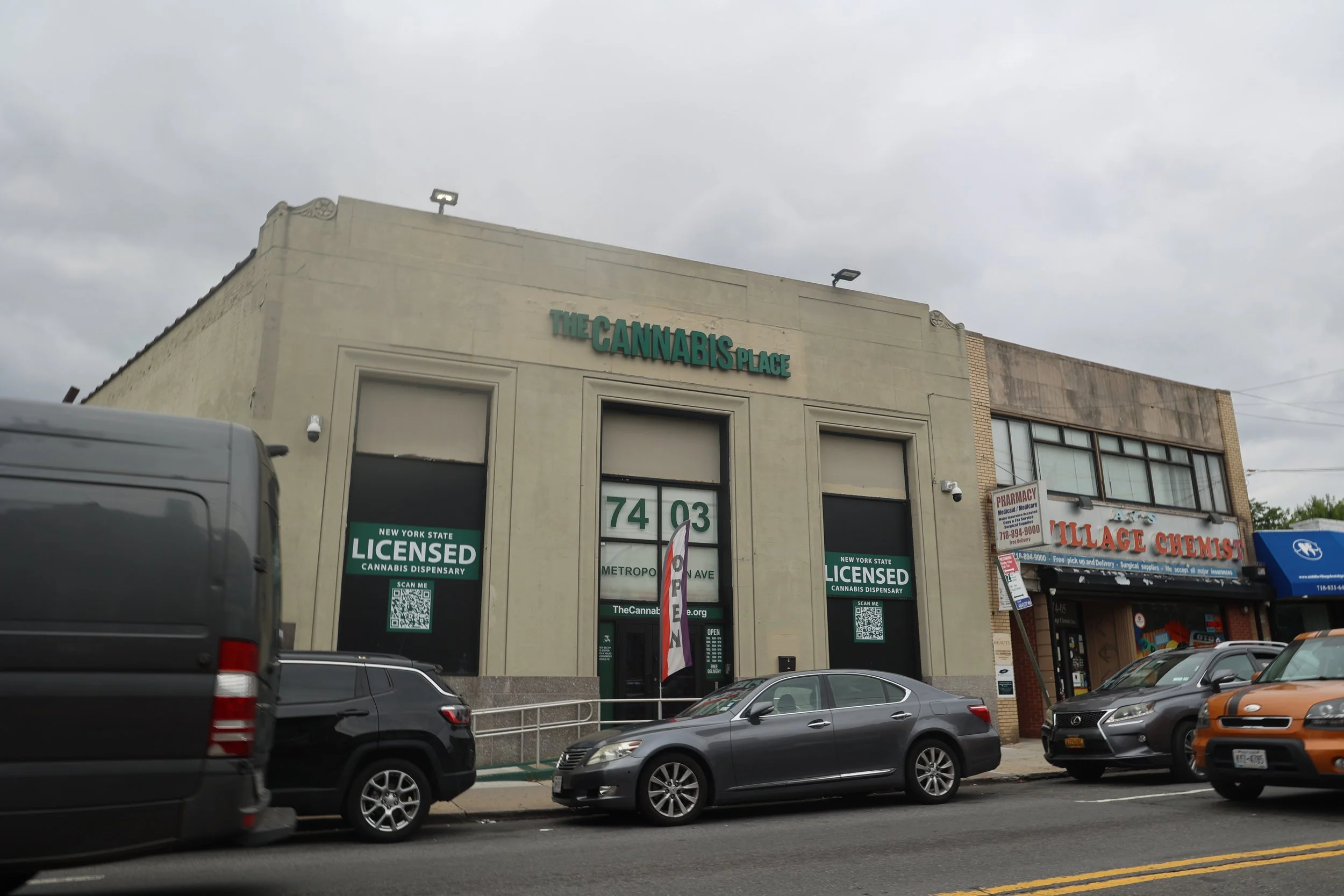
Queens cannabis shops, like The Cannabis Place in Middle Village, are reeling after the state changed the rules for dispensary locations. Eagle photo by Ryan Schwach
By Ryan Schwach
Several legal cannabis shop owners in Queens have been left in the lurch after the state said changes to its own rules may require over 100 pot shops to pack up and move.
Last week, the governor’s office and the Office of Cannabis Management notified 152 soon-to-be open and already open cannabis dispensaries across New York State that their current locations are no longer legally compliant.
In Queens, eight applicants and 14 already-opened stores are affected by the change.
The sudden reversal, made without warning, means that applicants and pre-existing dispensary licensees will either need a new location to operate out of – a move that could come at potentially at great personal cost – and has left store owners worried about the future of their business.
The state chalked up the issue to a “misstep” and a misinterpretation of a line in the state’s 2021 cannabis law that refers to a dispensary’s distance from a school. According to the state, stores, which can’t be located within 500 feet of a school, were being measured against their distance from the entrance of a school, when they should have instead been measured from a school’s property line.
The state and OCM are providing financial assistance to applicants that have not yet opened a store, and have guaranteed that already-in-operation dispensaries will be able to stay open until legislation is passed tweaking the measurement rules.
But with legislation not guaranteed, pot shop owners in Queens – many of whom cleared a number of bureaucratic hurdles to open their store in the first place – are fearful the dream they just began to realize may soon go up in smoke.
“There's a great degree of concern because this could have a detrimental and devastating impact,” said Osbert Orduña, the CEO of The Cannabis Place, a dispensary on Metropolitan Avenue.
The change in OCM’s interpretation of the law came as a surprise to cannabis shop owners. Orduña and the rest of the affected businesses received an email last week from OCM informing them of the discrepancy.
“I am keenly aware of the repercussions for you, your business, and the community,” said the letter, signed by OCM Acting Executive Director Felicia A.B. Reid and obtained by the Eagle. “You have poured your energy, time, savings, dedication, and heart into the promise of New York’s cannabis industry. To give you this is news and for the weight of it, I am incredibly sorry.”
A disabled veteran who served in Iraq, Orduña’s original interest in the legal cannabis market came as a treatment for Post Traumatic Stress Disorder. After toiling to obtain a license several years ago, he said OCM’s letter was a “complete shock.”
“We have done everything correctly and followed every regulatory process in order to get licensed, and we've done everything right,” he said. “To find that because of an administrative error by a governmental agency, that all of a sudden everything is now in a state of turmoil was a complete shock, and just speaks to the lack of leadership and thought process as you know this agency and overall within government.”
Orduña said that he and his partners – who also own a store in New Jersey – just recently invested $1 million into a renovation of the Queens store.
“If we were to have to move, it would have an economic impact on our business, because that would mean that we would have to rebuild somewhere else,” he said. “The price of everything has gone up…That's a lot of money. And you know, where does that capital come from?”
Other dispensary owners are in similarly difficult positions, including one that spoke to the Eagle under the condition of anonymity. The owner recently was granted a license but had yet to begin construction on their store in Queens.
“While we're not open yet, we have invested heavily in the lease, build out, and planning based on the guidance OCM provided at the time,” the owner said. “Now we're left in a position where we may not be able to renew the license because the location is no longer compliant.”
Because the owner already has their license, they don’t qualify for the financial assistance for applicants, and also do not have the guarantees benefited to pre-existing sites.
“Since I'm not operational I don't feel comfortable continuing to invest time and money into the building,” they said. “This leaves me in a gap with no support. We did everything by the book and are risking losing everything without getting a chance to open.”
“But we will push on and find a new location,” they added. “Personally, it's cost me thousands so far, luckily this happened right before the serious construction was going to start so it could have been a lot more devastating. But for many license holders, I'm sure it's a lot worse.”
The owner also said that OCM has not responded to email follow ups since last week.
“The decision to make this change comes off as very arbitrary and non-transparent,” they said.
Orduña also didn’t shy away from criticizing the state and OCM either.
“They were trying to protect themselves, and had little or no regard for the impact that this would have on businesses and local communities and the overall cannabis supply chain,” he said. “In the stroke of one email, they are going to shut down 152 legal stores, and that shows a complete lack of leadership and a poorly executed plan.”
Passing the buck to the left-hand side
In a statement immediately following OCM’s announcement, Reid, the agency’s acting executive director, made it clear that the agency is responsible for the mistake, and is looking to correct it.
“This was a difficult but necessary decision to bring the office’s practices into full alignment with Cannabis Law,” she said. “I recognize the impact this correction may have on licensees and communities, and I want to be clear: our success as a regulatory body is tied directly to the success of our licensees. We are actively pursuing legislative solutions to protect impacted businesses, and we remain committed to learning from past missteps to ensure a more stable, transparent, and legally sound cannabis industry moving forward.”
Governor Kathy Hochul, whose office oversees OCM, criticized the oversight.
“Under Governor Hochul’s leadership, New York has strengthened its nation-leading cannabis market by addressing any problems created by previous agency leadership – and that work continues today as we correct this unacceptable oversight,” her office said in a statement. “The State is taking immediate action to support any cannabis store owners impacted by this issue, and the governor will continue to ensure that New York’s billion-dollar cannabis industry remains the most equitable adult-use cannabis market in the country.”
Since marijuana was legalized by the state in 2021, OCM faced myriad criticisms for their sluggish rollout of the legal licenses, and for their inability to quickly shutter the thousands of illegal smoke shops that popped up across New York ahead of the legal market’s full introduction.
However, former leaders of the agency, several of whom were fired or left under contentious circumstances, said that the mistake wasn’t theirs. Instead, they said the sudden change was a politically motivated policy shift being disguised as an oversight by OCM.
“I don't think anything went wrong,” said Damian Fagon, the former chief equity officer at OCM, who now works for the Bronx Defenders. “I think that this is a manufactured crisis.”
Fagon resigned from the state agency last year after he was accused of targeting cannabis licensees who spoke out against the agency. A probe into the accusations found the claims to be unsubstantiated.
Aaron Ghitelman, who did communications for OCM and now works with cannabis shops, agreed with Fagon’s comments to the Eagle on the current crisis.
“This is an explicitly anti-business regulatory change from Governor Hochul,” Ghitelman said.
Fagon said the measurement issue was fleshed out years ago.
“It's being masked as a mistake or an error or an oversight,” he said. “The door-to-door rule was established in the public comments period before formulation of the adult use regulations. It was recommended by the public, by the industry, and it was approved by the governor's office.”
“It's been in place for two years with no issue,” Fagon added. “This is a manufactured crisis.”
Fagon said he thinks some of the stores are bound to go bankrupt as a result of the decision.
“They followed the rules that were in the regulations that were approved by the governor's office and that have been in place for two years now, and now they're being punished,” he said.
In response to Fagon’s statements, OCM said they remain focused on helping the impacted business.
“Our priority is clear: these businesses will remain open and operating while the OCM offers practical support and ensures these entrepreneurs have the tools they need to succeed,” a spokesperson said. “We are committed to meaningful, forward-looking solutions that keep equity and opportunity at the center of our work."
Hochul’s office did not respond to requests for comment on Fagon’s statements.