‘Killing hope’: Advocates say gov has abandoned clemency reforms after failing to commute sentences
/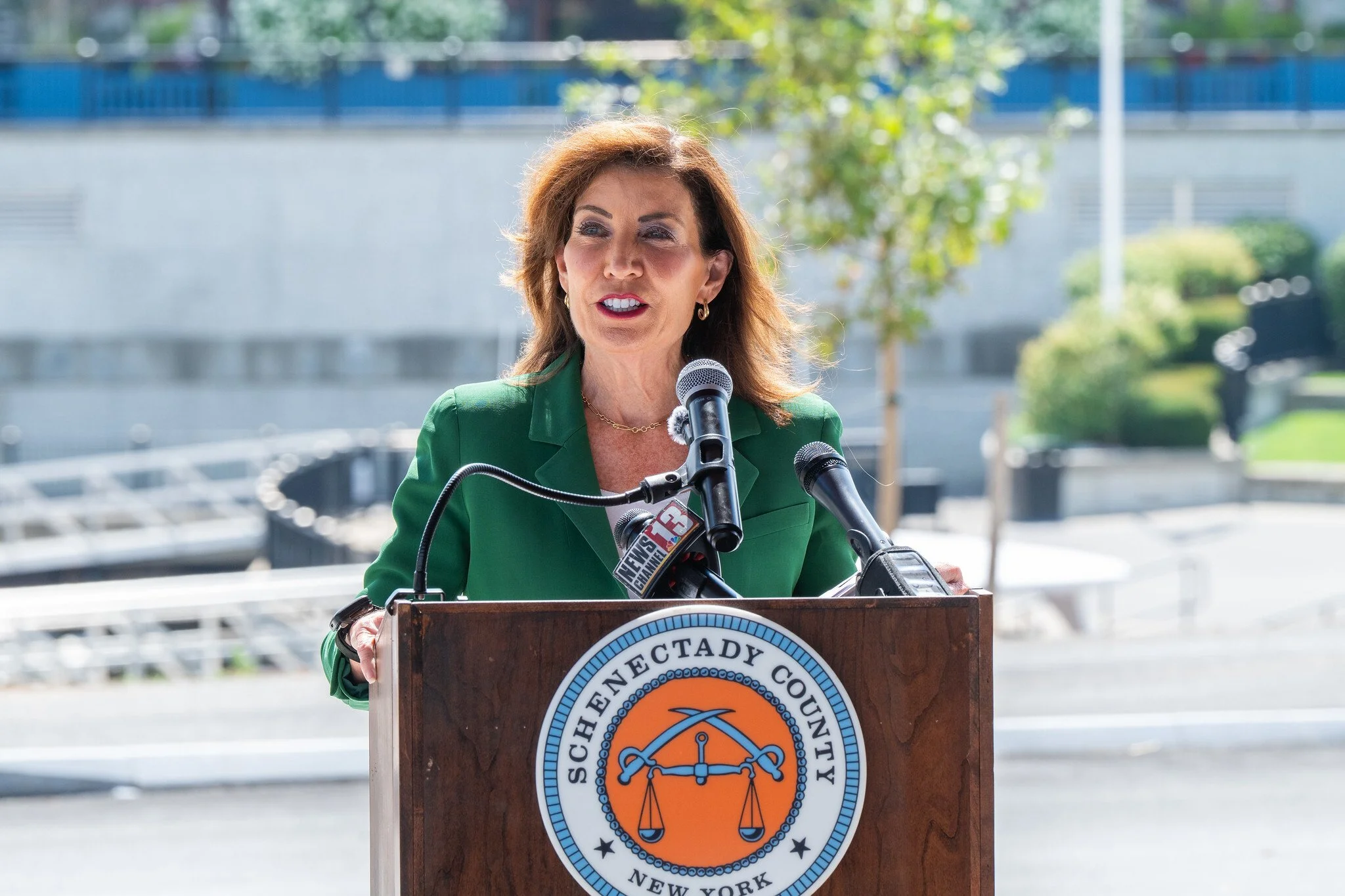
Governor Kathy Hochul granted pardons to over a dozen people on Friday but didn’t grant one of the over 1,330 sentence commutation applications pending with her office. Photo by Darren McGee/Office of Governor Kathy Hochul
By Jacob Kaye
Issuing her first round of clemencies in eight months, Governor Kathy Hochul on Friday pardoned 13 people but chose not to commute the sentence of a single New Yorker, despite the fact that commutation request make up a vast majority of the hundreds of clemency applications sent to the governor’s desk each year.
The 13 pardons granted by Hochul on Friday were given to New Yorkers “who have demonstrated remorse for their actions and exemplify a commitment to bettering their communities.” At least one of the people granted clemency on Friday needed a pardon in order to remain living in the United States. Many of the pardons granted by Hochul over the past four years have been to New Yorkers whose criminal convictions threatened their immigration status.
But Friday’s round of granted clemencies raised alarms among advocates and incarcerated New Yorkers, who said their fears that Hochul has abandoned her promise to reform the clemency process in New York have all but been confirmed.
“What this highlights to me is the governor's backtracking on her promise,” Steve Zeidman, a professor at the CUNY School of Law and the director of their Criminal Defense Clinic, told the Eagle. “The part of clemency that she was being pushed to recognize, the part of clemency that the advocates were pushing for the hardest were sentence commutations, all the people who were sentenced to perish in prison.”
“The governor can tout the fact that she's granting clemency in the form of pardons, but she has to address the question of what happened to sentence commutations,” Zeidman added.
Hochul set off to reform the clemency process during her first year in office. Clemency, which can come in the form of a pardon for those already released from prison or a sentence commutation for those currently behind bars, is a power granted solely to the governor that had been rarely used for much of the 21st Century. Former Governor Andrew Cuomo had attempted to revive the practice by granting clemencies every Christmas Eve, but Hochul said she wanted to take the process one step further.
The governor laid out a number of reforms in 2021 that she would go on to slowly implement over the next several years. She convened a panel to review and recommend clemency applicants to her. Her office also began more regular communications with people who had pending clemency applications.
But the reform most sought by advocates was her promise to grant clemency on a rolling basis, breaking from the pattern of granting clemency only around the December holidays, as had been the practice for years.
The governor began granting clemency on a rolling basis for the first time In 2023, when she granted two commutations and five pardons in April, three commutations and 10 pardons in September and four commutations and 12 pardons in December. In all, the governor commuted the sentences of nine people and pardoned 27 others, more than the total number of clemencies she granted during her first two years in office combined.
When Hochul again announced a round of pardons and commutations in May 2024, advocates and applicants hoped she’d follow a schedule similar to the one she followed the year prior – some even hoped she’d increase the number of times she’d grant clemency.
But Hochul didn’t grant any clemencies until several days before Christmas, when she pardoned 21 people and commuted the sentence of just one New Yorker.
Friday’s round of granted clemencies were the first she’s issued in 2025 and the first she’s ever issued without a sentence commutation.
“She’s going backwards,” Zeidman said. “She raised hope for the people inside that sentence commutations were real. She raised hopes for their families on the outside. And it turns out, it was false hope.”
In a press release announcing the pardons issued on Friday, Hochul highlighted the reforms she introduced in 2021.
“When I took office, I pledged to reform the clemency process by bringing greater transparency and expert analysis to each case that comes before my desk,” the governor said.
But Zeidman said Hochul’s claim that she’s committed to the reforms is "disingenuous."

Over 1,330 incarcerated New Yorkers have clemency applications pending with the governor’s office. AP file photo by Mark Lennihan
“It's fulfilling her commitment to grant pardons,” he said. “Clemency includes sentence commutations.”
In a statement, Hochul’s deputy communications director for public safety, Matt Janiszewski, said Hochul “considers each application for clemency on a case by case basis, reviewing and considering each based on its own individual circumstances.”
But just how clemency applications are reviewed is unclear.
The governor’s office does not specify exactly how many applications were reviewed by the clemency panel, nor how many the clemency panel recommended be approved by the governor.
In 2025, 186 commutation applications and 84 pardon applications were submitted to the governor’s office. There are now over 1,800 clemency applications pending with the office, including over 1,330 commutation applications and over 510 pardon requests.
Though commutation applications make up around 74 percent of total clemency applications, they have only accounted for around 14 percent of clemencies granted by the governor dating back to 2023.
Stanley Bellamy, a Queens man whose sentence was commuted by Hochul in 2022, said that he knows personally what it feels like to be waiting for a clemency application to be granted, and what it feels like to be told that you didn’t make the list.
“It kills the hope,” he said. “And that's the one thing that sustains a lot of people inside – hope.”
“You take that away, you basically take away everything,” he added.
Hochul’s apparent rollback of her reforms comes as she’s gearing up to run for reelection. In 2022, Hochul defeated Republican challenger Lee Zeldin in a race where rhetoric about the candidates’ bone fides when it came to fighting crime took center stage. Hochul will likely face a Republican challenger again in 2026 and crime may likely again become a theme on the campaign trail.
Zeidman said that he believes Hochul’s reluctance to release people from prison through sentence commutations is rooted in her fear of appearing weak on crime.
“I can think of no other reason why this is happening other than political calculations,” he said. “It’s political cowardice.”