NYPD’s quality-of-life units hit Queens’ streets
/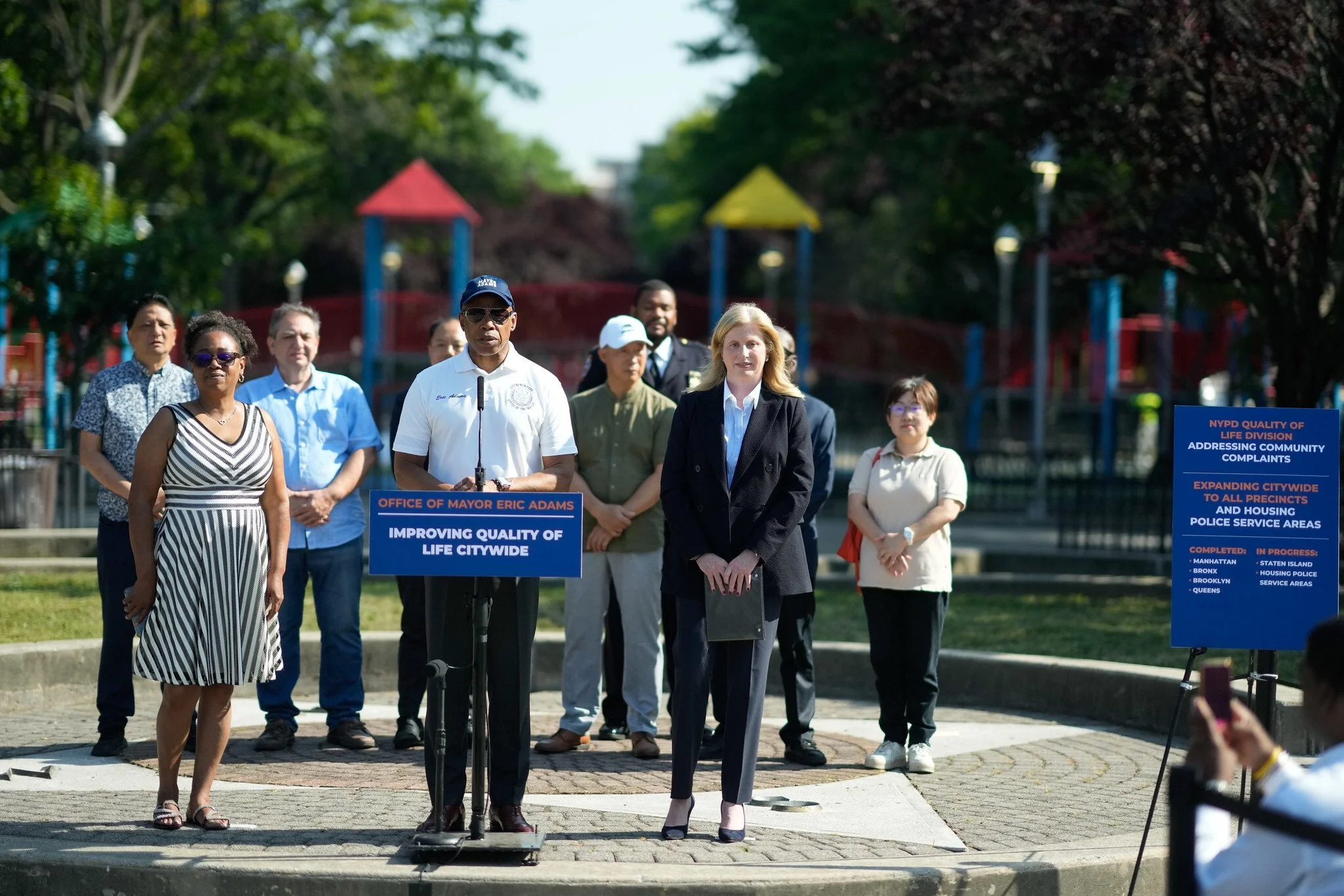
New York City Mayor Eric Adams and NYPD Commissioner Jessica Tisch announced the expansion of the NYPD’s Q-Teams into Queens on Monday, Aug. 11, 2025. Photo by Michael Appleton/Mayoral Photography Office
By Jacob Kaye
Every police precinct in Queens will soon be outfitted with a team of officers whose sole purpose is to address quality-of-life issues, the mayor and police commissioner announced on Monday from Astoria.
The NYPD’s Q-Teams, which began as a pilot program in several precincts earlier this year and has since been expanded to include all precincts in Manhattan, the Bronx and Brooklyn, will now be installed in all of Queens’ 17 precincts.
The mayor and police commissioner, fresh off celebrating a citywide drop in shootings through the first half of 2025, claimed the expansion of the quality-of-life units came after they saw success in the policing strategy in other parts of the city.
The unit centers around policing things like illegal mopeds, abandoned cars, homeless encampments, outdoor drug use and noise complaints.
“[Public safety] is about how people are feeling, it's about what people see when they walk out their front door, what is in their shopping areas, what is along the corridors of their community,” Adams said from Queens on Monday. “Because every New York deserves a high level of security, we are focused on how do we reduce both actual crime decreases and the perception of crime.”
“That is why, earlier this year, Commissioner [Jessica] Tish created NYPD’s quality-of-life division and launched a pilot program to address quality-of-life issues across our city,” he added. “And today we're bringing the program right here to all of Queens…The borough of my raising will be seeing safe and cleaner neighborhoods thanks to our NYPD quality-of-life teams, our localized precinct-based teams will be helping reduce crime and improve quality of life.”
The first Q-Teams were introduced in five precincts in April, including the 101st Precinct on the Rockaway peninsula. In July, the teams expanded to Manhattan, the Bronx and Brooklyn.
Since being launched, non-emergency response times have dropped by 47 minutes on average citywide, according to the mayor.
Collectively, the Q-Teams have towed 71 cars and trucks, and seized 318 illegal e-bikes, scooters and mopeds.
According to Adams, the units have responded to over 31,500 911 and 311 calls since launching.
“For too long, the kinds of problems that chip away at a block's sense of safety have gone unaddressed,” Tisch said on Monday. “The abandoned car that hasn't moved for months, mopeds weaving through pedestrian sidewalks vanishing under illegal vendors, loud music blaring deep into the night, homeless encampments lining city streets. These aren't isolated issues, and they haven't gone unnoticed for years.”
While nearly all of the seven major crime categories have seen a reduction in the five boroughs over the past several years, the same hasn’t been true for 311 complaints.
In 2024, New Yorkers logged over 3.4 million complaints with 311, marking a 7 percent increase from the previous year, according to a May report from the state comptroller’s office. Some of the most frequent complaints included illegally parked cars, noise and heat and hot water outages, according to the report.
While Tisch said the NYPD’s “focus has rightly been on violent crime,” their attention has shifted to include the quality-of-life complaints, which Tisch said have doubled over the past seven years.
“We're building the infrastructure to take on these challenges consistently as part of the department's everyday work, because it's hard to measure quality of life, but you know when it's missing and you know when it's been restored,” the commissioner said. “That's the standard we're aiming for, and the work begins in Queens now.”
While city officials have touted the units’ success, the program hasn’t been without its critics.
Upon the Q-Teams’ expansion into Manhattan last month, the New York Civil Liberties Union railed against the Adams administration’s reliance on the NYPD.
“Cracking down on ‘quality-of-life offenses’ is just broken windows policing under a new name – and the latest example of the Adams admin's unwillingness to think beyond the Giuliani playbook,” the group said in a July statement. “New Yorkers need investments in services and resources, not in failed policing tactics.”
Tisch shot back at the criticism on Monday and claimed that the units weren’t concerned about making arrests.
“Some critics have tried to misrepresent this approach, calling it a return to zero-tolerance policing, but that is a fundamental mischaracterization of what we're doing here,” the commissioner said. “This isn't about preventing future crime, it's about restoring present order. That means responding to the problems people are actually living with and making sure that they get fixed.”
Beyond the mayor and the NYPD, the expansion of the Q-Teams was celebrated by Astoria Houses tenants on Monday, as well as Queens District Attorney Melinda Katz.
“I welcome the expansion of the NYPD's Quality of Life Q-Teams across the borough of Queens,” Katz said in a statement. “Residents are rightly concerned about unlicensed smoke shops, abandoned vehicles and unregistered scooters. By focusing on these issues, we help improve public safety in this borough block by block and erase the notion that some portions of the city are more important than others.”