
‘More than a basketball tournament’: Nonprofit brings teens and incarcerated people together in Queens
/
Justices Michelle Johnson, Karen Gopee, and Ira Margulis; Chief Clerk Cherise Ellison; Queensboro Superintendent Linda Carrington-Allen; and Flames founder Gerard J. Papa posed with the players of both teams after the game. Photo courtesy of Queensboro Correctional Facility
By Noah Powelson
For three years now, prisoners in Long Island City have participated in a unique program – playing basketball against a team of high schoolers.
Flames basketball, a primarily Brooklyn-based youth basketball nonprofit, operates a pro bono program that brings a group of teens to correctional facilities throughout the state to play a game of basketball with the incarcerated individuals who reside there. Last month, on June 12, Flames paid a visit to Queensboro Correctional Facility in Long Island City, the third time the program has come to the facility.
The game is a special occasion for everyone, its founder said. Incarcerated individuals play, as well as serve as the referees and the table crew. After the game is over, the two teams get together for a conversation about the game itself, their own lives and decision making.
While the teens ultimately lost last month at the Queens facility, Flames’ founder Gerard Papa told the Eagle the games are about so much more than a score.
“When we first began this in 2019, I knew it would help these kids. It would make them see life in a different way and would leave a good mark on them,” Papa told the Eagle. “The kids grasp the significance of the game, and they understand it even more coming out.”
And for the incarcerated players, the game provides a glimpse of stability and represents one more step closer to the outside. Whether it’s at Queensboro or other upstate correctional facilities, the team is welcomed warmly by both the prison staff and the incarcerated individuals themselves, Papa said. At one point, Papa remembers when an incarcerated person in Otisville Correctional Facility said how much he looks forward to Flames coming, because otherwise they’d all just be fighting instead.
“I had no idea how much of a mark it would make on the prisoners," Papa said. "No matter how you feel about the righteousness of justice, they're still human…That’s why I keep doing this.”
Flames was first founded around 1974 by Papa, a Columbia Law School graduate. Papa said he estimates he’s coached over 20,000 New York City kids between the ages of 8 and 20 over the years.
Flames first played inside a DOCCS facility over 30 years ago against a team of incarcerated individuals at Eastern New York Correctional facility, a maximum-security facility in Ulster County.
The program ran for a number of years inside New York State prisons before the partnership with DOCCS came to a halt. The partnership was reestablished in 2019 and has been going strong since.
The most recent game at Queensboro also marked a relatively new and ongoing tradition for Flames, as several Queens judges were invited to observe the game and speak with the players and prisoners.
Chief Judge Rowan has long advocated for alternative justice solutions besides incarceration, such as problem-solving courts. UCS leaders said programs like Flames provided a valuable service that helps communities heal and bridges the gaps between incarcerated individuals, judges and young New Yorkers.
“This initiative is so much more than a basketball tournament,” Deputy Chief Administrative Judge for Justice Initiatives Edwina G. Richardson said in a statement. “It’s a perfect example of the good that can be achieved through collaboration and community engagement. Bringing together people from different lived experiences, the Flames program promotes understanding, dialogue, and connections that serve to strengthen our criminal justice system, aligning closely with the vision and goals of the Unified Court System’s leadership to advance equal justice and civic participation.”
Richardson was the first administrative judge to observe the Queensboro games, but she wasn’t the last. The following year, Justice Donna-Marie Golia attended the Flames game, and got to witness a rare victory by the teens.
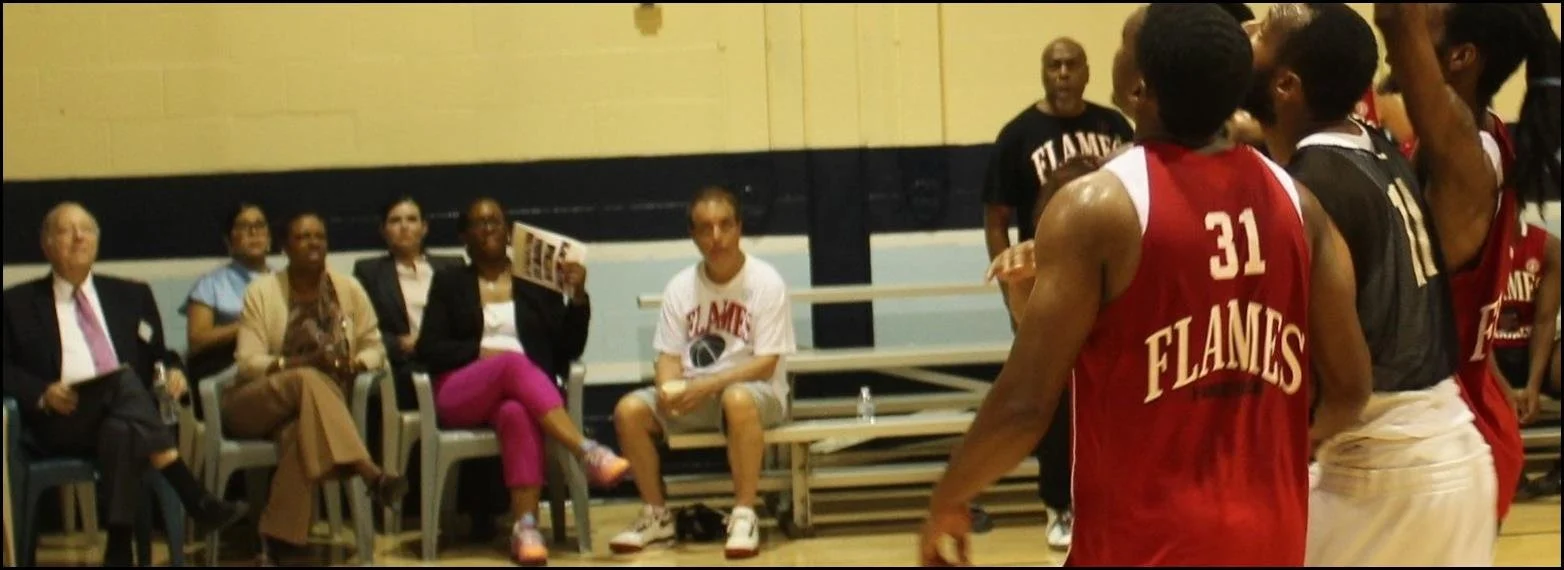
Justices Michelle Johnson, Karen Gopee, and Ira Margulis; Chief Clerk Cherise Ellison; and Flames founder Gerard J. Papa sat courtside for Flames game at Queensboro Correctional. Photo courtesy of Queensboro Correctional Facility
This most recent game at Queensboro, three judges attended, including Justice Michelle Johnson, the administrative judge for the Queens Supreme Court, Criminal Term. Johnson had taken a particular interest in the Flames program outside the game as well, as she handed out hundreds of awards at the 51st Annual Flames Youth Awards Night last March.
“Sports generally serves as a bridge between people of different backgrounds and communities,” Johnson said. “The Flames program is an inspirational bridge between young men with the hope of being released back into the community upon completion of their sentence of incarceration; and young men in the community who see, firsthand, the potential consequences of poor decisions.”
Other judges who observed the game included Supreme Court Justices Ira H. Margulis and Karen Gopee.
“The tour and game at Queensboro Correctional Facility was eye opening,” Maruglis said. “Both teams played to the best of their abilities and after a few minutes I felt like I was courtside at an NBA game. Although there was a lot of pushing and shoving as in a professional game, no one on either team lost their cool or became hostile. I believe it was a fun evening for all.”
“The energy and enthusiasm of both teams was palatable, ending with shared pizza and lifetime memories,” Gopee said. “Programs such as these, that engage our youth, bridge the gap between our youth and the police, while also helping to divert them from bad choices and create support for those who are returning to our community after a period of incarceration, are truly invaluable.”
For Papa and the players, the partnership with judges and UCS leadership marks a significant milestone for the program. Arranging these games is a long and difficult process, requiring coordination between the players, their families, the facility, the NYPD and DOCCS.
“DOCCS is grateful for its continued partnership with the Flames Youth Basketball Program, which helps mentor youth by sharing incarcerated individuals' real-life experiences and the consequences of one’s choices,” NYS Department of Corrections and Community Supervision Commissioner Daniel F. Martuscello said. “The value of the games played in our facilities is reflected in the positive feedback from both staff and the incarcerated population. I look forward to our continued work with Flames and supporting youth as they navigate their path through adulthood.”
One of the biggest hurdles is convincing the kids and their families to go.
At the end of every year, Papa picks about 20 players of the 400 he coaches for a chance to be a part of the “Elite Team,” who play at the correctional facilities. He usually picks older kids who he thinks have the right disposition to handle going into a prison.
Many teens are nervous at the prospect, and oftentimes their parents don’t feel comfortable with the idea. Papa said it’s not uncommon for as much as half of selected players to back out at some point during the process.
But those that do go come away learning a lot about the world and themselves, and walk away with a better appreciation of the inmates, the judges and the police. It usually begins as soon as the game starts.
"They approach all these games with a certain amount of apprehension, but very quickly they throw themselves into the game,” Papa told the Eagle. “It just becomes any other game in the park."
In Queensboro, where inmates often only have a year to go before being released, the talks between players and incarcerated people after the game are often a lot more lighthearted compared to when Flames play at other upstate correctional facilities. Unlike other prisoners who have years, if not decades left in their sentence, inmates at Queensboro can see the light at the end of the tunnel and playing a game with the teens represents one more step to a closer life beyond bars.
Papa said that no matter how much fear is there initially, the teens leave smiling.
"There's no question these kids feel better about themselves,” Papa said. "It feels great."