
7 line remains overwhelming epicenter of subway surfing epidemic
/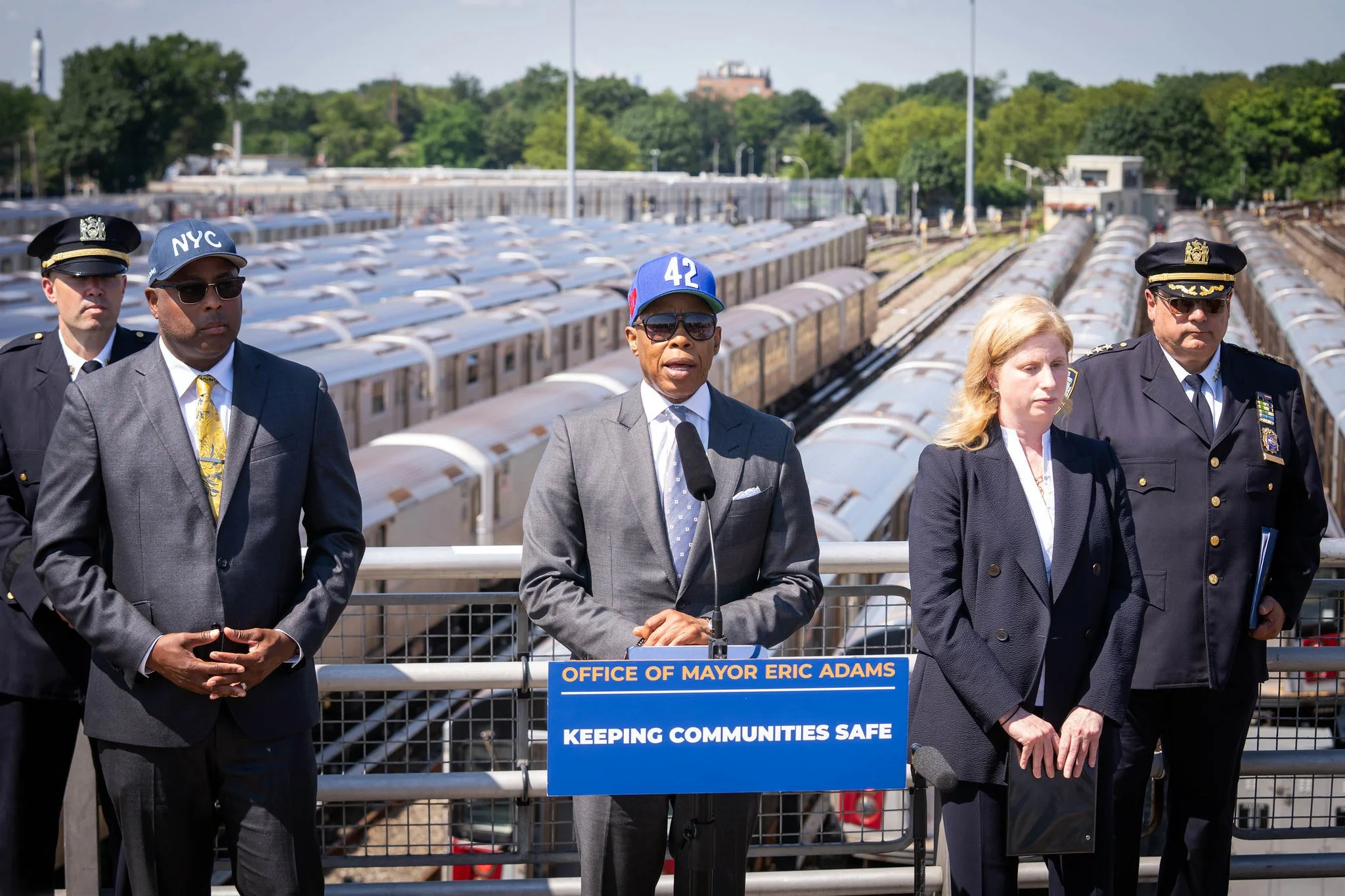
Mayor Eric Adams and law enforcement officials said Monday that over 50 people have been caught subway surfing this year and a vast majority of them have been caught along the 7 line. Photo by Ed Reed/Mayoral Photography Office
By Ryan Schwach
As the city continues to crack down on the dangerous subway surfing habit among young New Yorkers, Queens famous 7 line remains the epicenter of the trend.
Mayor Eric Adams and law enforcement officials on Monday stood on the walkway outside the Mets-Willets Point 7 line subway station, the route which 80 percent of subway surfers have been caught riding going back a year and a half.
City officials promoted their drone enforcement program, which has led to the catching of more than 50 would-be subway surfers this year alone. They also touted their efforts to deter teens from getting on top of trains in the first place.
“Subway surfing is dangerous, there's no other way to get around it,” Adams said. “We're going to do everything that's possible to make sure that it does not take the life of an innocent person.”
So far this year, three individuals have died while subway surfing, including a 15-year-old who died riding a 7 train in Long Island City earlier this month. Three others have been hurt. Six died last year.
Adams and Police Commissioner Jessica Tisch said they are making progress on getting more subway surfers, who are commonly teenagers, off the tops of trains.
“Subway surfing is not a trend, it's not a rite of passage, and it's certainly not viral entertainment,” the commissioner said. “It's a deadly risk taken mostly by kids, often in groups fueled by social media, amplified by peer pressure and sustained by a false and naive sense of invincibility. It is Russian Roulette on rails, and too many kids are playing it without understanding mistakes.”
Tisch said that the NYPD has made 52 "recoveries" so far this year and exactly 200 going back to November 2023 when the city began using drones to enforce against subway surfing. Police officials did not expand on what they meant by “recoveries.”
The focus of the deployments have been along hot spots for subway surfing, which are mainly scenic, elevated routes like the 7 train.
The popular Queens-Manhattan route, well known for the diverse neighborhoods it rides over, has been characterized by officials as the “epicenter” of subway surfing incidents.
According to the city, of those 200 recoveries, 165 have come on Queens-centric lines and 160 of them have come on the 7 train.
“That 7 line in Queens is an elevated line that is the overwhelming location where we're experiencing subway surfing,” said then MTA’s security chief, Michael Kemper, before the City Council in 2023. “It's relatively flat, it's extremely scenic, and this all fits into what's driving subway surfing.”
The NYPD also said Monday that 44 percent of overall subway surfing incidents have occurred on the 7 line.
The police commissioner insisted on Monday that the locational data has been key to the enforcement.
“This is not guesswork,” she said. “These are focused deployments based on pattern analysis through 911, call data and incident response.”
According to NYPD data, since November 2023 drones have been used 340 times to spot subway surfing incidents.
Tisch said the NYPD sends the drones out over certain sections of elevated train tracks to monitor the tops of moving trains. If a subway surfer is spotted, the drone operators radio a nearby transit officer who then attempts to get the kids down.
“It's fast, it's coordinated, and it is highly successful,” Tisch said.
The NYPD is likely to expand its use of drones in transit-crime related police work.
“I think you're going to see an incorporation of drones and our transit patrol in many ways,” Adams said. “These drones can patrol platforms. It can move through tunnel areas where you can't get a helicopter…We're seeing across the globe the use of drones using some war action, but we're using it in a peaceful way, and we're excited. We're excited about what the possibilities are.”
The NYPD’s use of drones under Adams have been a source of controversy though.
In December, the city Department of Investigation alleged that some of the administration's use of drones violated laws that regulate their use.
“NYPD’s increase in drone usage in recent years has raised privacy concerns related to how drones are used to conduct police surveillance and monitoring,” Inspector General Jeanene L. Barrett said.
Tisch said that nearly 60 percent of drone deployments in subway surfing incidents identified surfers.
While many of those identifications have led directly to arrests, Tisch said she describes them as “saves” because it prevents the loss of life.
“We call them saves, because that's what we're doing here,” she said. “We're saving lives, and in the vast majority of cases, we're talking about children's lives.”
Outside of NYPD enforcement, the city, through the MTA and Department of Education, have promoted their “Subway Surfing Kills – Ride Inside, Stay Alive” campaign, which was created and designed by New York public school students as a way to reach their peers on the dangers of subway surfing.
That program was expanded in June to include a comic-book ad campaign, and new on-train audio messages from students. The city also teamed up with Nigel Sylvester, a Laurelton-born BMX athlete, to spread the message.
On Monday, Tisch reiterated statements made by Adams and called for social media companies to take down videos of subway surfing, and criticized app makers who glorify the act.
The popular game “Subway Surfers” has one billion downloads according to the Google Play store.
“Social media platforms need to take this content down, not after it's gone viral, but before it can spread,” the commissioner said. “The app developers who gamify this deadly behavior, you are part of the problem too. We won't tolerate it, and neither should app stores.”