Students rally for QueensLink project
/
Deputy Public Advocate for Infrastructure & Environmental Justice Kashif Jussain rallies with Queens College students for QueensLink investment.Eagle file photo by Noah Powelson
By Noah Powelson
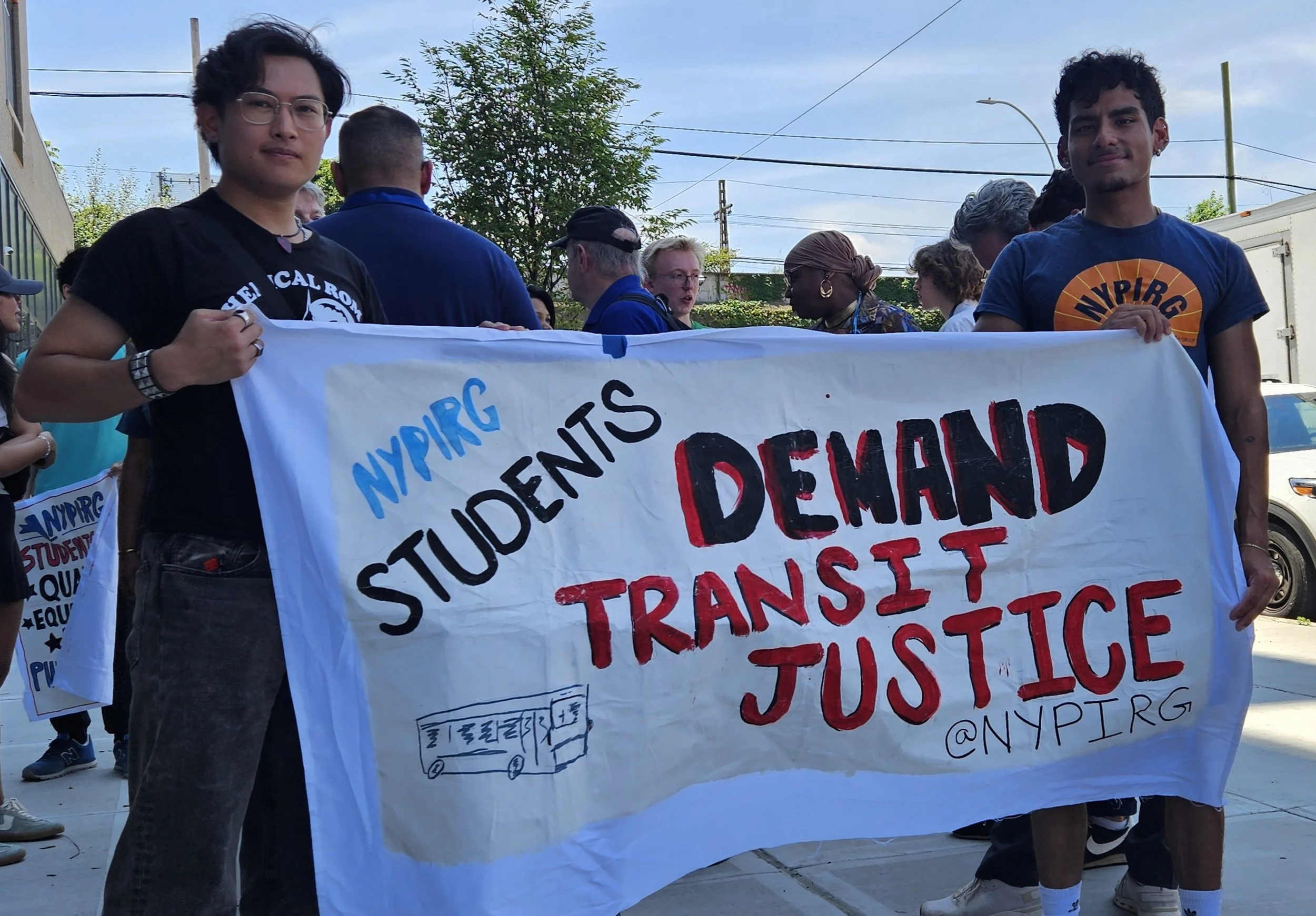
Queens College students rallied in Rego Park on Wednesday, calling for the city and mayoral candidates to invest the city’s cash into resurrecting an old train line in Southeast Queens.
Dozens of Queens College students, Southeast Queens residents and transit activists gathered just outside the long-abandoned rail lines that would be used for the long-shot transit project known as QueensLink.
The rally coincided with a new report released by the non-profit New York Public Interest Research Group Fund. The report included testimonials and polling data from students, residents and community members who attended a Town Hall held at Queens College on April 28. In the report, students shared their commute experiences and how their current lack of public transportation options affect their daily lives.
Students in the report said buses were their most relied on form of transportation, that transferring between transit lines was commonplace and that travel times were often between one to two hours for a one-way commute. The report also detailed the most common consequences on riders for lack of transportation options, such as regularly being late or missing school or work.
Alongside the report, the students came with a petition with 1,500 signatures in support of the QueensLink. The report also encouraged the city to include funding for a full Environmental Impact Study and to reactivate the Rockaway Beach Branch in the MTA’s 2030 Capital Plan.
NYPIRG said they had emailed the report to all New York City mayoral candidates and gubernatorial candidates.
The rally on Wednesday was just the most recent of many attempts to encourage city officials to revitalize momentum for the transit project they say could save Southeast Queens residents 20 mins travel time in their daily commutes.
Despite support for the project, the MTA and Mayor Eric Adams have seemed to abandon the transit project in favor of using the track to create QueensWay, a 3.5 mile park reminiscent of the High Line in Manhattan.
The QueensWay was first funded by Mayor Eric Adams in 2022, and has since then been funded further with $117 million from the federal government. The project is already deep into its planning and design process.
QueensLink has retained continued support from locals in Southeast Queens and several elected officials, but has failed to gain traction in City Hall, or with the brass at the MTA, who would ultimately be responsible for the train route’s construction.
City Hall has promised QueensWay would not eliminate the possibility for new transit projects in the area, but transit advocates say adding a park over already available railways would make new train line construction even more unfeasible and costly.
While QueensLink remains a distant dream, some small progress has been made to keep momentum for the transit project alive. In January, QueensLink received a $400,000 federal grant from the U.S. DOT’s Reconnecting Communities program – with a $100,000 match in the state budget – to help support the commission of a local impact study.
QueensLink has also received strong ongoing support from Public Advocate Jumaane Williams, State Senators James Sanders Jr. and Leroy Comrie, Councilmember Selvena Brooks-Powers and State Assemblymember Khaleel Anderson.
“Southeast Queens needs a more robust, more accessible subway network. This is why I joined my fellow elected officials to invest in the bold idea known as QueensLink,” Anderson said in a statement. “Together we can advance transit equity and fulfill the need for expanded public transportation in Queens.”
At the rally on Wednesday, Southeast Queens community board members said that their communities have been suffering the effects of living in a transit desert for too long, and said the economic growth a new train line could bring would more than make up for the costs.
“QueensLink has the potential to revolutionize north-south connectivity within the borough, linking neighborhoods that have long, support sustainable growth, stimulate economic development, and promote transit equity,” District Manager of Community Board 14 Felicia Johnson said. “The feasibility study is a critical first step—ensuring a comprehensive, data-driven analysis of engineering, environmental, and community impacts.”
Additionally, Queens Assemblymember Zohran Mamdani, the Democratic nominee for mayor, has been a vocal supporter of the transit project and recently said it would be one of his priorities if elected.
“I think [the QueensLink] will continue to be very important to me,” Mamdani said. “QueensLink is something that I've attended public events in support of and ultimately, what it speaks to is that if we want New Yorkers to use public transit, we have to ensure that that public transit is the most convenient option wherever they live.”
But the biggest roadblock to QueensLink isn’t the lack of support, but its cost.
In 2023, the MTA rolled out a 20-year needs assessment and scored QueensLink abysmally on several metrics, describing it as “high cost and [serving] a relatively modest number of riders.”
Transit advocates have called the MTA’s assessment flawed, claiming the full costs and benefits QueensLink would have on an economically growing Queens couldn’t be known unless a fully funded environmental impact study is completed.
“[Queens] is getting all this economic activity – new airports, proposed new casinos, we’re expanding the Van Wyck, 10,000 new units of housing in the Rockaways – the investment will go with all the other investments we’re making,” the leader of NYPIRG’s Straphanger Campaign, Matthew Paolucci, said. “Those cost numbers need a reexamination. Examining the QueensLink project from a full EIS perspective, we’ll have a total grip when we ask Albany or the federal government for money…right now we don’t have a concrete number, and that’s why we need an EIS.”