Campaign cash flows as election day comes into view
/
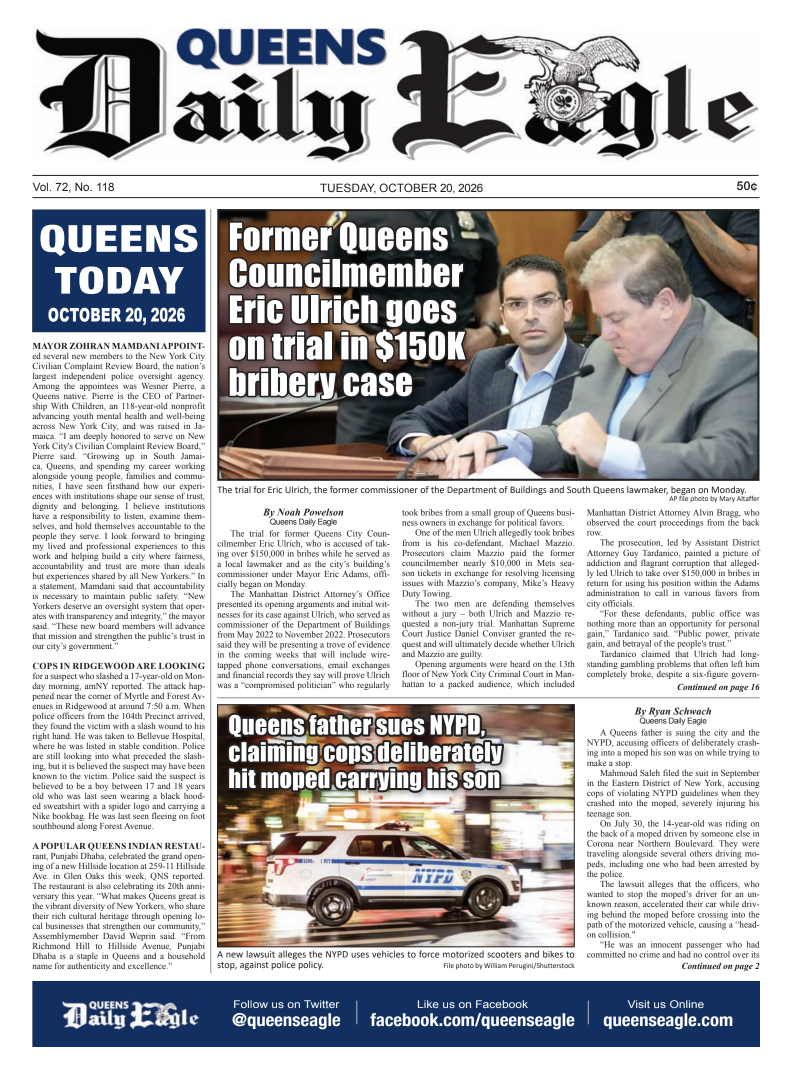
Campaign cash has begun to flow with a little more than three weeks left before New Yorkers head to the polls to cast their votes in primary races for mayor, comptroller, public advocate, City Council and a slate of judicial positions. Eagle file photo by Ryan schwach
By Jacob Kaye
Campaign cash has begun to flow with a little more than three weeks left before New Yorkers head to the polls to cast their votes in primary races for mayor, comptroller, public advocate, City Council and a slate of judicial positions.
Last week, candidates’ fundraising and spending was unveiled in the latest filings with the Campaign Finance Board. Later in the week, the board doled out matching funds, putting an additional $10,955,500 into races throughout the five boroughs.
In Queens, 12 candidates were given matching funds, including the two candidates who, until Friday, had yet to be awarded the coveted cash.
In all, Queens candidates picked up a combined $399,300 in matching funds on Friday, a cash infusion that will only add to the campaign spending that has spiked in recent weeks.
Between the five Democratic primary races in the World’s Borough this election cycle, candidates spent a combined $824,017 on their respective campaigns in the past two months, the latest filings with the city’s Campaign Finance Board show.
Many Queens Council candidates did most of their spending in the latest filing period, which ran from March 14 through May 19 – all but one of the 16 Council candidates in Queens did at least half of their spending thus far in the campaign in the last two months.
The spending likely won’t slow down – the primary will be held on June 24, three weeks from Tuesday.
The bulk of the spending in Queens over the past two months has come in the races for the only three open seats in the borough.
The race to replace City Councilmember Francisco Moya in District 21, which includes parts of Jackson Heights, East Elmhurst, Elmhurst and Corona, saw over $206,000 spent between four candidates over the past two months, records show.
District 28, which covers parts of Jamaica, South Ozone Park, South Jamaica, Springfield Gardens and Rochdale Village and which is currently represented by City Council Speaker Adrienne Adams, saw nearly $300,000 in candidate spending over the past two months, a high for the borough.
The three candidates running to replace City Councilmember Robert Holden in District 30, which includes parts of Maspeth, Middle Village, Glendale, Ridgewood, Elmhurst and Rego Park, spent nearly $175,000 in the past two months.
Here’s a breakdown of the financial picture in Queens as the final weeks for the race for office begin.
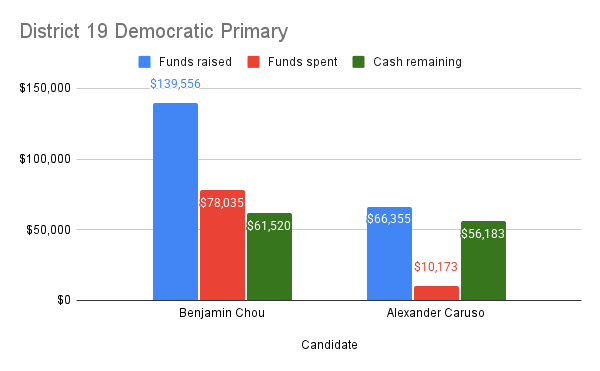
Data via Campaign Finance Board. Graph by Jacob Kaye
District 19
Two candidates are running for the chance to face off against Republican City Councilmember Vickie Paladino in District 19, which includes parts of College Point, Whitestone, Murray Hill, Flushing, Auburndale, Bayside and Douglaston. They include Democrats Alexander Caruso, who has been backed by the Working Families Party, and Benjamin Chou, a firefighter.
Chou has led the fundraising race and that didn’t change in the most recent cycle. Chou brought in $6,341, bringing his total haul, including public matching funds, to $139,556.
Though Caruso has gone most of the race without public matching funds, the Campaign Finance Board awarded him around $56,600 through the city’s eight-to-one matching program on Friday. The money could go a long way toward righting Caruso’s campaign.
In the most recent fundraising cycle, Caruso brought in $3,033 and saw his campaign nearly $500 in the red at the time the filing was due. His campaign account is now up to $56,183.
Chou has significantly outspent Caruso in the race, spending nearly $17 for every $1 Caruso has spent.
A bulk of the $78,000 spent by Chou in the race has gone to North Shore Strategies, a local campaign consultant firm popular among candidates running for office in Queens. In all, Chou paid the firm a little more than $53,000.
Chou was also awarded more public matching funds on Friday, getting $38,160 from the program.
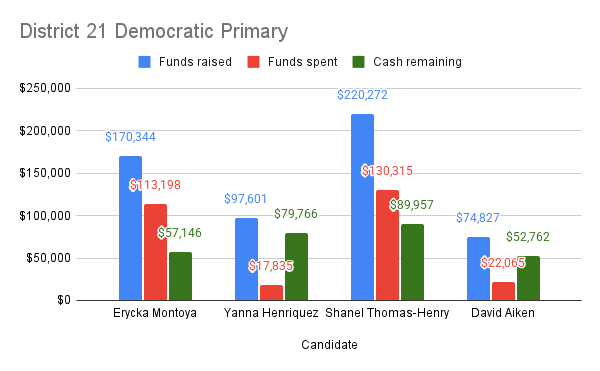
Data via Campaign Finance Board. Graph by Jacob Kaye
District 21
Spending has been high in the race to replace Moya in District 21.
In the most recent campaign finance period, Working Families Party-backed candidate Erycka Montoya has led the way in both fundraising and spending. Montoya, the most progressive candidate in the race, brought in $23,924 over the past two months and spent $90,240 in that same time period. She has around $57,000 left in her campaign account and picked up an additional $43,457 in matching funds on Friday, one of the largest hauls among all Council candidates in Queens.
Montoya has spent a vast majority of her funds on campaign consultants, including to North Shore Strategies, which she paid to run her ballot petitioning operation.
While Montoya has fundraised and spent big as of late, she’s not the top financial candidate in the race.
That distinction belongs to Shanel Thomas-Henry, a candidate for the seat who worked on the redevelopment of LaGuardia Airport. Thomas-Henry, who both the Queens County Democratic Party and the Working Families Party said should be ranked second on the ballot by their respective supporters, brought in $6,275 in the most recent cycle and spent $82,190. To date, Thomas-Henry has brought in $220,200 and spent over $130,000 in the race – and she has nearly $90,000 remaining in her bank. She got an additional $20,000 in matching funds late last week.
Thomas-Henry has spent big on consulting firms, including local firms Legion Outreach Consulting LLC and Culver Place Strategies. She’s also brought on a campaign manager with experience in the district, Tarik Coles, who recently helped Larinda Hooks get elected to the Assembly in a district overlapping District 21.
Yanna Henriquez, the Queens County Democratic Party’s pick for the seat, raised the second-most funds this past cycle, bringing in $9,045, adding to her $97,600 total. Despite the fundraising boost, Henriquez only spent $17,468 over the past two months, accounting for nearly every dollar she’s spent on the campaign thus far.
Her money has mostly gone towards her petitioning operation, which was conducted by a local consulting firm run by political strategist Hank Sheinkopf.
With the exception of two candidates who previously maxed out their matching funds, Henriquez was the only candidate in Queens not to be awarded new matching funds on Friday. According to the CFB, her filing featured too many errors.
David Aiken, the final candidate in the race, raised $6,510 over the past two months and spent over $16,000 in that same time frame. With $52,762 remaining in his campaign coffers, Aiken has the least amount of money of all candidates in the race.
A little less than a third of the cash he’s spent in the race has gone toward campaign literature while the rest went to either local consultant Dr. Darlene Williams, his campaign’s attorney or people who petitioned for his spot on the ballot.
Data via Campaign Finance Board. Graph by Jacob Kaye
District 25
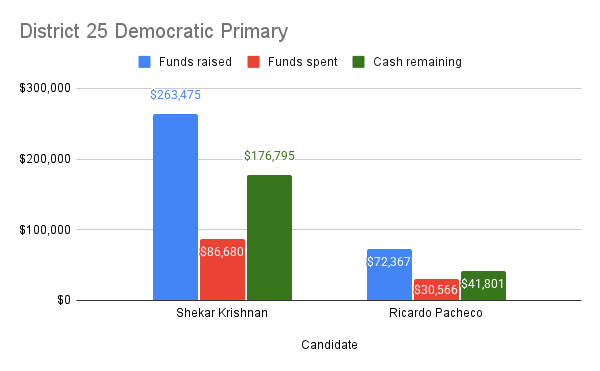
City Councilmember Shekar Krishnan is facing a challenge from perennial candidate Ricardo Pacheco in the Democratic primary race in District 25, which includes parts of Jackson Heights, Elmhurst, East Elmhurst and Woodside.
Despite the natural advantages incumbents typically have, Krishnan has also poured some cash into his campaign. Krishnan, who raised $1,805 in the most recent cycle, spent nearly twice as much as Pacheco over the past two months – Krishnan has spent over $44,000 while Pacheco spent a little less than $24,000.
Krishnan’s biggest expenses have been to his law firm, Cozen O’Connor, and to his campaign consultant, Trip Yang, a Queens political strategist.
Even if Pacheco, who brought in only $648 in the past two months, were to up his spending, he’d still be at a major disadvantage. Krishnan has over $176,000 in his campaign account heading into the final month of the race, while Pacheco has around $42,000.
On Friday, Pacheco was awarded $3,154 in public funds. Krishan, who has been awarded over $192,000 in matching funds this campaign, has maxed out his use of the program.
Data via Campaign Finance Board. Graph by Jacob Kaye
District 28
More cash was spent in District 28 over the past two months than in any other district.
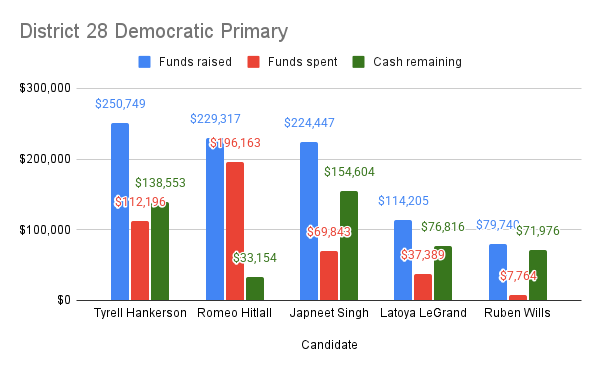
The race boasts three candidates who have brought in over $200,000 to date.
Recent spending in the race was driven by Tyrell Hankerson, City Council Speaker Adrienne Adams’ district chief of staff running with the backing of the Queens County Democratic Party and a number of local elected officials, including his boss; and Romeo Hitlall, a business owner whose active in the district’s local civic community.
Hankerson, who brought in $10,282 this cycle, spent $81,290 in the past two months. Hitlall, who brought in $2,298, spent $145,369.
A bulk of Hankerson’s cash has gone toward Clivenson Denasty, a campaign consultant who previously worked for State Senator Leroy Comrie. Hankerson’s campaign has paid Denasty over $10,000 this year.
Hankerson has also retained local campaign consultant firm Connective Strategies LLC and Dynamic SRG, which has worked on behalf of Queens County Democratic Party chair Rep. Gregory Meeks.
Hitlall has spent over $132,000 on work done for his campaign by Threshold Group, Inc, a Manhattan-based political consultant firm. Over 67 percent of all the money spent on Hitlall’s campaign has gone to Threshold.
The spending has depleted much of Hitlall’s campaign account, bringing his balance down to $33,000. Hankerson has around $138,000 remaining.
Hitlall got somewhat of a boost on Friday though, getting $17,746 from the CFB. Hankerson also got additional cash, bringing in $5,834 in matching funds.
Japneet Singh, a local advocate also running for the seat, spent nearly $40,000 this cycle despite bringing in only $25 – overall, Singh has brought in over $224,000 and has maxed out his use of the matching funds program.
Singh’s biggest expenses have been his attorney, Paul D. Newell, and consultants.
Latoya LeGrand, who works for Assemblymember Vivian Cook, spent around $27,000 over the past two months, and brought in $5,830 in that same time frame.
She’s spent a bulk of her money on campaign literature and fundraisers.
LeGrand was awarded an additional $14,858 by the CFB on Friday, leaving her with around $76,800.
Ruben Wills, who formerly represented the district but was convicted of – then later cleared of – corruption charges, spent around $7,700 in the most recent reporting period. Wills, who has raised only $11,300 in the race, unlocked matching funds for the first time on Friday, being awarded $68,400, the largest haul of the day among all Queens candidates.
He likely will have to spend it fast. Wills’ only major expense thus far on the race has been on his campaign website.
Data via Campaign Finance Board. Graph by Jacob Kaye
District 30
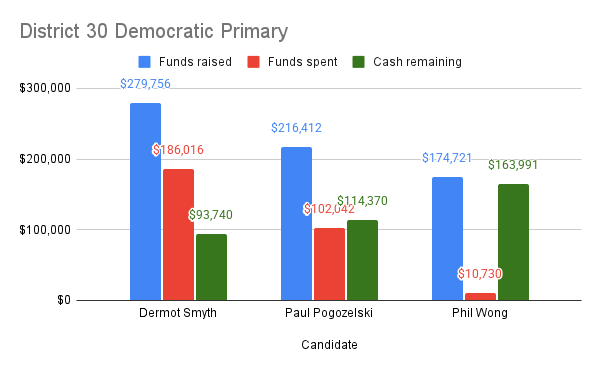
The race to replace Conservative City Councilmember Robert Holden in District 30 has seen nearly $175,000 spent in campaign cash in the past two months.
Dermot Smyth, a longtime United Federation of Teachers’ organizer who has been backed by the Queens County Democrats, led the way with over $104,000 spent in the most recent financial period.
Smyth has spent over $70,000 on the work of Threshold Group. His second biggest expense has been his campaign manager, Alyssa Verrelli, who previously worked on a congressional campaign for a candidate running in California.
Paul Pogozelski, the owner of a local roller hockey league, spent around $60,900 in the most recent filing period.
His biggest expenses have been on campaign mailers and fundraisers.
Phil Wong, who works for and has been endorsed by Holden, spent $9,105. His biggest expense thus far in the campaign has been a $3,888 bill at Ocean Bay, a seafood restaurant in Elmhurst where he hosted a fundraiser.
While Wong spent the least, he has some cash to burn in the final weeks of the campaign. Wong has $163,000 remaining in the bank, while Pogozelski has around $114,000 and Smyth has $93,000.
Smyth picked up $35,559 additional matching funds last week, while Pogozelski was awarded $46,208 and Wong was given $10,336.