As public defender strike looms, appellate attorneys are demanding a higher wage
/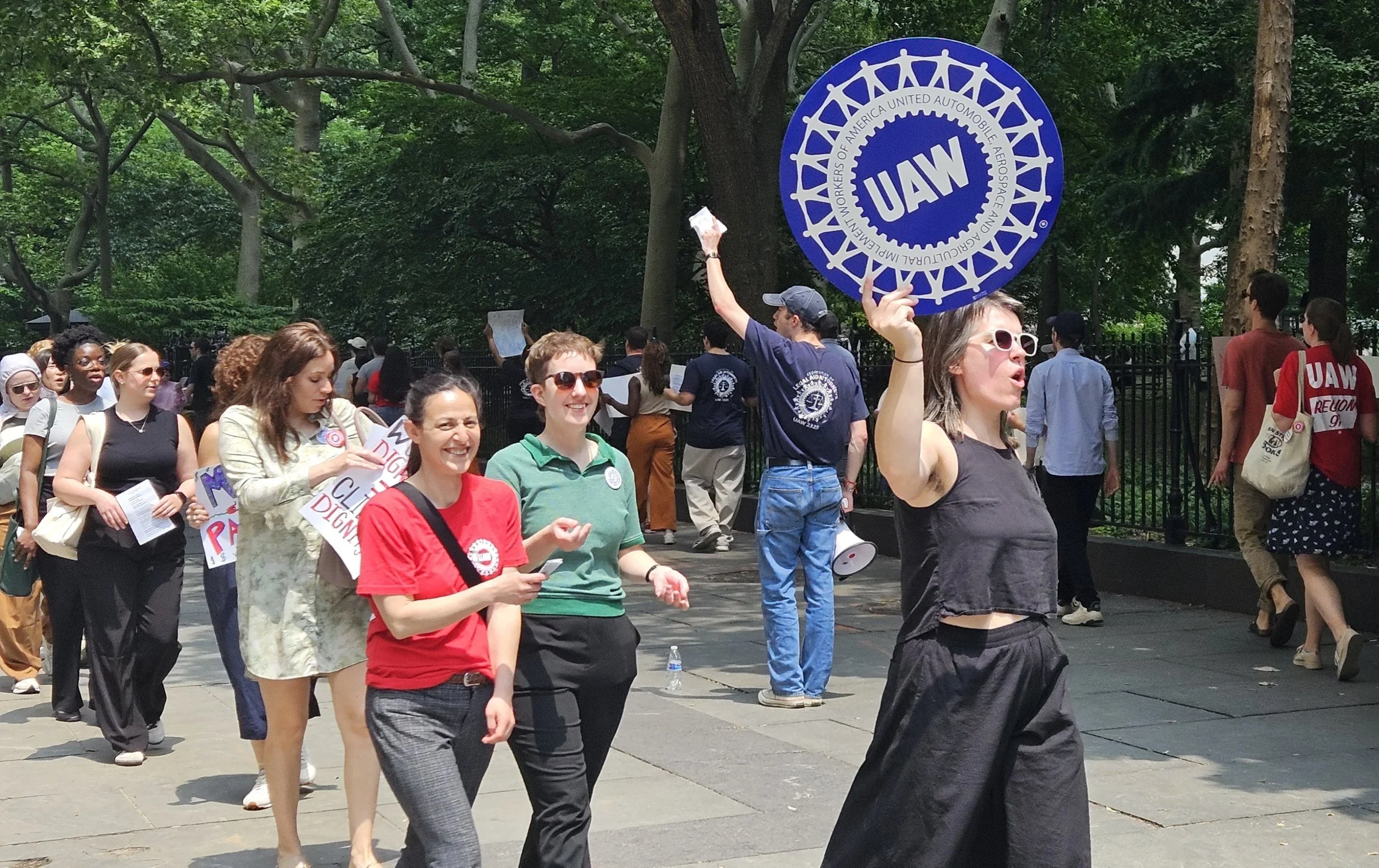
Attorneys and staff at appellate legal services organizations rallied outside City Hall, demanding the Mayor’s Office of Criminal Justice and the Office of Management and Budget raise the wage floor for all appellate service providers. Eagle Photo by Noah Powelson
By Noah Powelson
Appellate service providers rallied outside City Hall on Wednesday demanding the city fund their office and bring a wage increase for attorneys as a mass strike of public defenders threatens to throw the court system into disarray.
Organized by the Association of Legal Advocates and Attorneys, the city’s largest public defender union, nearly 60 appellate public defenders marched outside City Hall calling on the Mayor’s Office of Criminal Justice to increase funding to their offices. Chief among their demands is MOCJ and the Office of Management and Budget raise the wage floor for all appellate service providers.
According to ALAA organizers, some appellate service providers are making under $50,000 a year, which they said is just not a living wage while attorneys face burgeoning caseloads. Appellate organization representatives say they recieved a variety of counter officers, including freeze on the pay scale or a 3 percent increase, which organizers say is nowhere near enough to meet their demands.
If wages aren’t increased, the organizers said, the city could face reduced services for appellate clients.
“Work will continue to be undone, clients’ needs aren’t going to be met and court appearances will continue to be delayed, or clients just won’t be getting the representation they need,” ALAA Leave of Absence Organizer Estefania Rodriguez told the Eagle. “If the city wants to avoid being in that situation, wants to show they care about clients, especially in the political moment that we’re in…then they should be increasing funding so that we can get the contracts we deserve.”
Attorneys and staff from appellate service organizations, Center for Appellate Litigation, Appellate Advocates and Office of the Appellate Defender appeared at the rally, alongside ALAA organizers.
ALAA, which represents over 3,400 public defenders, are currently in the midst of contract bargaining with the Legal Aid Society.
Contracts for nearly two dozen legal services providers that ALAA represents throughout the New York City metropolitan area are set to expire on June 30. The alignment of contract negotiations is by design – the union encouraged their chapters in recent years to negotiate labor agreements that expire in 2025 as a way to boost their negotiating power this year.
Appellate service providers work with individuals who have already been convicted of a crime and are incarcerated, helping them appeal their cases or find other services. Appellate service providers face rising caseloads in particular, because the process to resolve cases can take years.
“It’s always increasing, it builds up,” Senior Staff Attorney at the Office of the Appellate Defender Sam Steinbock-Pratt said. “When you get assigned a case you don’t just close it out and it’s done. That takes up an enormous amount of time where they are being denied medical care or being abused by correctional officers.”
Unlike other public defenders in Criminal or Civil Court, appellate public defenders don’t see the end of a case once it reaches disposition. If their client needs medical care, or faces deportation because of their immigration status, appellate public defenders advocate on their behalf.
“I’ve had clients who were denied surgery, I’ve had clients who were beaten by guards, that’s also part of my job is making sure they can get help,” Steinbock-Pratt said. “So even when a case is closed officially…we’re still working on it to make sure our clients are getting what they need.”
Steinbock-Pratt said that he isn’t worried about staff not taking more clients or cutting off clients because of high workloads, but he is concerned lack of pay will leave attorneys with no other option but to leave.
“What I am worried about is that they might say ‘I need to work in an office that actually allows me to live in this city,’ and so they leave and do other work in this sector and public interest,” Steinbock-Pratt said. “As that happens, we not only lose the ability to actually handle these cases and give clients the help they need, but we also lose the institutional knowledge.”
“So much of the work is really specific…and when we lose that institutional knowledge, we lose the ability to advocate as best we can,” Steinbock-Pratt added.
Steinbock-Pratt said these appellate offices already lost a lot of that institutional knowledge when the COVID-19 pandemic drove many attorneys out of the city or into private practice. They’ve replenished much of their lost numbers over the years, but the rising cost of living in the city and rising caseload has slowed recruitment.
“If we don’t get the funding we need to actually keep people on and hire more, that [knowledge] is going to go away and the situation is just going to get worse,” Steinbock-Pratt said.
ALAA organizers said the threat of strike is very serious, and they will be holding frequent rallies and events leading up to the June 30 deadline.
“We are really hoping that management meets our demands in order to avoid a potential strike,” Rodriguez told the Eagle. “I think we’ve definitely made it clear to management through this action and other actions that we are willing to escalate as much as necessary. Whether they understand the gravity of that is still to be determined.”
The Office of Appellate Defenders and Center for Appellate Litigation did not respond to a request for comment. Appellate Advocates declined to comment.
Attorneys working at organizations including the New York Legal Assistance Group, Bronx Defenders, Center for Appellate Litigation, Appellate Advocates, Office of Appellate Defenders, RiseBoro, Goddard Riverside Law Project, Urban Justice Center and CAMBA Legal Services are all currently negotiating their contract with their employer.
In Mayor Eric Adam’s Executive Plan released on May 1, an additional $20 million was allocated to City’s public defenders, including $7.5 million for appellate providers, starting in fiscal year 2026.
At a City Council budget hearing on May 29, ALAA representatives told City Council Finance Committee chair Justin Brannan the city needs to invest at least $74 million into the Legal Aid Society to meet their demands.
“If negotiations do not improve in the next month, we are prepared to withhold our labor and interrupt essential city services to win a fair contract,” Jane Fox, ALAA’s Legal Aid Society chapter chair, said at the time. “You have the power to value your own communities by investing in us.”
At the rally outside City Hall on Wednesday, appellate attorneys, public advocates and paralegals said no one gets into this line of work looking to make a fortune, but because of its importance. Appellate attorneys are often the last line of legal defense for indigent clients who face false convictions, overly harsh sentences or deportations. A lack of pay increase, organizers said, undervalue not just the attorneys but the vulnerable clients they serve.
“I’m sick and tired of hearing that there is only way to thrive in the city, which is going to corporate or not being able to do the work that we want to do,” Aidan Auel, a Client Advocate at the Center for Appellate Litigation, said to cheers from the gathered legal workers.
CORRECTION: A previous version of this article stated that the $7.5 million increase in funding for appellate providers was not included in the mayor’s original budget plan unveiled in January. That $7.5 million was included in the mayor’s budget plan in May and the article was updated to reflect that.