Lawmakers call for the end of ‘predatory’ court fees
/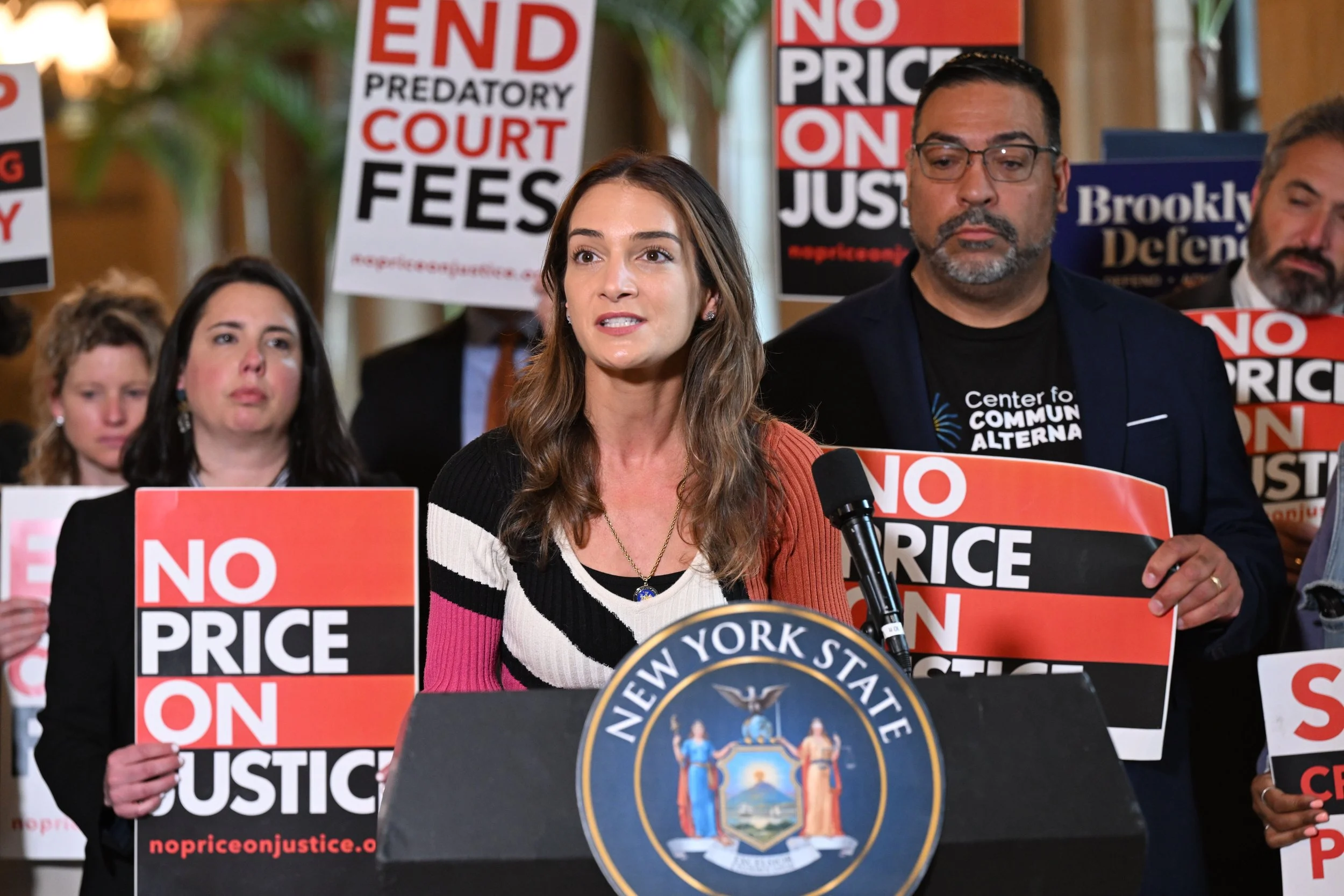
State Senator Julia Salazar at the New York State Capitol called on support for the End Predatory Court Fees Act. Photo via the Center for Community Alternatives
By Noah Powelson
State lawmakers and legal advocates rallied in Albany on Tuesday for a new bill that would eliminate a host of administrative fees associated with criminal court proceedings.
Inside the state house this week, State Senator Julia Salazar called on her fellow lawmakers to pass the End Predatory Court Fees Act, a bill she’s sponsoring along with Assemblymember Karines Reyes. The bill would eliminate fees and surcharges for violating penal, vehicle and traffic laws, which advocates say burden struggling families with hundreds of dollars of debt.
These fees, the bills’ sponsors argue, also disproportionately affect people of color and feed into a cycle of incarceration for low-income families and communities in New York. Fees the bill seeks to remove include mandatory court surcharges, DNA databank fees, crime victim assistance fees, probation fees and sex offender registration fees.
The bill would also eliminate all mandatory minimum fines under the penal law and the vehicle and traffic law, as well as ban the practice of incarcerating those who haven’t paid court fines and fees.
Proponents of the bill say these fees force New Yorkers struggling with poverty and their families to choose between potential jail time or cutting back on their household expenses. In New York, a person convicted of a felony is charged a mandatory surcharge of $300, those convicted of misdemeanors pay $175 and those who commit violations are required to pay $95.
Citing a survey from the Fines and Fees Justice Center, 61 percent of people who faced court-imposed debts reported experiencing at least one essential hardship, such as food, housing or health care.
“In New York, three out of five people don’t earn a living wage. So, when the system demands your fines and fees, it devastates families,” Peggy Herrera, a member of the Center for Community Alternatives, said during the rally.
Herrera said spent nearly five years paying off thousands of dollars of court debt and that further plummeted herself and her family into financial hardships.
In 2019, Herrera called 911 seeking help for her son while he was having a panic attack. But instead of help, Herrera found police officers at her door telling her they were going to take her son into custody. Herrera said she was arrested that night too.
“My son never got the help he needed, and I spent the night in jail.” Herrera said.
But that one bad night turned into a financial burden that would plague her and her family for years. Between her own court fees and debts her son had accumulated from other offenses, Herrera was stuck with over $12,000.
To pay it off, Herrera said she spent years scrounging money during the COVID-19 pandemic taking extra jobs, maxed out her credit cards and sought donations at churches. Even when she paid off her debt, Herrera said the cost put an immense burden on her family and they are more vulnerable now than ever.
Herrera’s story is just one example of the “predatory” court fees advocates say need to end.
“As a public defender, I have seen firsthand how mandatory court fines and fees trap New Yorkers in a cycle of economic instability and further criminalization and incarceration,” Jackie Gosdigian, the supervising policy counsel with Brooklyn Defenders’ Criminal Defense Practice, said. “As costs of living continue to rise, court debt forces people to choose between paying for basic necessities, like housing and groceries, or risk incarceration over failure to pay debt. Lawmakers can put an end to this unnecessary punishment by passing the End Predatory Court Fees this session.”
Mandatory surcharges were first implemented in the 1980s as a way to raise state revenue, but supporters argue these fees are not reliable. The Center for Community Alternatives said that collection rates for court fees range anywhere between 28 percent and 56 percent depending on where you live in the state, and that the state loses money pursuing these debts.
“New York imposes millions of dollars per year in fees on criminal defendants who can least afford to pay. This regressive tax punishes poverty, encourages policing for profit, and funds government services on the backs of Black and Brown New Yorkers,” Zachary Ahmad, the senior policy counsel at the New York Civil Liberties Union, said. “Government revenue should not be extracted from New York’s poorest residents, and our courts must not function as debt collectors.”
2025 marks the third legislative session the End Predatory Court Fees Act has been introduced. The bill has never made it out of committee. The bill, which currently sits in the Senate Codes Committee, has received a strong showing of support this session with 22 state senators signing on as co-sponsors, including Queens State Senator Leroy Comrie.
“The Senate held a hearing on this legislation and 100 percent of the testimony was in support,” Salazar said. “It is unbelievable that we continue to burden low-income New Yorkers with these fines and fees. They are essentially a regressive tax. It’s more important than ever that we finally pass the End Predatory Court Fees Act.”