Advocates call for fully funded RTC as city prepares for new leadership
/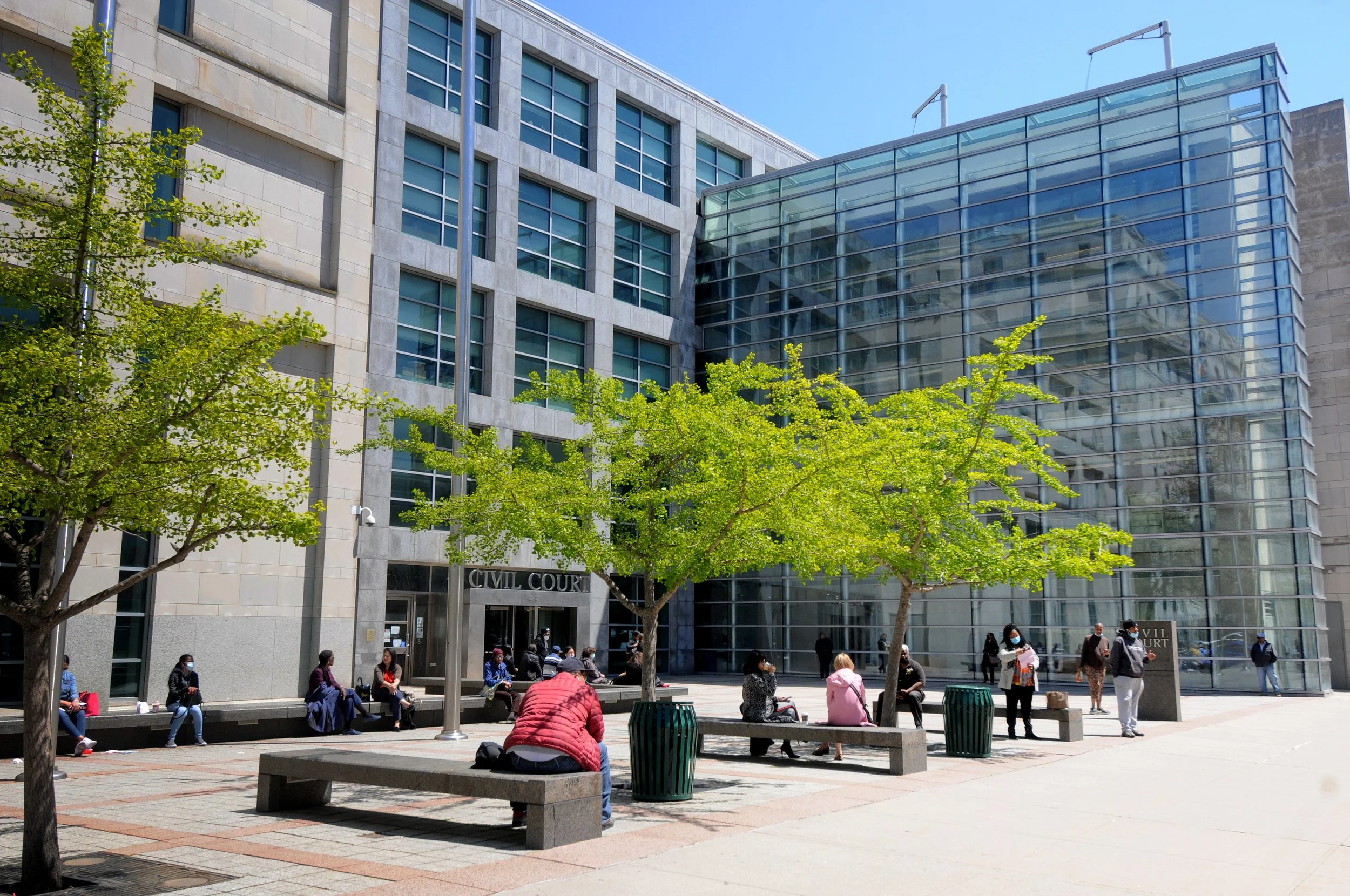
The Mayor’s Office of Civil Justice held a public hearing on the current city’s Right to Counsel program. Eagle file photo by Walter Karling
By Noah Powelson
As a new mayor and new City Council speaker are set to soon take office, legal and housing advocates are making the push to get the city to fully fund its long-struggling Right to Counsel program.
The Mayor’s Office of Civil Justice held a public hearing earlier this month on the city’s RTC program, which entitles every qualified New Yorker to free and full legal representation if they are facing eviction. The first-in-the-nation program has struggled to fulfill that promise since first being enacted in 2017, largely due to budget constraints.
At the public hearing on Tuesday, Dec. 9, legal providers, tenant rights organizers and city bar associations called on the mayor’s office to fully fund the RTC program.
According to the Right to Counsel NYC Coalition, over 110,000 households have faced eviction proceedings without legal assistance since 2022, even though the majority of them were eligible for RTC.
“When properly implemented, RTC prevents eviction, keeps families housed, and strengthens communities,” the Right to Counsel NYC Coalition said in a statement. “But today, [OCJ] the city agency charged with enforcing RTC, is falling short of its mandate. The Right to Counsel is only powerful at keeping tenants housed if it is upheld.”
The Right to Counsel NYC Coalition called on the city to increase RTC funding by $350 million, and to include a mechanism that adjusts funding depending on the volume of cases RTC is facing.
Their call for further funding was echoed by the New York City Bar Association, which said RTC had proven to be a successful program even without being fully funded.
“RTC preserves affordable housing, stabilizes low-income communities, stems displacement,
promotes family stability, and reduces the incidence of homelessness among low-income New
Yorkers together with concomitant human and governmental costs,” NYCBA said in their submitted testimony. “RTC is transforming the culture in Housing Court, to a more balanced forum with greater civility and deeper attention to legal rights and principles.”
RTC’s future will largely be determined by Mayor-elect Zohran Mamdani and the future City Council speaker, who is largely expected to be Councilmember Julie Menin. The two will lead their respective branches of government during budget negotiations during the first half of the year.
Neither Mamdani’s transition team nor Menin’s office responded to inquiries for this story.
The calls from various legal organizations come after several investigations and reports showed RTC is the most overwhelmed with demand and desperate for funds since the program first started.
A report released from the city comptroller’s office in May showed that, despite eligibility for the program more than doubling since 2022, funding for the RTC program only grew by 33 percent and that RTC representation rates have dropped significantly as a result.
The report found that RTC representation rates dropped from 71 percent in 2021 to 42 percent in 2024 across all five boroughs, meaning only four out of 10 New Yorkers facing eviction had legal representation. Neighborhoods with higher rates of low-income Black and Latino residents also had the highest rates of eviction filings, eviction execution and lack of legal representation in Housing Court.
Queens also saw a significant drop in representation, going from 81 percent in 2021 to 46 percent in 2024.
The city’s Independent Budget’s Office also released a report in September that found that while RTC eligibility increased by 222 percent from 2019 to 2024, RTC spending only increased by 129 percent.
A major part of ensuring RTC remains fully operational is securing legal service providers to take on the growing number of clients. But providers at the hearing, which include The Legal Aid Society, New York Legal Assistance Group and Bronx Defenders, said they are struggling to recruit attorneys and maintain their current staff levels, and therefore can’t keep up with the growing demand.
The current RTC contract terms, the legal providers said, are one of the major roadblocks to recruiting new attorneys.
According to testimony provided by a coalition of legal service providers at the hearing, the current cost-per-case for the average provider is at least $7,500 per case. In their joint testimony, legal providers called on the city to fund RTC contracts to allow for a $7,500 case rate for providers as well as imposing a 10 percent penalty when providers fail to meet contract goals.
The providers argued more funding is needed as recently passed tenant protection laws, like the Good Cause Eviction Law of 2024, has further complicated eviction proceedings and increased the time it takes to reach a disposition.
“While on paper the program funds approximately 33,000 cases a year, the actual number of cases handled is much lower because of the increased cost of providing services,” their testimony read. “Important laws have strengthened tenant protections but, at the same time, significantly increased the length and complexity of eviction defense.”
“The underfunding hampers our ability to solve the totality of our clients’ housing problems and will lead to tenants being sued in Housing Court year after year,” they added.