
Something ‘needs to be done’ about sentencing reform, NY’s top judge says
/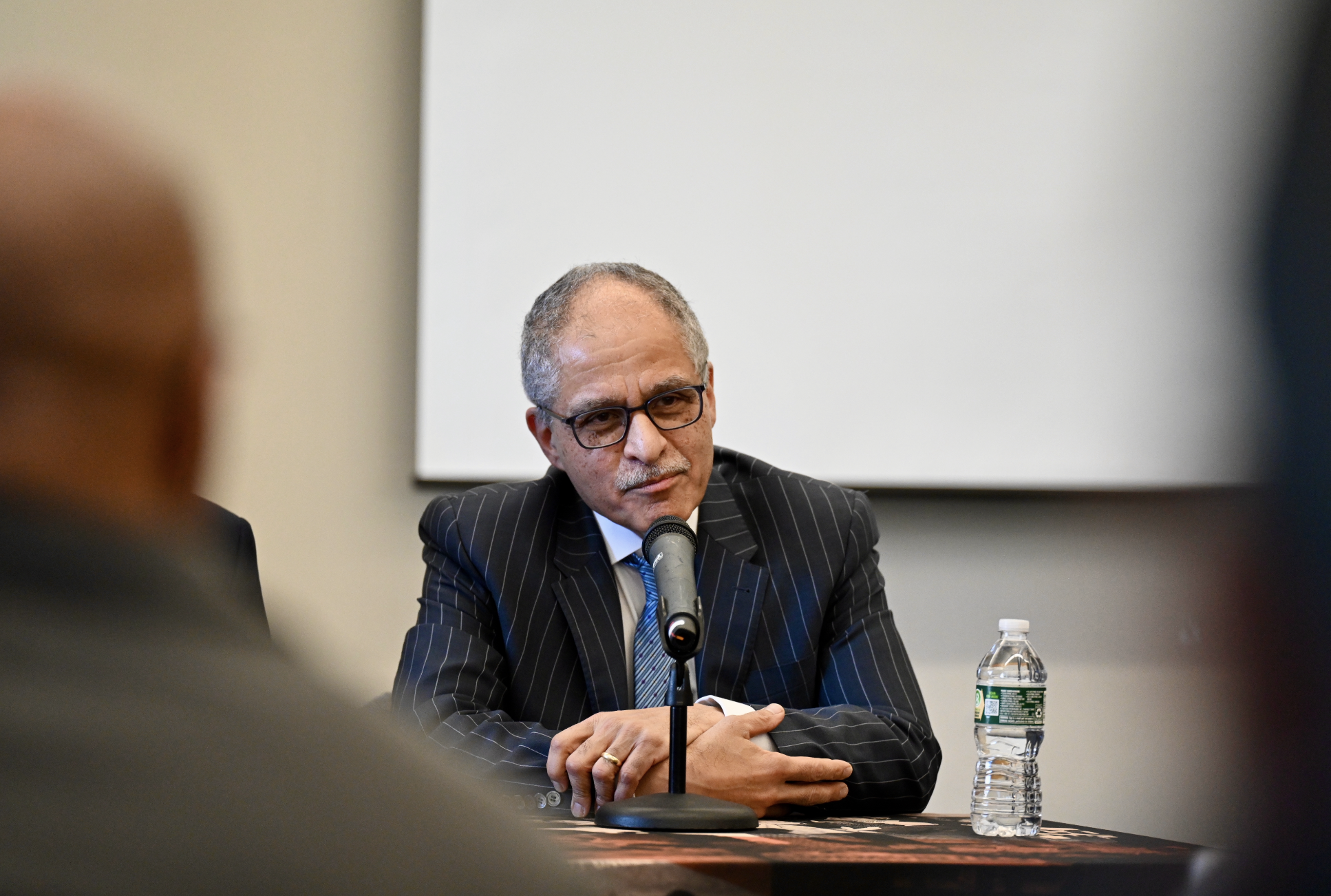
Chief Judge Rowan Wilson called on the governor and elected officials to throw their support behind the Second Look Act in the upcoming legislative session. Photo courtesy of The Bronx Defenders/Eliza Colón
By Noah Powelson
New York’s top judge said that now is the time for comprehensive sentencing reform and that he is making it his goal to push for the passage of a piece of legislation that aims to do as much.
At a public symposium in Yonkers on Dec. 3, Chief Judge Rowan Wilson joined lawmakers, attorneys, prison reform advocates and formerly incarcerated New Yorkers to call on the legislature to pass the Second Look Act this coming legislative session. The bill, which Wilson has advocated for since he assumed the role of chief judge, would create a process for incarcerated persons sentenced to 10 or more years in prison to request a resentencing hearing.
Originally sponsored by Queens and Brooklyn State Senator Julia Salazar, the Second Look Act was first introduced to the state legislature in 2021 but has struggled to make its way out of committee in the years since.
At the symposium earlier this month, Wilson called not just on elected officials to throw their support behind the bill in the upcoming legislative session, but encouraged all New Yorkers to also advocate for sentencing reform. Wilson stressed that criminal justice reform was a long held and deeply personal value for him growing up in the 60s and 70s, and said bills like the Second Look Act can’t make progress unless there is strong organization and advocacy.
“This has mattered to me in some form or another since the 10th grade,” Wilson said. “Everybody here can do something and needs to do something.”
Since becoming chief judge, Wilson has encouraged other judges to think of themselves as problem solvers and not just adjudicators. In that same vein, he encouraged judges and elected officials to look at prison sentences as not just criminal punishments, but predictions of the future.
When judges of the past sentenced convicted New Yorkers to 25 years to life or longer, Wilson said that the judge was making a prediction about whether or not the convicted person will commit harm again. The chief judge was careful not to criticize the sentencing decisions of past judges and said that every sentence is made based on the facts of the case. But Wilson also said the facts of today, including how incarcerated people have changed while serving their sentence, should also be considered.
“There is a whole different set of facts now,” Wilson said. “Should we ignore those facts and rely just on the prediction somebody made a long time ago based on a different set of facts? Or instead, should we look at the facts as they are now? Judges are pretty good at looking at the facts as they are now.”
Jane Fox, the chapter chair of the Legal Aid Society Attorneys United, UAW 2325, said during the symposium that creating pathways for incarcerated people to return home would keep families secure and local economies stable.
“Safety and justice can go hand in hand,” Fox said. “They can by addressing the affordability crisis in this state, by addressing the economic crisis in this state, by bringing people home to reunite with their families so that they can contribute to the economy of New York State. Because when one person is incarcerated, it's not just affecting that one person, it's their entire family, and it’s the entire economy of that family.”
While the Second Look Act has struggled to gain traction, support for it has accumulated over the years and increased significantly this past year when a multitude of crises inside New York’s prisons came to a head.
When the bill was first introduced in 2021, it had 15 senate co-sponsors and 35 assembly co-sponsors. In the most recent session, 31 senate co-sponsors and 60 assembly co-sponsors backed the bill.
Among those recent co-sponsors is Yonkers’ State Senator Shelley Mayer, who said she was convinced of the value of the Second Look Act after consistent advocacy from her constituents.
“There are so many people who would benefit simply by having the opportunity to have a judge determine that their sentence was too long and revisit the sentence,” Mayer said. “I want to thank all of you who came to my office…to see me and push me, because that’s what we’re going to have to do.”
Queens legislators who signed on as co-sponsors include State Senators Jessica Ramos, Leroy Comrie, Kristen Gonzalez, John Liu, Toby Ann Stavisky, as well as Assemblymembers Catalina Cruz, David Weprin, Steven Raga and Claire Valdez.
Mayor-elect Zohran Mamdani also signed on as a co-sponsor during his tenure as an assemblymember.
Wilson has devoted significant time and advocacy to sentencing reform, making statements that are unprecedented for the state’s top judge to make.
In February, Wilson spent the entirety of his third State of the Judiciary to make his case for why legislation like the Second Look Act is needed to address systemic injustices in the state’s incarceration rates.
“Our criminal justice system isn’t working,” Wilson said in February. “Maybe it hasn’t really ever worked.”
To highlight his point, Wilson invited Christopher Martinez, who was convicted for second-degree murder when he was 17 years old and sentenced to 65-years-to-life, to share his story before New York’s top judges. While in prison, Martinez became the first in his family to receive a bachelor’s degree, and said education gave himself and his family the first feelings of hope that he wasn’t destined for a life behind bars.
“Mr. Martinez surely did something very wrong but that isn’t the question before us,” Wilson said at the time. “The question is whether the judge who sentenced Mr. Martinez might have been wrong when he decided the actions of a 17-year-old required a sentence rendering Mr. Martinez ineligible for release until he is 82 years old.”
At the symposium earlier this month, Wilson again shared the stage with formerly incarcerated people advocating for sentencing reform.
Wilson said at the symposium the best way to shift people’s perceptions on sentencing laws was to invite legislators and judges to meet with incarcerated persons in prisons. He said he had invited the assemblymember and state senator who represent the district that the Greenhaven Correctional Facility is located in to come to meet with incarcerated persons in hopes of getting their support.
“When I go to prisons and I meet incarcerated people, they aren’t any different,” Wilson said. “Anybody who met with them and sat and talked for 15 minutes, and scratched their head and said, ‘I know why we have prisons, but I don’t understand why this person is in prison.’ That’s why this matters.”