Advocates demand governor sign prison reforms into law
/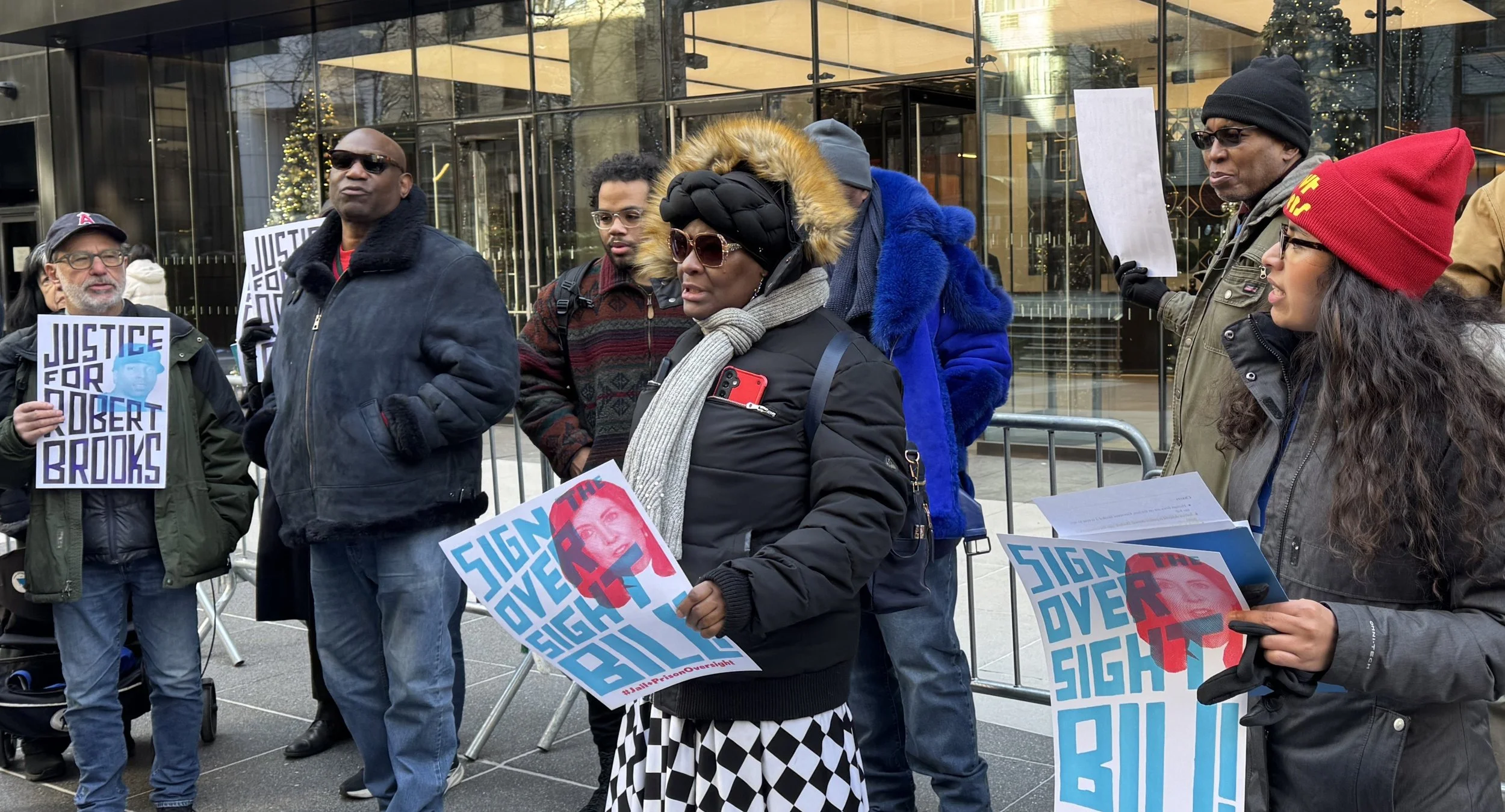
Ziyadah AmatulMatin (center) voices her support for the Prison Reform Omnibus Bill outside Governor Kathy Hochul’s New York City office while members of the Katal Center watch on. Photo Courtesy of the Katal Center
By Noah Powelson
Advocates on Tuesday demanded the governor sign a package of bills meant to reform the state’s troubled prisons, a year after the killing of Robert Brooks put a spotlight on the worsening conditions behind bars.
Elected officials and prison reform advocates rallied outside Governor Kathy Hochul’s New York City office in Midtown Manhattan on the one-year anniversary of Brooks’ killing by prison guards in Marcy Correctional Facility. Rallygoers demanded the governor sign the Prison Reform Omnibus Bill, which was crafted, in part, as a response to Brooks’ murder and which was delivered to Hochul’s desk on Monday.
Outside the governor’s office on Third Avenue, several formerly incarcerated people endured the cold to say how the reforms laid out in the bills would establish desperately needed transparency and accountability requirements in New York’s state prisons.
One such rallygoer was Ziyadah AmatulMatin, who said her brother died while incarcerated and fears her recently incarcerated son will face the same fate. AmatulMatin said her son was beaten by correctional officers last February and has been denied proper medical care, and that the reforms introduced in the reform package would prevent her son from receiving further harm.
“My brother, Ramadan Mubarak Ibn Abdul-Mateen, died at Wende Correctional Facility after being denied the medical care he urgently needed and enduring abuse from correctional officers,” AmatulMatin said in a statement. “If he’d received proper care, he would still be alive. As we mourn him, I fear for my incarcerated son’s safety, who is facing the same starvation, medical neglect, and violence… I call on Governor Kathy Hochul, from one mother to another, to sign the jail and prison oversight omnibus bill.”
The Prison Reform Omnibus Bill was introduced by Queens and Brooklyn State Senator Julia Salazar and Assemblymember Erik Dilan, and was quickly passed through the state legislature this year. The bill was introduced as an immediate response to the deaths of Brooks and Messiah Nantwi, who were both killed inside state correctional facilities in 2025.
The bill would institute a number of new transparency, accountability and regulatory guidelines for reporting the deaths of incarcerated people. It would require 24/7 video surveillance of common areas in correctional facilities, timely notifying of the death of inmates to their families, as well as publishing notices of inmates’ deaths to the Department of Corrections and Community Supervision’s website within 24 hours.
The bill would also expand the State Commission of Correction and the Correctional Association of New York, two prison oversight agencies. SCOC would receive a larger board and new investigation requirements under the bill, while CANY would receive more authority to conduct independent investigations of facilities and incarcerated people.
Hochul did not say whether she planned on signing the bill when it made it through both the state Assembly and Senate on the last day of the 2025 legislative session, and has not said what her plans are now that the bill has been delivered to her.
Hochul has 30 days from the day the bill was delivered to her to make a decision before it automatically passes into law.
The bill has received strong support from state and city elected officials, including the chair of the council’s Committee on Oversight and Investigations, Councilmember Gale Brewer.

Governor Kathy Hochul received the Prison Reform Omnibus Bill on Monday. AP Photo/Jeenah Moon
“New York’s jails and prisons are in crisis, and the horrific deaths of Robert Brooks and Messiah Nantwi make painfully clear what so many families, advocates, and directly impacted people have been saying for years: the State’s oversight system is failing, and lives are being lost as a result,” Brewer said in a statement. “[The Jail and Prison Oversight Omnibus Bill] is a comprehensive overhaul and will finally bring transparency, accountability, and independent oversight to facilities from Rikers to Marcy and Mid-State.”
Several Queens elected officials have also voiced their support for the reform package, including Assemblymembers David Weprin, Catalina Cruz and Salazar.
“For decades, New York’s state prisons have been plagued by a systemic pattern of racism, staff violence towards incarcerated individuals, and human rights abuses, with little to no accountability or oversight,” Salazar said in June when the bill made it out of the legislature. “This is progress, it will make a difference, and I’m proud to stand behind it.”
2025 was a year of crisis and controversy for New York State prisons as reports of abuse, neglect and murder of incarcerated people ignited a wave of outrage from elected officials and criminal justice reform advocates.
In February, a group of 14 officers were charged in the brutal beating and murder of 43-year-old Brooks, which was captured on body-worn camera footage. The killing took place on Dec. 9, 2024, and several of those guards have since pleaded guilty to manslaughter charges and were sentenced to various prison times.
Problems only continued after an illegal mass prison guard strike broke out just days before officers were charged with the murder of Brooks. The wildcat strike lasted from early January to March 10, during which seven people died while incarcerated.
One of those deaths was 22-year-old Nantwi, who was beaten on March 1 by correctional officers at the Mid-State Correctional Facility – directly down the road from Marcy Correctional Facility.
Elected officials and advocates in support of the Prison Reform Omnibus Bill said the lack of transparency on the treatment of incarcerated people has enabled violence to manifest in state prisons.
Public Advocate Jumaane Williams also appeared at the rally on Tuesday, and said the bill would bring safety and transparency to prisons and jails that are currently overrun with danger and a lack of accountability.
“Let us have transparency about what’s happening in those jails,” Williams said. “No one should be against transparency, unless you want people to still believe that Robert Brooks wasn’t murdered. That can be the only reason you don’t want to be transparent.”
The governor’s office did not respond to an inquiry for this story.