City plants funds into QueensWay after feds cut cash
/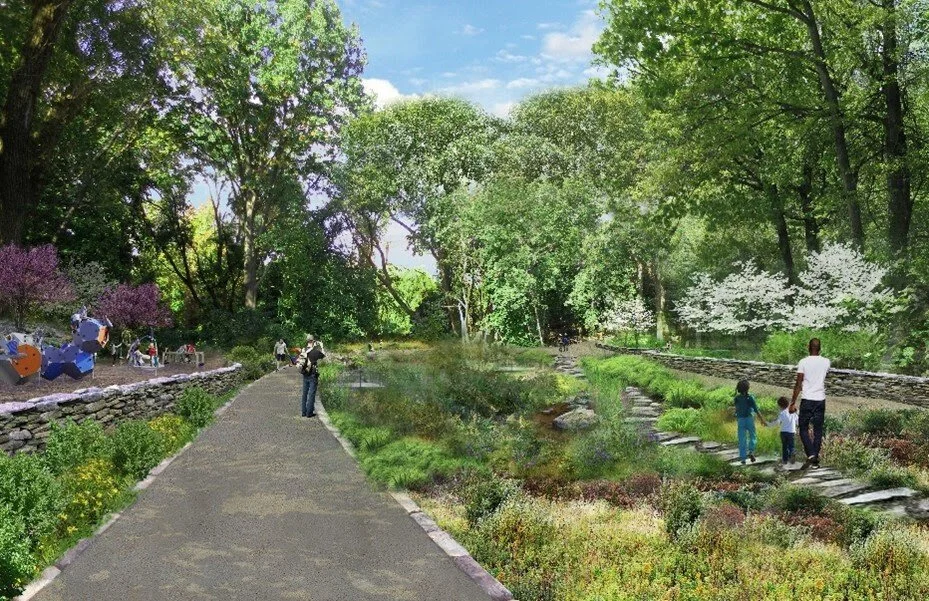
The city allocated $14 million for the QueensWay, which recently lost millions of dollars in federal cuts.Rendering via EDC
By Ryan Schwach
The city is trying to cover some of its losses on its plans to build the QueensWay, a High Line-like park planned for Central Queens, after the federal government snatched $117 million from the proposed linear park plan earlier this year.
As part of the Fiscal Year 26 September Capital Commitment Plan, the city announced $14 million would be allocated to help the QueensWay move forward with its first phase despite the loss of the federal grant funding.
The new city money fully funds the first phase of the park, allowing the project to move forward – for now.
This summer, through provisions in President Donald Trump’s “Big Beautiful Bill,” over $117 million in federal funding once allocated to the plan was clawed back by the feds.
The federal dollars were intended for the second phase of the QueensWay plan – a 3.5-mile greenway starting in Rego Park and ending in South Ozone Park.
Phase one of the plan centers around the Metropolitan Hub, which will include a 5-acre park with 0.3 miles of new shared greenway. The first phase was funded by the city in 2022, and is already well into its design process.
The new funds from the city assuaged fears from the park’s supporters that the disappearing federal dollars would spell doom for the plan, which served as one of the first major infrastructure projects pursued by Mayor Eric Adams.
“Friends of the QueensWay and local residents applaud the city’s funding and commitment to this transformative vision for Central Queens,” said Karen Imas from the Friends of QueensWay group and longtime Forest Hills resident. “We remain focused, working with the city, on delivering Phase One as a proof of concept that reflects local priorities. It’s vital we don’t lose sight of the long-term vision to create quality open space, economic opportunity, public art and recreational programming, and public safety for our neighborhoods through this greenway.”
The first segment of the plan is adjacent to Forest Park, and will include a greenway, pedestrian and cyclist paths, seating, a fitness area and various other amentieies, some of which were added to the plan after the city held a number of meetings with locals.
“We’re very happy to show what we've been able to incorporate so far in terms of the feedback that we heard,” said EDC Project Manager Angelina Espino at a meeting last December.
The preliminary design for the Metropolitan Hub, which locals saw renderings of in a meeting last December, includes a train track inspired theme calling back to the land’s past, and refreshed greenery in what is now an overgrown area.
The Metropolitan Hub is being constructed by the city’s Economic Development Corporation and will cost around $49 million.
“Mayor Adams remains committed to building more greenways throughout the five boroughs as we continue to work across city agencies and with local communities to identify underutilized land for the benefit of all New Yorkers,” a City Hall spokesperson said in a statement.
“Through the Adams administration’s recently approved capital commitments, we look forward to breaking ground on the first phase of QueensWay, transforming a vacant, city-owned corridor into a 5-acre high-quality park for the surrounding communities,” they added.
City Hall added that they are continuing to explore pathways for funding the second phase.
Local Councilmember Lynn Schulman said she is happy about the new funding, and also hopes that the new funds continue to come in.
“I'd like to see that move forward, and then we can go from there,” she told the Eagle. “There are a lot of issues in terms of cuts because of the federal government. I think things are very up in the air right now. I'm very glad about phase one, and I'm looking forward to us moving forward.”
“I know the Friends of the QueensWay are putting together a whole bunch of ideas around what that's going to look like, the design phase and everything else,” she added. “I'm looking forward to that, and then we'll see what's going on in the midterms. We'll see. It depends on a lot of things.”
As the QueensWay project chugs along, so too does the competing QueensLink, which proposes building a new train route on the abandoned train tracks the QueensWay is set to be built on top of.
In September, QueensLink supporters hired consulting company The Steer Group to conduct an economic study of the train route.
“Steer has incredible expertise in the mass transit world and has produced countless other business case studies across North America,” QueensLink said on social media.
QueensLink’s leaders hope that a positive outcome of the report could bring more data to the table to help them show the potential benefits the train line could bring.
“Billion dollar projects deserve thorough, objective, transparent data and community input to decide how to use priceless public assets,” said Rick Horan, the executive director of QueensLink. “City residents deserve to know that City property is being used to return maximum economic, quality of life and environmental benefits. Studies that deliver that sort of information that leads to an informed discussion in the public square, should be a required first step before any decisions are made or funding allocated.”
The city’s $93 billion September commitment plan includes funds for a number of other Queens projects, like a commemorative landscape to be added alongside a Holocaust Memorial at Queens Borough Hall, which would be the first memorial dedicated to those lost in the Holocaust in the World’s Borough.
A previous version of this story inaccurately stated the first phase of the QueensWay project will be 0.7 miles long and will cost $46 million. The story has been updated to reflect the accurate length and cost.