Queens man awaits retrial over two years after his murder conviction was overturned
/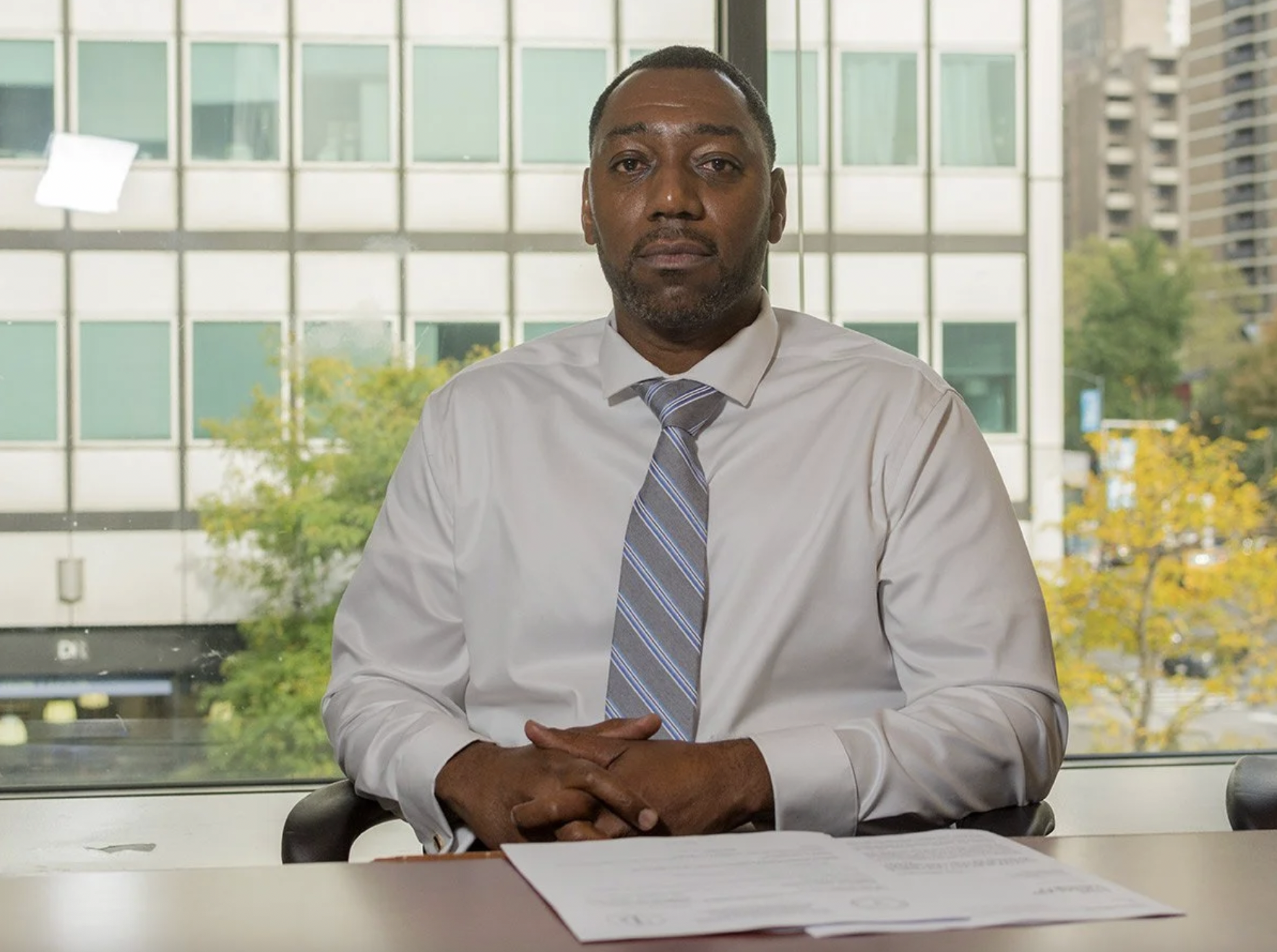
Michael Robinson has been waiting two and a half years for his retrial after he was found to be wrongfully convicted of the 1993 murder of his estranged wife. Eagle file photo via the Legal Aid Society
By Jacob Kaye
It’s been said that the wheels of justice turn slowly. They turn more slowly for some than for others.
More than three decades after his first murder trial, Michael Robinson is still waiting for his second one.
Two and a half years after his 1993 murder conviction was overturned, Robinson and his attorneys claim that they are ready for the retrial but have been subject to countless delays from the Queens district attorney’s office and the courts.
“Mr. Robinson has been waiting over two decades to resolve this matter,” the Queens man’s attorney, Michelle Benoit, said in court during a hearing at the end of September.
Robinson, who has maintained his innocence for years, is accused of killing his estranged wife inside a Bayside home in 1993.
After discovering new DNA evidence in the case in 2013 while he was still incarcerated, Robinson and his attorneys with the Legal Aid Society began the long process of getting the conviction overturned. That ruling wouldn’t come until 2023, when a group of judges in the Appellate Division, Second Department said that the 1993 jury would have likely seen Robinson’s case differently had they heard about the DNA evidence, which was found under the victim’s fingernails and had a one in 78 trillion chance of belonging to Robinson. Though they overturned his conviction, the judges did not rule that he was innocent.
Despite the ruling, Robinson’s case was not over.
The appeals judges kicked the case back to the lower court and six months later, Queens District Attorney Melinda Katz said that she wanted to retry the case despite the new DNA evidence and the fact that the case’s sole eyewitness had documented vision issues and was long dead.
But little has happened in the two years since, despite the fact that Robinson has appeared before a judge 19 times since the September 2023 decision.
And while a trial is not yet on the books, the Queens man may be closer than ever to having his second day in court.
“This doesn't look likely to happen before the end of this year,” Queens Supreme Court, Criminal Term Administrative Judge Michelle Johnson said during the most recent appearance in the case, held on Sept. 25.
“My hope is that by November, we will be able to set a firm trial date at the beginning of next year,” she added.
Johnson, who took over the case at the start of 2025 after the previous judge on the case retired, said that the long road to a trial could mostly be blamed on a court system that is trying hard to move along cases where a defendant has been held in jail for two or more years. Robinson, who served 26 years behind bars, has been out of prison since 2019.
Complicating the matter is that both assistant district attorneys prosecuting Robinson have been assigned to some of the older cases with incarcerated defendants.
“This is a murder case and your client is out,” Johnson said during the hearing. “Because [the prosecutors] have so many old cases, in order to try to get some control over that, it has been requested that we try certain cases in order of the age…As long as they are on the case, it doesn't look like [a trial will be held] before next year.”
Assistant District Attorney Jonathan Selkowe denied that the DA’s office was doing anything but trying to resolve all the cases on its docket quickly.
“We are diligently working through both the backlog on homicide defendants who are awaiting their day in court as well as Mr. Robinson’s case,” the prosecutor said. “We are not dragging our feet.”
A spokesperson for the DA’s office said that they were “ready and prepared to try the case subject to the trial schedules of the attorneys involved.”
Despite the claim, Benoit, Robinson’s attorney, said during the September hearing that they’d consider filing a motion claiming Robinson’s right to a speedy trial had been violated if the delays continued.
“We have been ready since last November,” she said.
When and if Robinson’s case eventually does make it to trial, it’s likely to be an unusual one.
The Queens DA’s case hinges on the testimony of Alveina Marchon, who owned the Bayside home where Robinson’s estranged wife, Gwendolyn Samuels, was killed. Marchon, who employed Samuels as a home health aide, was 88 years old at the time of the murder and has since died.
Like several other witnesses in the case, Marchon’s 1993 testimony will be read to jurors at Robinson’s second trial.
Marchon told jurors 32 years ago that she was confident Robinson killed Samuels in a jealous rage. Samuels had recently become pregnant with her new boyfriend’s child, around a year after she and Robinson had separated – Robinson and his attorneys have suggested Samuels’ boyfriend committed the murder.
During the trial, Marchon admitted that she’d had some difficulty with her vision – by the time of the trial, she was legally blind – but claimed her eyesight was good enough at the time of the murder to identify the killer.
On Marchon’s testimony alone – there was no DNA evidence tying the defendant to the scene, nor were there any other witnesses – Robinson was convicted of murder.
Last year, Robinson’s attorneys uncovered evidence that showed that not only had doctors documented Marchon’s “long history of double vision” five months before the murder, but also given her diagnosis to Queens prosecutors before the trial, who then kept it from the defense.
Marchon’s previously documented issues with her eyesight were never presented at trial.
In May 2024, Robinson’s attorneys argued the case should be thrown out based on the apparent Brady violation, which occurs when prosecutors withhold evidence that could benefit the defendant. Their motion was denied.
Robinson will next appear in court on Nov. 19.